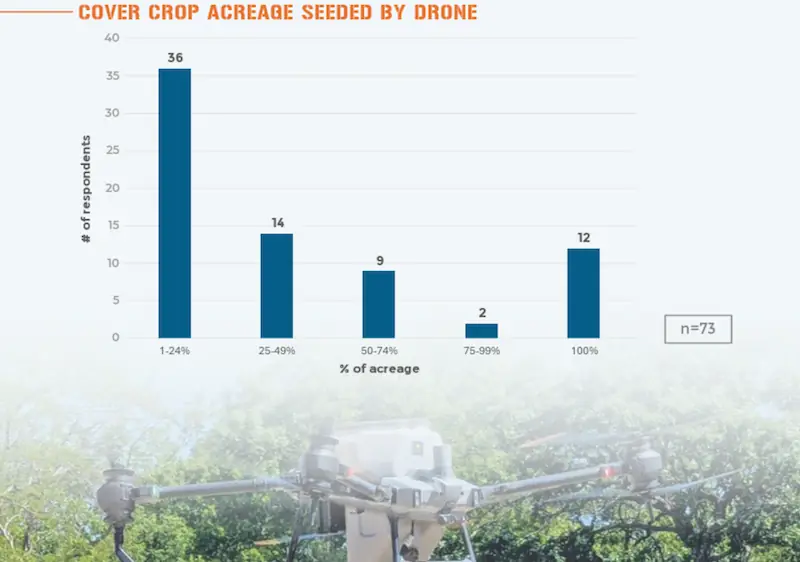
The 2026 National Cover Crop Survey from the Conservation Technology Information Center, USDA Sustainable Agriculture Research and Education (SARE) program and the American Seed Trade Association (ASTA) dug into drone usage for the first time in the 14-year history of the survey.
Among 459 cover crop users responding to the survey, just 13 (2.8%) reported using their own drones for cover crop seeding, but 62 growers (13.5%) said they hired a drone pilot to seed cover crops.
Drones are building a fan base for speed and convenience as payloads increase with larger units built specifically for agriculture, according to the survey analysis. Asked to select as many reasons for drone seeding as they liked, 54% noted that drones make it easier to plant in the desired time frame. Just over 40% said they wanted to try out a new method, 36.5% used drones for better access to small, irregular or tree-lined fields and 35% said overseeding is easier with a drone than with other methods.
Among other reasons selected, 29.7% said the ability to plant in conditions too wet for ground equipment, 14.9% said improved seed placement accuracy and 10.8% said drones were more cost-effective than other seeding methods.
Zeroing in on the benefits of seeding cover crops with drones, timing was far and away the most popular answer, with 75.4% selecting it as a benefit. Just over 30% selected reduced soil compaction, and 26% said drones achieved better seed placement compared to other aerial methods.
Another 23% noted better cover crop stand establishment and reduced labor requirements as top benefits, while the ability to experiment with new cover crop species or mixes attracted 21.7% of the replies. Just under 16% selected better fall cover crop biomass as a benefit.
Not all the answers were positive. Among the four growers who selected “other,” one had purchased but not yet used a drone. Stand establishment was an issue for two of the respondents: “Have not been able to get a stand with the drone and balansa clover,” wrote one, while the other wrote, “worse germination.” The final write-in grower noted, “Works with irregular field edges but the stand is generally not good.”
The survey also asked growers to identify the biggest challenges with using drones to seed cover crops. Stand establishment issues (47.1%) was the top challenge, followed by slow speed due to weight restrictions (35.3%), not cost effective (22.1%), delays due to drone operator availability (19.1%), difficulty achieving uniform seed spread (19.1%), problems with mixes spreading evenly (14.7%), difficulty finding a drone seeding service (10.3%) and technical issues with drone operation (1.5%).
Just over 13% of respondents chose “other,” and wrote in the following the replies.
“Too light of rate and poor battery setup.”
“Cannot seed close enough to tree lines and powerlines.”
“It’s a mess when they crash into electric fences that the pilot didn’t see.”
“Moisture is key.”
"Still learning."
Another respondent pointed out that drone users can’t fertilize while simultaneously spreading cover crop seed.
One respondent said there were no drawbacks with drones.
Click here to download the full survey report.