
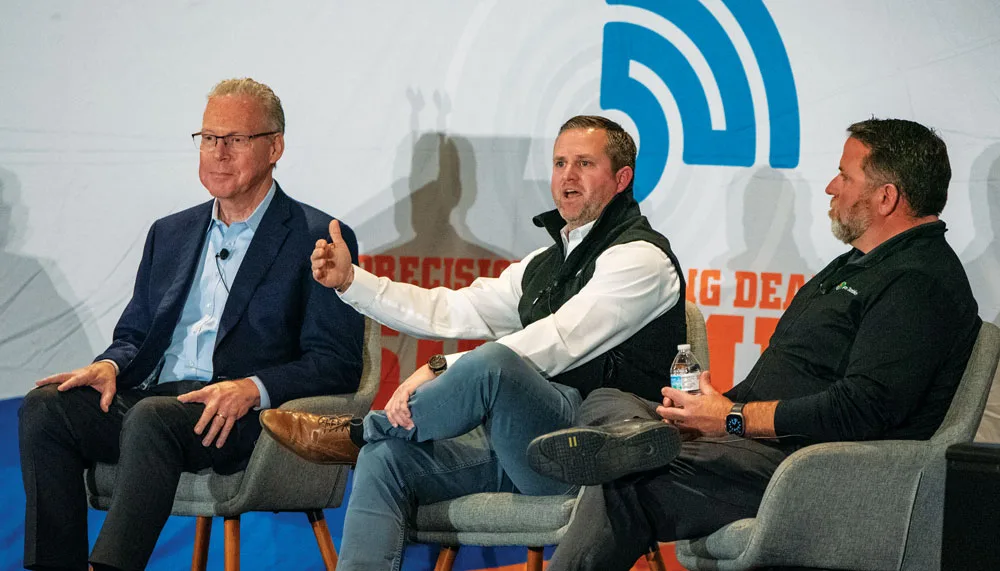
Precision ag leaders from 3 OEMs put competition aside and gathered for an unfiltered discussion about their strategic direction for business at the 2026 Precision Farming Dealer Summit in St. Louis.
Jake Ridenour, channel sales manager for AGCO/PTx Trimble, Nathan Greuel, precision product marketing director for CNH (Case IH, New Holland, Raven) and Joe Michaels, senior director of Kubota North America, discussed the latest precision ag trends and best practices embraced by the top-performing dealers in their network.
Here are some of the top highlights from the conversation.
What separated your top performing precision ag dealers from the rest of the pack last year?
Ridenour: Diversification. At AGCO, with Precision Planting, Trimble, Headsight, our dealerships can offer a wider portfolio and look at products that historically maybe they haven’t looked at in the past. But when they go on a farm, they take the approach of being agronomic consultants and not just selling whatever is in that portfolio.
Greuel: Digital engagement has grown so much. We’ve introduced Case IH and New Holland FieldOps and have seen a growth in new user accounts. If the dealer is involved in that digital ecosystem through machine utilization reports or field boundaries, that sets them apart and creates a better relationship with the customer.
“We’re seeing a continued growth in telematics & the need to take data & transform it into actionable insights…”
We’ve also done a lot with certification over the last 3 years. Two years ago, you had to take some online courses, but now we’ve made precision certification for our dealers a little tougher. Dealers that are involved and engaged in that certification, they’re coming up with a plan at the beginning of the year and executing it. It’s not just a “check of the box” to say they completed certification.
Michaels: Flexibility is the new stability. Successful dealers are getting back to the basics and figuring out how to get the right people in place to execute their plans. But they also have flexibility, so as new things come out, they have faith in us, the manufacturer, and we have faith in them, the dealer, to address the challenges of the day.
What technology has gained the most traction with your customers?
Greuel: Upgraded displays and interfaces. The usability, the brightness, the processing power, it was all quite a lift in 2025 and there’s some upside for even more growth in 2026.
Entry level telematics would be the other big one. And it’s not necessarily your full-blown modem, but it’s something that you can put on a pickup truck or tender vehicle or semi-truck. We saw exponential growth — 4 times what we forecasted into entry-level telematics. I think that’s because of the increased input into the digital platform, that you’re not just connecting factory machines, you’re also wanting to connect your whole fleet.
Michaels: I’ll build off that a bit. We’re seeing a continued growth in telematics and the need to take data and transform it into actionable insights. I don’t know how many farmers and dealers I’ve been around that have drawers full of USB sticks of data and don’t know how to make actionable information out of it. So, that information and the telematics to enable all of it, that’s where we’re seeing real growth in our business from a precision standpoint.
Ridenour: We’ve seen the highest adoption rates with spot spraying technology and being able to identify weeds as you’re going across the field. AGCO dealers are aware of FarmENGAGE and what we’ve done is a step one into telematics and managing the data to make sure it’s in the right place. That takes us into the bleeding edge of autonomy. We have to start getting the data right on the farms for us to take that leap into autonomy.
What’s been the biggest development on the autonomy front?
Greuel: The word autonomy means different things to different people. It’s almost like sustainability. It’s one of those vague words that we use and even when it was introduced 5-10 years ago, everyone probably thought of little robots. I always think about it as an adjective, like it’s an autonomous tractor.
There are several stages to autonomy. We introduced guidance 35 years ago. Connectivity came 15 years ago. Machine-to-machine communication came 10 years ago. We’re now at the sensing and acting stage. We’ve gotten really good at automating tasks. When we can automate guidance, speed and turning, the machine just becomes autonomous. It almost just folds into autonomy naturally. The biggest progression we made in 2025 was around obstacle detection and avoidance, which is really the last step on the path to having an autonomous machine.
Michaels: Certainly, sensorization and AI are meeting new milestones that are going to take us to that next level as we go forward. I see acceleration on this, especially with the needs and pressures in the market, not only with commodity prices, but labor shortages.
For Kubota, this is about doing bigger jobs with smaller machines. Maybe not a swarm creeping around at night, but smaller machines that can be more easily transported and achieve that flexibility leading to stability. At Kubota, we feel we have a core competency in small machines for agriculture as well as construction markets.
Steering the Future
Click here to watch the entire discussion with Joe Michaels, Jake Ridenour and Nathan Greuel during the 2026 Precision Farming Dealer Summit. The PFDS Video Replay is brought to you by Vi by visorPRO.
Ridenour: One of the companies that came into the collection that is PTx today is JCA Technologies out of Winnipeg. They had started an autonomy project, which AGCO has now named OutRun. It’s commercially available for grain cart operations. We harvested a very large number of acres this past fall with OutRun. We’re currently taking OutRun and trying to make it capable of performing a higher horsepower tillage operation.
Greuel: And we can’t forget what the mission statement is for autonomy. It’s scalability to run 24/7. One of the biggest benefits, too, is repeatability. Every year that autonomous machine is getting smarter on all the different conditions that you’re harvesting or planting. It’s improving over time. So, the value propositions of autonomy are there, it’s now just about nailing the system and its ability to go tackle the customer needs.
The other piece to this is insurance. The insurance industry needs to be ready for this, and that’s something we continue to work on corporately to make sure that a grower has an option and that they’re not sticking their neck out going into this autonomy world.
How are you ensuring your dealers are equipped to service and sell new technologies coming to market?
Michaels: We’re placing an emphasis on working with the dealer to find the right individuals who are cut out for service and support roles with precision technology and growing those individuals into lifetime employees within the community. That’s not simple, but it’s really where a lot of our push is.
The other thing we’re working on is to make sure that we have the right information at the right time and the right way available to those people so they’re able to do their jobs.
Ridenour: I’ve been fortunate to experience a lot of what Precision Planting was about in the past, which is simply just education, and doing it in a fashion where they’re using real life experience on 2 test farms in North America to train and educate people. And they’re inviting everyone in the agriculture industry to those farms to experience it.
Greuel: I would echo that — training, demos and being able to articulate the value of precision tech. We offer master precision classes and regional training courses. We enable our field teams to be those specialists that dealers can call upon as subject matter experts. Hands-on training is always the best way to learn the system.
How do you support dealerships in developing precision farming departments?
Ridenour: Precision Planting holds an event called Dealer Development Days. It’s an optional one- or two-week event. There are two days of business training and two days of technical training. We’re hoping to replicate that across all PTx brands and make sure our dealers can attend, interact with the manufacturers and engineers who are building the products, so they can go home feeling confident they’re representing the right line.
Michaels: Kubota is rather diverse, and we like to think that we’re going to work specifically with each dealership, but that’s easier said than done. We must find that right mix for the dealership and their community and the product lines of ours that they focus on, especially with technology.
“The biggest progression we made was around obstacle detection & avoidance, which is really the last step on the path to having an autonomous machine…”
We have an internal saying at Kubota and a brand promise of “simple to use and reliable.” Simple to use and reliable starts with what you’re trying to bring to the market. We’re going to concentrate on practical technology that brings a large amount of value to the dealers for their customers.
Greuel: To be fully transparent, I don’t know if we have it all figured out. We have guidelines. I go back to our certification that puts recommendations and directions out to our dealer network, but I don’t know if we’ve necessarily figured out the magic potion that says we want to help develop these core fundamental teams across the dealer network.
Frankly, when I arrived at CNH 4 years ago, I had an individual at a dealership who told us to stay out of his business and that he will be the one who makes decisions on his business. So, we don’t want to make the recommendations on behalf of the dealer. We just put forth a couple beneficial things through certification that can help lead our dealers, but I think we’re going to have continued growth over the next couple years trying to figure out that magic potion.

![[Technology Corner] Aligning ‘Smart Implements’ with Autonomous Tractors](https://www.precisionfarmingdealer.com/ext/resources/2026/10/01/Aligning-Smart-Implements-with-Autonomous-Tractors.webp?height=290&t=1790966217&width=400)

