
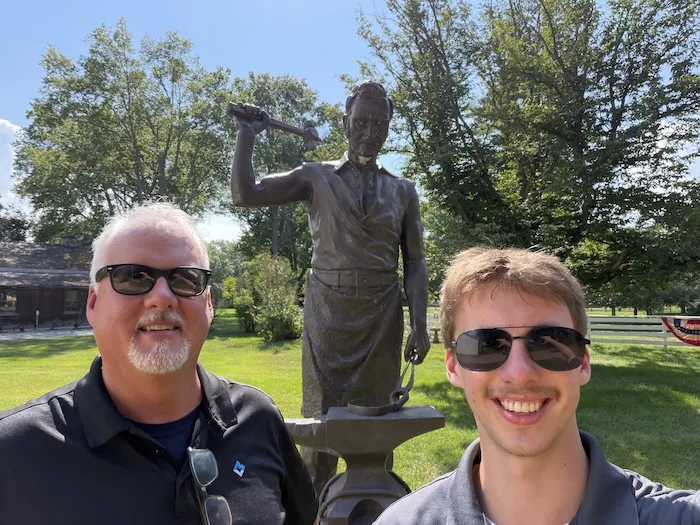
As an intern at Lessiter Media, my dad, Mike Lessiter, called on me to take a road trip with him throughout central and northern Illinois to visit manufacturers and dealerships in front of next week’s Dealership Minds Summit. The annual conference is taking place for the first time in its capital city of Springfield this year.
As a suburban kid from Southeastern Wisconsin, I admit I haven’t seen much of Illinois outside of the Chicagoland area where my grandparents live and never considered much of what else the state had to offer. I visited Springfield in my youth, but other than that I’d hardly been around.
As I grow older and I travel around more, I realize just how different the rest of Illinois is to Chicago. Every state has its more urban areas and Illinois is no exception, but after driving through miles after mile of beautiful farm country, I came to appreciate the rural side of Illinois all the more.
While Illinois may avoid what some city slickers may call a “flyover state” due to the metropolis of Chicago, the majority of the state is vastly different.
Illinois is one of the flattest states in the nation, and it shows. When driving down those back-country roads you can see for miles (like the Who song), and much of that scenery is coated in cornfields. Illinois has just under 30% of its total land area covered by corn crops, second only to Iowa in terms of corn acreage. This paired with excellent glacial soil and typically heavy rainfall in the summers makes Illinois a great environment to grow corn in.
In addition to taking in the Illinois landscape, I also became familiarized with another aspect of the state: the rural communities and entrepreneurial spirit that came off of its farms. Illinois is home to dozens of large equipment manufacturers such as Deere and Yetter, with several times more dealership locations serving the state’s 75,087 farm operators according to the Illinois Department of Agriculture.
Morton and Dixon, Ill.
One of the primary reasons for our trip was to visit one of these manufacturers: Gregg Sauder at his 360 Yield Center headquarters in Morton, Ill. There we captured video and audio as well as background for a major project featuring Sauder appearing next month.
Sauder, who is the president and founder of 360, started the company after selling his first ag manufacturing company Precision Planting in 2012 for $250 million. Rather than sit back in retirement, Sauder then went on to quickly start another equipment manufacturing company, 360 Yield Center.
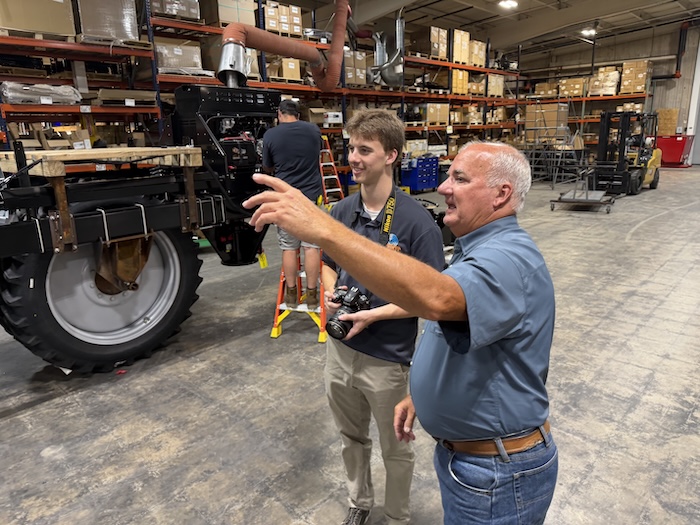
360 Yield Center President Gregg Sauder shows Hayden Lessiter around the company’s facilities.
As we toured 360’s facilities and another hour-plus interview, I was impressed with Sauder’s passion for his work. He emphasized throughout the visit how much he cared about his work and his confidence in the quality of his products.
And for a guy with his Hall of Fame like stature in the industry, he was as down to earth and friendly as my dad said he’d be.
As we ventured on from Morton while stopping at a handful of machinery dealers, we decided we could make a couple of stops along the way back home. First, we went on to Dixon, Ill., to visit President Ronald Reagan’s boyhood home.
I’m not entirely sure how much Reagan has to do with farming or the ag equipment industry, but it was still interesting to see the relatively modest beginnings that such an important man had. Those sorts of humble beginnings led me into the next place we stopped, immediately northwest of Dixon, Grand Detour, Ill.
John Deere & Grand Detour
In the small town of Grand Detour (named for the strange path the Rock River takes at that point), lies the John Deere Historical Site.
I’ll admit I didn’t know very much at all about Mr. Deere’s personal story before I visited Grand Detour, but I sure learned a lot about the man during our visit.
At the Deere Historical Site, you can tour the home he built, which is still standing, a replica of his forge with a blacksmith and a museum area showing the original blacksmith shop with excavated artifacts. It’s a free experience I’d definitely recommend to anyone traveling through that area.
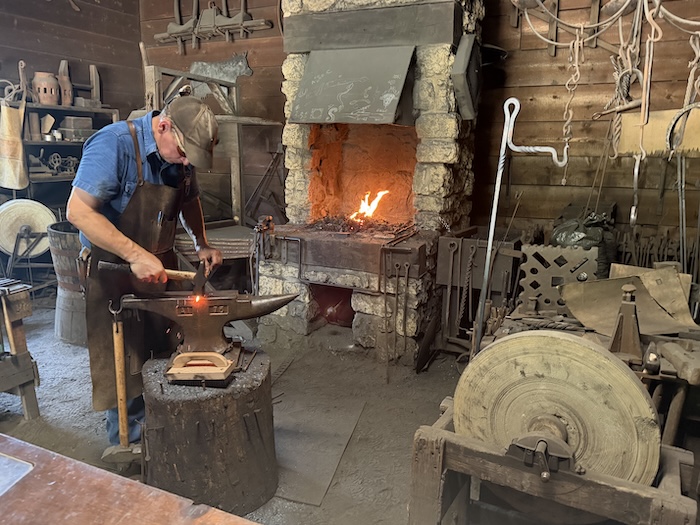
Blacksmith re-enactor at John Deere’s forge at the John Deere Historical Site.
On our tour we had an enthusiastic guide who gave us the ins and outs of antebellum Illinois living, especially on how bathing worked. She said the entire family would use one bathtub without changing the water in between washes and would do so only about once a week. Imagine how dirty a blacksmith would get without washing…
Also apparently the phrase “don’t throw the baby out with the bath water” originated from warning against accidentally tossing your child out with the dirty water at the end of bathtime. Sometimes with all of our modern day worries and technology I wonder if life would’ve been better, say 200 years ago. Though, when I learn about things like this, I tend to renounce that opinion…
Originally from Rutland, Vt., Deere became a skilled blacksmith after working as an apprentice for Captain Benjamin Lawrence, a blacksmith from the town of Middlebury (also home to the 2006 Farm Equipment Dealership of the Year, Champlain Valley Equipment). In 1836, however, after his blacksmithing operation burned down and several other starts and stops, he decided to move to Illinois, traveling for several weeks until he started providing blacksmithing to the residents of Grand Detour. He found good demand as there was a lack of blacksmiths in the region. He then built a home for his family, which he reconnected with after 2 years of separation when his wife and children made the trek to Illinois and joined him.
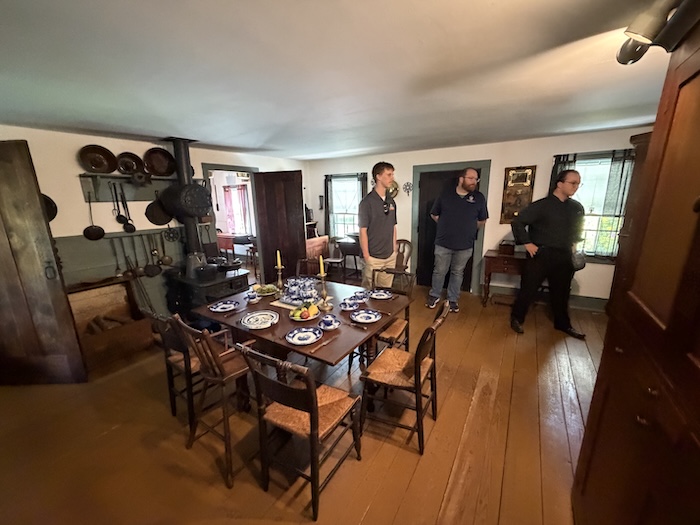
An inside look into John Deere’s original 1838 home.
The Illinois prairie soil was sticky and tough to plow through, which caused Deere in 1838 to invent and produce the self-scouring steel plow, a plow that could resist the clay soil and allow for a much cleaner and efficient way of farming. This plow has even been credited with opening the western U.S. to settlement and as one of the top factors playing into the nation’s rapid growth in the 19th century. Of course this amount of plowing did eventually lead to ecological disasters like the Dust Bowl in the 1930s, but history sometimes makes you accept both the good and the bad.
“Without innovative folks in agriculture, the industry, and nation does not become as advanced or large and sustainable…”
This plow quickly became successful, with Deere manufacturing around 100 plows a year by 1841.Deerer relocated to Moline, Ill., in 1848 to take advantage of the Mississippi River’s better transporting and water powering abilities for his rapidly growing company. His son, Charles, soon took over day-to-day operations and John incorporated the company as Deere & Co. in 1868.
Innovation in Rural America
Deere & Co. would go on to become the largest ag machinery manufacturer in the world, but it all started back with one product in that rural town in Illinois. And just like Sauder’s confidence in his work, Deere showed that same commitment to quality, stating, “I will never put my name on a product that does not have in it the best that is in me.”
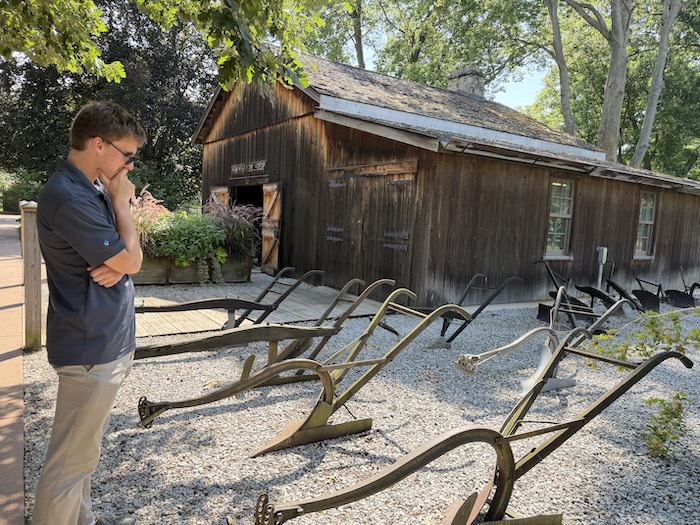
Deere's famous self-scouring steel plows outside of the replica forge.
Without innovative folks like John Deere or Gregg Sauder, the industry, and nation, does not become as advanced or large and sustainable. It’s no surprise that ag innovation often comes from the heart of the most productive agricultural region in the country.
Our nation and its history and future is often best observed through the small towns and ordinary homes that produce great decisions and great people. This is a pattern that can be observed all throughout the nation, and further proves that no state is truly itself without its rural members and land.
That history hidden in plain sight is a part of why I like traveling so much through the U.S. I’m even hoping to sneak away from the action at the Dealership Minds Summit and National Strip-Tillage Conference this year in Springfield to see Abraham Lincoln’s home (just a few blocks away) at some point…

![[Technology Corner] Aligning ‘Smart Implements’ with Autonomous Tractors](https://www.precisionfarmingdealer.com/ext/resources/2026/10/01/Aligning-Smart-Implements-with-Autonomous-Tractors.webp?height=290&t=1790966217&width=400)

