
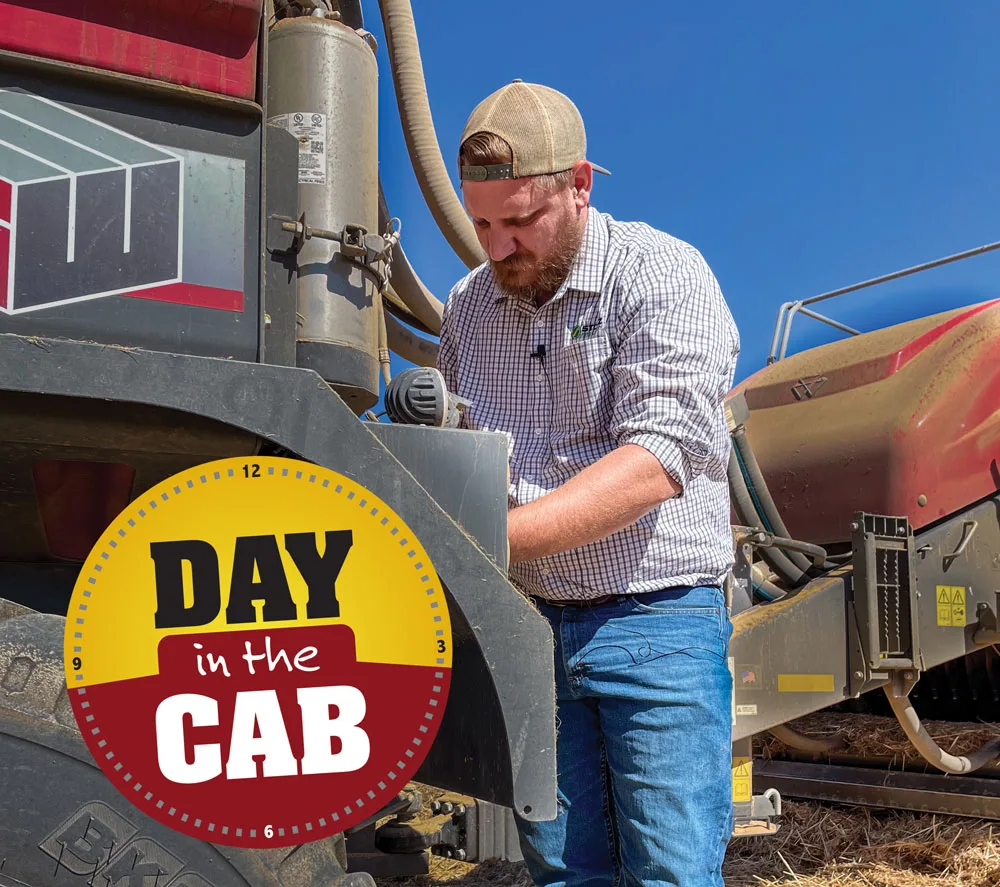
Twenty-four store John Deere dealer Stotz Equipment has set the bar high for precision sales and service the past several years, with a team of over 30 precision specialists covering a wide range of farming practices and crops across Arizona, California, Colorado, New Mexico, Nevada, Idaho, Utah and Wyoming.
The leaders of the department are Layne Richins, chief technology officer, Justin Murray, director of precision technology, Clayton Eliason, northern region manager and Omar Porras, southern region manager.
This edition of Day in the Cab features a trip to Omar’s southern region for a ride-along with precision ag specialist Jake Nordenberg in Buckeye, Ariz.
8:49 a.m.
It’s a relatively cool 87-degree morning in southwest Arizona as I arrive at the Buckeye store after a scenic drive from my hotel near the Phoenix airport.
Jake is finishing up some paperwork when I walk into his office.
“It’s pretty quiet in here most mornings,” he says. “I’m usually making phone calls until about 9 a.m., and then I’m out of the office. There’s usually some kind of fire to put out, but if there isn’t, which is rare, I’ll check on customers and see how they’re doing. Sometimes you make those check-in calls and they’ll say, ‘Oh, I was going to call you, come take care of this for me.’”
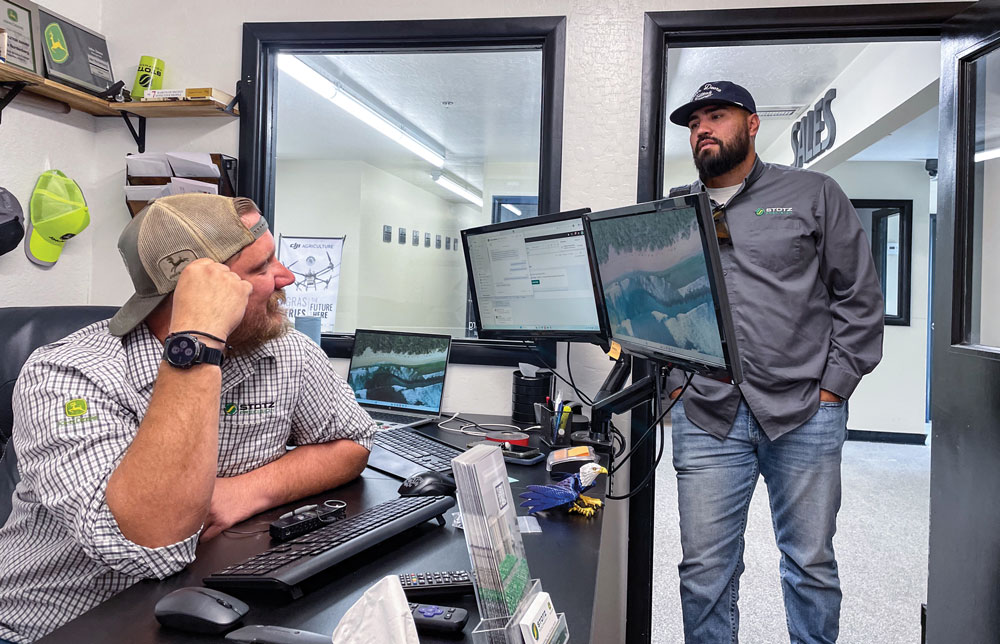
Stotz Equipment precision ag specialist Jake Nordenberg and southern region manager Omar Porras go over their plans for the day in the Buckeye, Ariz., office. Noah Newman
Jake works hard to build credibility with customers and be a reliable source when gremlins show up in the field. Perhaps a big reason for that is because he’s been around both sides of the business most of his life and can relate to the challenges farmers face day in and day out.
The Buckeye native helped his dad and grandpa run a custom harvesting business until 2012. Shortly before they closed shop, Jake started working for Stotz Equipment in the service department, a job he held until 2020 when he moved to South Dakota.
“I went to work with my uncle,” Jake says. “He was starting a farm and needed some help, so I went up there for 3 years to learn how to farm. I like to say that’s where I got my real education because I learned how to really fix things.”
Jake returned home for his second stint with Stotz Equipment in 2023, this time with the precision department.
9:04 a.m.
It’s my first Day in the Cab experience outside of the Corn Belt. Farming is a different ball game out here, as I learned the previous day while visiting Strip-Till Innovator and Stotz Equipment customer Robert Boyle’s farm in the nearby town of Coolidge. He’s growing something different — cotton, corn, triticale, wheat, sorghum and cover crops — on every field, some of which are next to saguaros (giant cacti) on soils with rocks “as big as watermelons,” as he puts it.
Boyle told me his farm gets about 7 inches of rain over the course of a few big storms per year if he’s lucky. Jake says recent annual rainfall has been as low as 0.75 inches in some areas.
“I remember being a farmer & not knowing the technology that was available to us. My job is to let them know what’s out there…”
Many Stotz Equipment customers use flood irrigation, but Jake has seen an uptick in the adoption of drip, pivot and linear irrigation systems.
“Busy season” for Jake is a bit longer than it is for the precision specialists I’ve shadowed in the Corn Belt.
“Twelve months a year, we’re busy,” Jake says. “There are some slow times, but it’s kind of constant. Where I am, it’s all hay. They cut every 26-29 days and then they bale. In January, we’ll start going to green chop, which is when everything gets chopped instead of baled, but everything is still getting harvested.
“In Casa Grande, there’s a lot more cotton, some wheat and more diversity overall, but it’s hay year-round for me. My customers also plant some corn. March is usually my busiest month, when they start planting or they’re replanting triticale.”
9:13 a.m.
Our conversation in the office continues as Jake explains how his current job often resembles a mix between parts, service and sales.
“You’re not fully a service technician or a parts guy, but you know where everything’s at,” says Jake, who embraces the consultative approach to sales and service. “You’re not fully a salesman, but you’ve got such a relationship with the customer that you can see things coming and where you can help. That’s the biggest thing with precision; how can you help? My biggest fear when I started doing this is I didn’t want to call and be just a bill, if that makes sense.”
He notes that Arizona agriculture is a different beast and requires a bit more creativity to leverage the latest technologies.
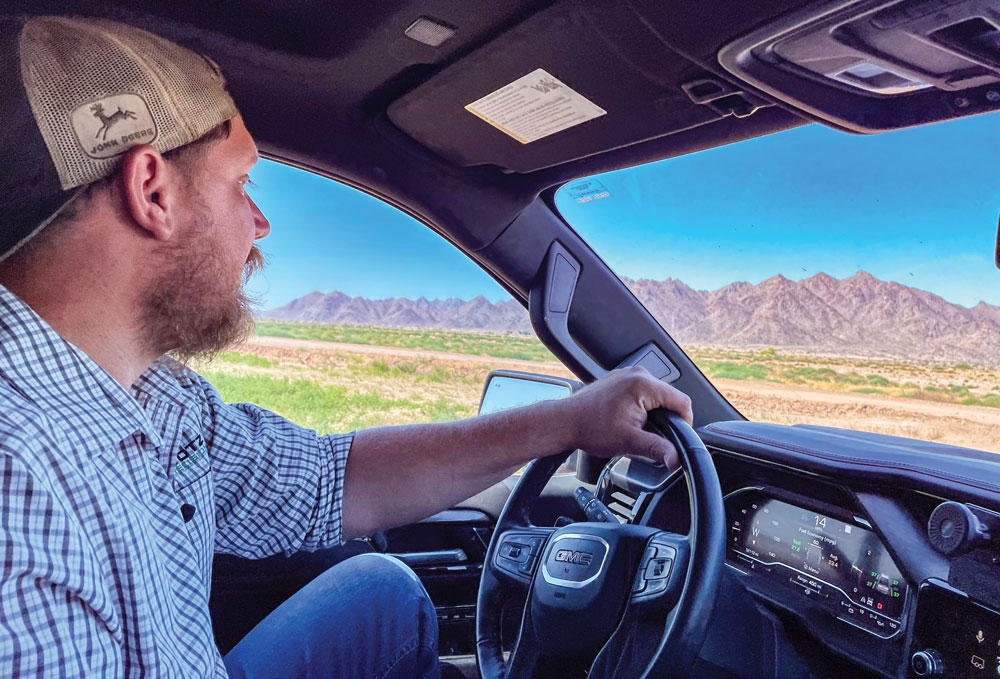
Jake hits the road for an on-farm visit to the nearby town of Arlington, where a customer is having issues with a new camera system on a baler. Noah Newman
“We’re not corn and soybeans, which is what most John Deere technology is geared toward,” he says. “See & Spray doesn’t work for hay, right? But we can take this DJI drone, fly it, do a target application map, find out where the weeds are and then send it to the ground rig.
“We have to take all this information and cool technology we get from Deere and figure out how it fits for our customers. Because if it doesn’t fit, they’re not going to use it. Maybe it’s a case where they won’t use 90% of the technology available, but there’s still 10% that will really help.”
Some of Jake’s customers are open-minded and will try using new technology if it makes financial sense, while others want proof it works before investing. Challenging economic times are pushing more farmers to adopt tools like rate controllers once they see the proven benefits and hear positive feedback from peers, he says.
9:21 a.m.
The John Deere Operations Center interactive map is up and running on a wall-mounted monitor. I’ve heard and read a lot about the “Ops Center” over the years, of course, but this is the first time I’m seeing how much it can actually do. With the click of a mouse, Jake can see equipment utilization reports for any of his customers in the area.
Customers can access the information on their own, or the dealership can set up automated email summaries for them. Many customers are still learning how to use the Operations Center, and some still don’t realize its full capabilities, Jake explains.
“I tell people the Operations Center can be as complicated or as simple as you want it.”
Day in the Cab Video Series
Go behind the scenes with Jake Nordenberg and Omar Porras as they share success stories and challenges with precision technology in the region and highlight their team’s unique approach to data analytics. Click here to watch the Day in the Cab Video Series.
He shares the story of a customer who initially only wanted to use the Operations Center to see machine locations and where his crew had been for the day. The customer gradually adopted other analytical features to track spraying and chemical savings.
“Then there are other guys who will pull reports on every single thing they can,” Jake says.
He runs through the maintenance manager feature, a digital fleet management tool that automates service reminders, tracks engine hours in real time and keeps machines running at peak performance.
“I remember being a farmer and not knowing the technology that was out there and available to us,” Jake says. “My job is to let people know what’s out there, and even if they don’t use it, at least they know it’s there. The second big part of my job is to help them, especially in these tough times. Sometimes that’s just going to their farm and bringing them lunch and building that relationship to where they know they have someone in their corner. And in farming, that’s how it should be.”
9:31 a.m.
Jake shows me on the map where we’re heading in a few minutes — the town of Arlington, which is about 13 miles west of Buckeye. He’s going to check on some experimental Deere cameras he recently installed on a customer’s baler that are now showing up as disconnected.
Jake’s manager, Omar, walks into the office, introduces himself and says he’ll be joining us for the morning.
“Three big boys in this small office, it’s about to get hot in here,” Jake jokes, before the three of us head toward his truck.
9:46 a.m.
On our way to Arlington, after some brief sports talk about Omar’s underachieving San Francisco Giants and the questionable handling of the quarterback position by Jake’s beloved Arizona Cardinals, I start asking about their jobs and what it’s like working for a big dealership that invests a lot in precision.
Omar’s been with Stotz Equipment for about 11 years, and he’s served as the southern region manager for about 4 years now.
“For precision, we have a south region, north region and also golf and turf,” Omar says. “I’m in charge of the Arizona stores, Farmington, N.M., Cortez, Colo., and a store in southern Utah, which is kind of in the middle of nowhere really.”
“We wish Omar a Happy Mother’s Day every year,” Jake says.
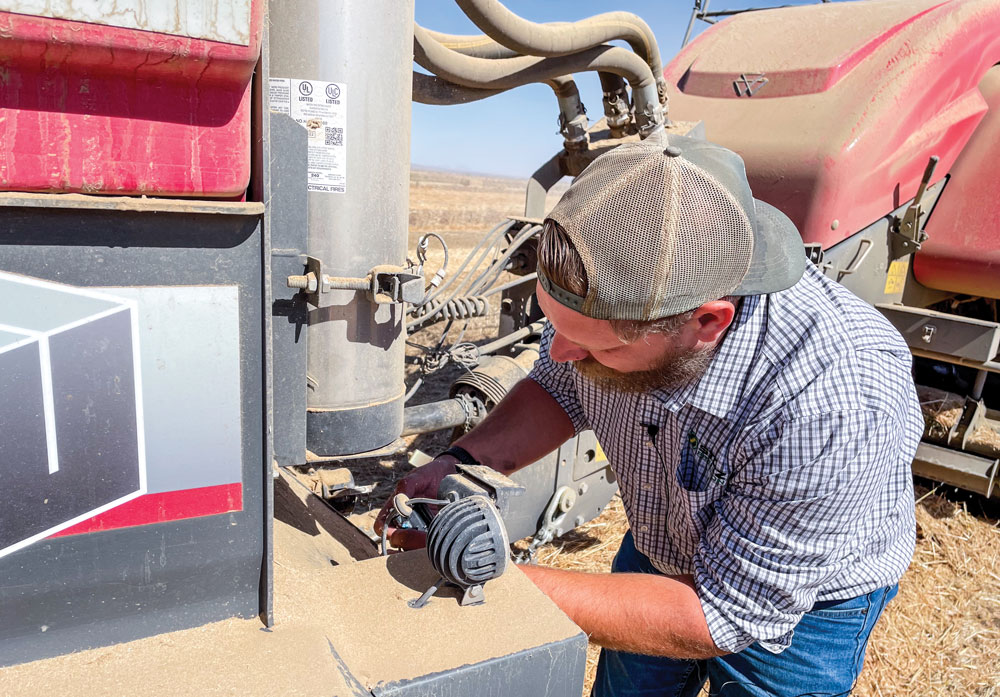
Jake tinkers with a new John Deere camera system he recently installed on a customer’s baler. Noah Newman
“Yeah, because I’m essentially their babysitter,” Omar jokes.
“He’s mama bird,” Jake replies.
“In all seriousness, we implemented this structure a while back and it’s been good for us,” Omar says. “I just try to get whatever support we can to these guys.”
“Deere’s technology moves so fast and it’s nice to have a point of contact with Omar to keep up with it,” Jake says. “He doesn’t always have to worry about the day-to-day stuff, like what we’re doing today. He can focus on the big picture items like new incentive programs and new technology we should try. Given how fast technology moves, it’s essential to have someone like Omar.”
“A lot of technology that comes out isn’t aimed toward the Southwest,” Omar says. “So, I’m the buffer, kind of like, ‘Hey, this will actually work here. Let me get this to my team,’ or ‘Yeah, this is something new, but it doesn’t work here so let’s not even waste our time with it.’”
9:56 a.m.
Toward the tail end of our drive, I notice the corn on some fields is already at tassel.
“That’s a rare sight for you Wisconsin guys in May,” Jake says.
“When do they plant corn out here?” I ask.
“Depends on the year, but some of this corn was planted in February.”
“Oh wow. We were still shoveling snow then.”
“We were out here shoveling sunshine.”
10:01 a.m.
We pull up to the customer’s field and Jake gives me the rundown on the mission.
“We put these cameras on that run through the ethernet,” he says. “Instead of running through a separate display, they run through the Gen 5 display. But the system is showing up as offline, so we’re going to see what the issue is. Are the cameras not working or is the harness fried somewhere? Did they change the cameras or harness for some reason? We just want to get eyes on it and report back to Deere.”
“So, there’s a big difference between the picture quality of these cameras and his old ones?” I ask.
“Oh yeah, big time,” Jake says.
10:07 a.m.
Jake and Omar meet up with the operator who’s running the baler for the owner of the farm.
“The owner is a fourth-generation farmer,” Jake told me before the visit. “There aren’t a lot of owner-operators around here anymore. They have people do the labor like this guy we’re meeting with.”
The operator tells Jake he disconnected the new cameras and re-installed the old ones. When asked why, he says he prefers the old cameras because the images appear larger on his monitor and the new cameras look “too small” on the Gen 5 screen.
Jake proposes adding more magnets so both the old and new cameras can be mounted and used simultaneously.
“Having a dedicated precision data team makes us feel like we’re trying to do right by the customer…”
“We’ll just leave them both on all the time,” Jake explains to the operator. “You’ll have all 4 up here like you had them, and then you’ll have these 2 cameras back here. Does that sound good?”
The customer agrees and Jake reinstalls the new cameras on the baler. While he’s doing that, I hop in the cab of the tractor to get a glimpse at the picture quality of the cameras on the monitors. The feed from the new cameras on the Gen 5 screen looks much sharper to me, albeit smaller than the feed from the old cameras.
“Yeah, it’s probably just habit. He’s used to the old cameras,” Jake tells me, before wrapping up the install and saying goodbye to the operator.
10:41 a.m.
A variety of topics are discussed on the ride back to Buckeye.
We talk about the uncertainty of selling drones amid changing federal regulations. Some dealers leave legal compliance to the customers to figure out, but Jake and Omar say that’s not how their team does business. To preserve long-term trust, they make sure to educate customers and avoid selling products that might soon be unusable.
The conversation shifts to data management. Stotz Equipment has a 3-person data analytics team that helps customers make sense of their data and use it to make improvements in their operations.
“Data management is also a good sales tool for us,” Omar says, “making sure customers have the right horsepower for their operation. Maybe they’ve been buying a certain type of tractor because their dad or grandpa always used to. With the data, we can say, ‘Hey, you’re only using this 5% of the time throughout the year. You really don’t need that horsepower.’ And then we can be a little bit more competitive when it comes to prices.
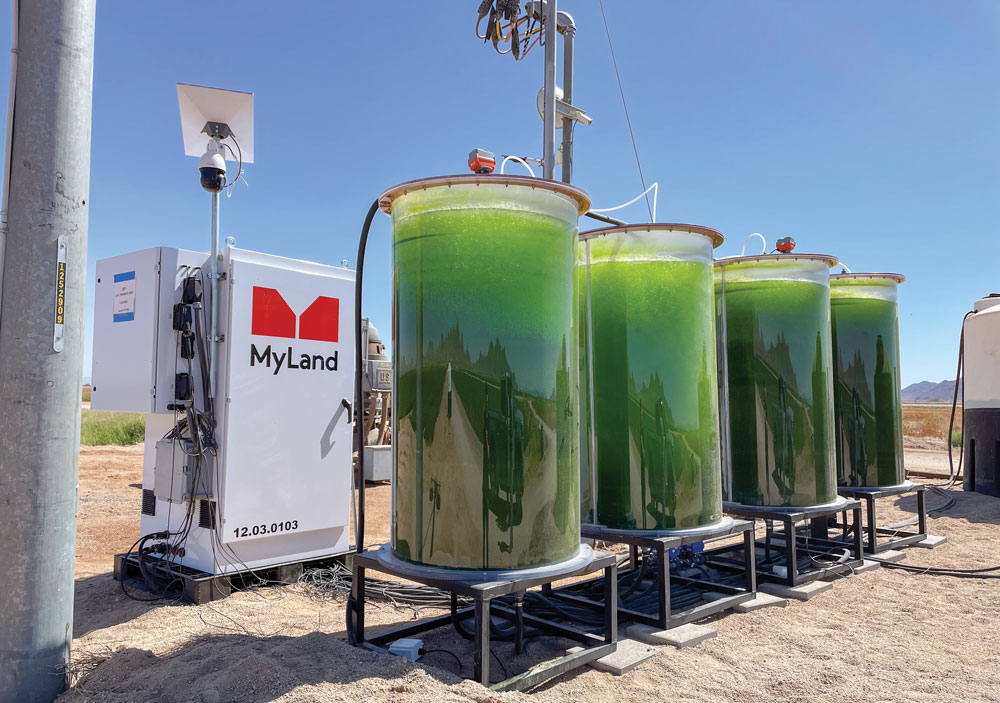
On the ride back to Buckeye, Jake and Omar spot a MyLand system, which integrates live, native algae with the farm’s irrigation system. Noah Newman
“We do the same thing with idle time and trying to help them be more efficient when it comes to equipment. We’ve shared horsepower and idle time reports with some of our bigger farmers that were maybe thinking of switching to a competitor. By going through the reports with them and showing them why sometimes they don’t need that higher horsepower machine, we can be a lot more competitive.”
“Having a dedicated precision data team really makes us feel like we’re trying to do right by the customer,” Jake says. “We’re not trying to sell them products that they’re never going to use just so we can get a few extra bucks. We’re trying to help them out.”
“The data team did some cool things with one of Jake’s customers recently,” Omar says. “The customer’s operation is spaced out, and they were looking at how much transport time he was spending on some of his machines. They concluded it would actually be cheaper if he just bought another machine and left it at one of his farms.”
10:56 a.m.
I recall reading about the Stotz Equipment Precision Summit earlier this year. It’s an annual event, organized by the precision team, that brings together customers for a day of educational presentations, networking and new technology demos.
The event has historically taken place in Las Vegas or St. George, Utah, since its inception 8 years ago, but they shifted to a more regional approach this year.
“Part of it was because of the budget, but I think the main thing was customers were asking for a change of pace and wanted a more hands-on event,” Omar says.
The southern regional Summit took place in Casa Grande in January and featured in-field demos with See & Spray and other equipment.
“There were definitely some things we learned from and could do better, but overall, the customers really liked it, especially with it being more regional because the guys up north do things differently than we do in the south,” Jake says. “We try to make it more customer led. We have customer panels, so they can hear from their counterparts about their experiences.”
11:01 a.m.
While driving by a field, we spot 4 giant tanks of a bubbling green liquid that looks like something straight out of a Batman movie.
“Oh, this is new,” Jake says. “Very cool.”
“It’s called MyLand. They sit here and build a profile for your irrigation, right?” Omar says. “And this is all algae and a couple other biomes. Farmers will add it when they start irrigating.”
“It mainly pumps algae, but I was reading into it, and it’s supposed to help with the growth of alfalfa and hay,” Jake says.
11:39 a.m.
Back in the Buckeye office, we finish recording some videos for PrecisionFarmingDealer.com. Jake says the rest of his day will consist of reaching out to customers and a few other local visits.
“That’s 90% of the job,” he says. “The more you know about their operation, the more you can help and see the technology that will be useful for them. If you don’t have that interaction with them and maintain that constant communication, you won’t know how to help them. The closer you can get, the more you can see their pain points and the more you can help them fix those pain points.”
12:01 p.m.
We say our goodbyes as Jake and Omar take their lunch break and I hit the road for the Phoenix airport for my afternoon flight back to Precision Farming Dealer headquarters in Brookfield, Wis. Another Day in the Cab adventure is in the books.

![[Technology Corner] Aligning ‘Smart Implements’ with Autonomous Tractors](https://www.precisionfarmingdealer.com/ext/resources/2026/10/01/Aligning-Smart-Implements-with-Autonomous-Tractors.webp?height=290&t=1790966217&width=400)

