Takeaways
- Demonstrate clear financial ROI to give farmers confidence in precision technology investments during tough economic times.
- Transition from product-focused sales to a trusted advisory role to build durable, long-term customer relationships.
- Leverage tools like remote diagnostics and unified CRM software to cut operational costs while keeping service quality high.
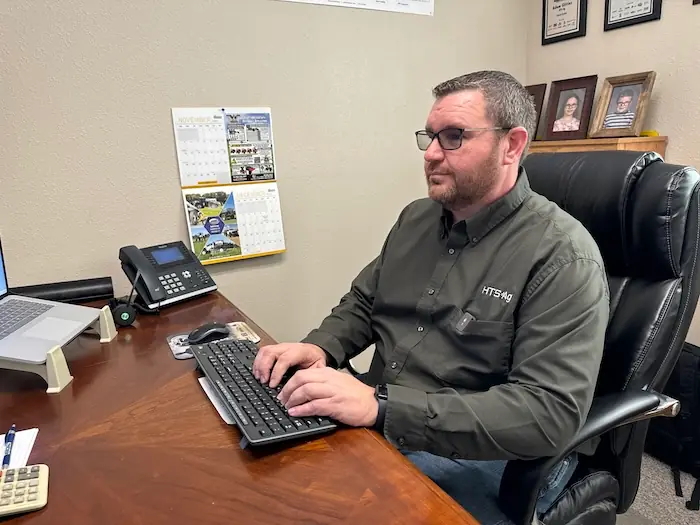
The agriculture sector is currently facing what Adam Gittins, President of Neola, Iowa-based HTS Ag (Precision Farming Dealer’s 2024 Most Valuable Dealership), describes as a triple squeeze. Farmers are facing financial strain due to low commodity prices, rising input costs and high interest rates. Instead of focusing on expanding, many farmers are prioritizing simply surviving this economy, leading to a delay in upgrades, stretches in equipment life cycles and a severe demand for proof of ROI before investing any money.
For precision dealers, enduring challenging times isn’t merely about weathering the storm. Rather, there are still many opportunities to deliver real value, build lasting trust and be as strong as ever.
Proving ROI with Precision Technology
Precision technology is capable of delivering the ROI that farmers are searching for. Being able to provide proof of higher yields and operational savings can help farmers make data-driven decisions, Gittins says.
“Dealers who can quantify these benefits and present them in clear financial terms will gain trust and secure sales,” he says.
As an example, section control is able to reduce input costs by 5%-15%, and eliminate overlap during the application process. For farmers, this means significant savings on seed, chemicals and fertilizer. Other technology, such as guidance and auto-steer systems, help save fuel, reduce operator fatigue and minimize compaction.
These precision tools are beneficial for farmers, especially when savings is important, so it is important to frame them as protection strategies, Gittins says. Through this, dealers are able to demonstrate to their customers how they can maintain profitability, even when commodity prices are low and input costs are high.
During the 2024 National Strip-Tillage Conference, Gittins showcased ROI figures for various precision technologies using a fictitious 1,000-acre corn and soybean farm with 100,000 bushels of on-farm storage. At baseline prices of $4.25 per bushel for corn, $11 for soybeans and an electricity cost of $0.12 per kilowatt-hour, the financial impact of input reduction became clear. Assuming full technology adoption across planters, sprayers, combines and grain bins, the numbers present that a $140,000 investment yields $131,000 in savings during the very first year alone.
HTS Ag takes this foundational ROI framework, and applies it to specific farm data. Through plugging each individual farmer’s operational inputs into an Excel spreadsheet, they are able to map out customized cost reductions and ROI tailored to their unique operation.
“Seeing the results of the data from their farms helps them visualize the impact it will make for them,” Gittins says.
Shifting from Transactional Selling to Trusted Advisory
Another crucial opportunity is to shift from transactional selling to advisory relationships. By doing this, dealers are able to emphasize the importance of focusing on farmer goals, diagnosing problems and recommending solutions that deliver measurable results.
Advisory selling involves proof-first strategies, such as pilot programs and side-by-side comparisons that will validate the ROI. Having regular value reviews that showcase savings can help reinforce trust into the farmers and demonstrate ongoing value, Gittins says.
HTS Ag has also found success through offering tiered service plans that accommodate different customer needs.
“By positioning ourselves as the trusted advisor rather than product vendors, we build long-term relationships that withstand economic volatility and foster loyalty,” he says.
Optimizing Support Plans & Service Delivery
The cost to serve customers can vary on numerous factors. If a farmer’s display is connected to the internet, dealers are able to remote into it and solve problems more quickly. This results in a lower cost to deliver the support, along with saving a trip to the farm. Additionally, if a farmer would rather have remote and phone support only, that saves a traveling cost.
HTS Ag partners with a data provider to include a data connection to customers who have a modem tied to their monitor, Gittins says. The dealership charges customers more if they don't have a data connection because service time is longer when they can't remotely access their display. Ultimately, for HTS Ag, this offsets the costs of the data plan they pay for annually.
When having a service plan, it is helpful to make it easy for customers to renew. The renewal process can be simplified in many ways, including a prefilled form or online quote.
Balancing Cost Control and Operational Efficiency
While cost control is essential in challenging economic times, it is imperative to not compromise quality of service. HTS Ag showcased the balance needed through the use of remote diagnostics. Remote diagnostics helps to resolve over 90% of their service calls without on-farm visits, Gittins says. Ultimately, it helps to reduce travel expenses along with downtime. They also found additional savings through inventory optimization, vendor negotiations and subscription audits.
“These measures collectively enhance our operational efficiency, preserve customer satisfaction and protect margins, proving that disciple cost management is a cornerstone of long-term success,” Gittins says.
Beyond remote diagnostics for cost management and operational efficiency, consolidating software systems is also helpful.
HTS Ag replaced 9 standalone tools with a single CRM platform (Odoo). This eliminated data silos and administrative double-entry while cutting $30,000 in annual software expenses.
The process of implementing Odoo was done through a phased rollout, starting with finance, CRM and quoting, and later expanding into projects, events and websites, Gittins says.
“Key success factors included a detailed data migration plan, governance standards for naming conventions, and the creation of internal superusers to champion adoption and build-out,” he says.
Learn More Online
Watch Adam Gittins' full presentation at the 2026 Precision Farming Dealer Summit here.