
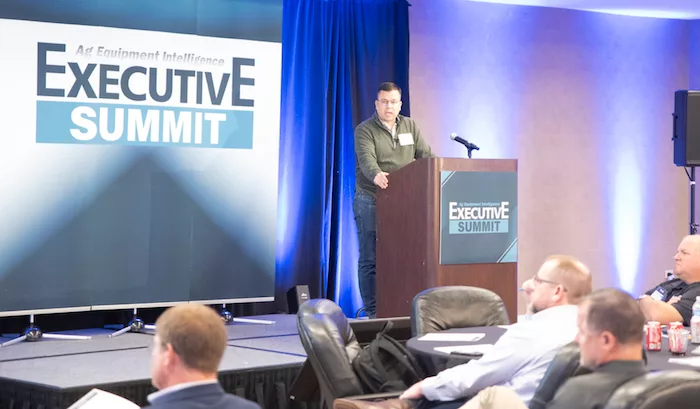
Editor’s Note: Chris Hunsaker, founder, Acuitus Ag, led an autonomy presentation and ensuing discussion for manufacturers, dealers, distributors and suppliers at the inaugural Ag Equipment Intelligence Executive Summit on May 20, 2026, in Chicago.
Is this the end of the Iron Era?
The business model of farm equipment is well understood. Sell machines, sell parts, sell service. Overall growth is generally dictated by the replacement cycle, which is well-documented to be about 4% annually. Growth rates higher than 4% can be achieved, but it usually comes at the expense of some other value stream. New product launches might outperform this; but growth always reverts to the replacement cycle’s cap eventually.
OEM equipment gross margins generally fall in the 20-35% range — with some specialty crop implements approaching 50%. Sales channel gross margins are generally lower and vary depending on channel structure, geography and crop. Parts and service margins are higher, but still nowhere near what’s emerging.
And what’s emerging? Honestly, it’s fluid and far from settled. But what IS clear is that the NATURE of what’s emerging changes the game entirely.
Here’s the reframe. The customer used to amortize equipment cost over as many acres as possible, and the value of the job done by the equipment was well understood by the customer. The manufacturer would develop new machine features or new models based on whether or not they could hit the gross margin they required to keep their businesses in the black. Distribution would mark up the equipment on a similar basis.New solutions are hired to do a job — the combined work of multiple machines, several humans and workflow steps the equipment-seller doesn't currently touch. The customer judges value by outcome, not by the asset. Suppliers (software, automation-as-a-service, data analytics, uptime guarantees) price as a function of that outcome, capturing a share of the efficiency, quality or throughput gains. Because those gains are so large, they can afford real innovation risk, and gross margins run 65-85%+. These solutions win on both sides of the economics equation — on price because more value is delivered to the customer and on cost because once software is written, the marginal cost to sell the next instance is near zero. Add subscriptions on top — the customer doesn't pay everything up front, adoption gets cheaper, the developer stays incentivized to keep improving — and steady, predictable cashflows make innovation less risky to fund.
The old paradigm of software in ag equipment was that software was used to enable your machine. That paradigm is dead. The new paradigm is that your machine is the hardware that enables the intelligence of software. If you’re still the company only selling iron, you’re not just losing on margin. You’re losing on scope. Someone else is capturing value across a much wider piece of the operation than you ever did.
This leads to a critical question. In 2030, or even just in a couple of years, will your company still be selling iron or will it be selling outcomes?
The engine driving all of this is autonomy. Software pricing, outcome contracts, bundled value capture, none of it works without autonomy as the underlying mechanism.
There are four main forces shaping autonomy in ag.
Four Forces
The first force I’ll call the AI catalyst. This force makes everything else relevant.
Five years ago, autonomous perception required about $100,000 of LiDAR hardware and sensors. Today, AI is making a $500 camera see the same way that the $100,000 LiDAR stack could. Perception cost has collapsed, which removes a significant barrier to entry.
The second force is capital intensity. Building autonomous machines from the ground up takes huge amounts of capital and conviction. In the self-driving car business, for example, Tesla is the only startup that’s been profitable so far. One of its highest profile competitors, Waymo, is not profitable because the cost of its vehicle is significantly higher than Tesla’s. Even so, Tesla has only survived up to this point because Elon Musk was willing to stake his entire fortune at near death experience moments during the company’s history to get it to where it’s at.
In ag, a Tesla-equivalent doesn’t exist yet, and even if it did, it would only solve half the problem. Self driving cars are the tractor autonomy problem. There is no automotive analog to the implement autonomy problem, and as such, application of the self-driving car playbook stops at the drawbar. Incumbent OEMs in ag have a significant defensive moat around their businesses that’s underappreciated. They’ve already invested deeply in design, manufacturing and distribution. They have this moat – startups do not.
The third force is marginal vs. revolutionary innovation. Ag OEMs have built their businesses on true innovation. Much of that innovation came from upstart shortliners. However, what was innovation at some point has become incremental improvement, and that’s dictated by the economics of legacy machines that are in service, dealer networks and risk averse corporate cultures.
Right now, tech is creating a new set of economics independent of the old economics, and this is a revolution that’s justifying innovation and risk taking for anyone who can see it.
The fourth force is institutional inertia. Ironically, the mass of investments already made by incumbent OEMs that give them a defensive moat also make strategic course changes really difficult. As the saying goes, it’s hard to turn a battleship around in a bathtub. Can OEMs adjust fast enough? That’s the question at the front of everybody’s minds as we see what’s emerging. Startups are lean, nimble and unencumbered by any of that institutional inertia.
The hidden asset that’s key to autonomy overall is the operational data of the machines that are currently in the field and being produced. If you don’t have that, automation is ridiculously harder to achieve. Startups without domain knowledge stall because they can’t reverse engineer years of experience with implements operating in the field. Each OEM holds the key to their own data, and many haven’t unlocked it yet. They’re not even capturing it yet. Startups that are coming to the market are capturing that data from day one.Given these forces, how does autonomy play out from here?
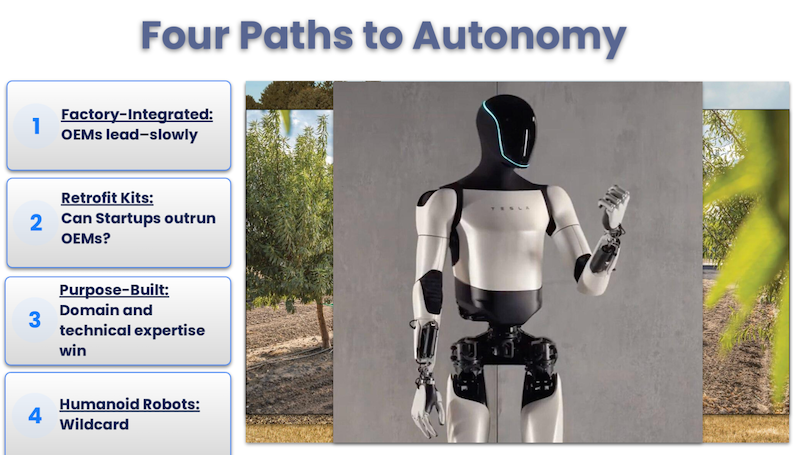
The 4 Paths to Autonomy
Four distinct paths to autonomy are emerging and each one has different winners, timing and barriers.
Integrated Autonomy. An autonomous CNH tractor was announced at the Farm Progress Show 10 years ago and it got a lot of attention at the time, but it was also a little bit of a “getting over your skis moment” because it hasn’t been shown publicly since that year.
Ironically, CNH built the tractor, but they didn’t build the autonomy stack. That was built by a company in Logan, Utah, called Autonomous Solutions.
There’s a lesson here. The speed and complexity of this path are tricky. Incumbents struggle because cultures that are built to support marginal innovation and institutional inertia make it really hard to shift gears.
Several startups have tried fully autonomous tractors, and they’ve also struggled because of sky high capital requirements and non-existent distribution. But even if OEMs and startups overcome these challenges, they’d still have an issue because again, tractor autonomy alone isn’t of much value if you can’t solve implement autonomy.
Retrofit Kits. John Deere has made attempts at ground up integration of autonomy, but they seem to be leaning into the second path, which is retrofit kits. This path appears to be where a lot of the action is right now in the industry.
Deere’s second gen retrofit kit is supposed to be available this year, but there’s a lot of cost that goes into this. I look at Deere’s current offering as being like the Waymo of ag autonomy. It’s built on older technology because of risk aversion, and it’s what’s available in the supply chain. The AGCO PTx Outrun Autonomous Grain Cart system is available, and I’ve seen that one in action. It’s impressive, and they’ve made some smart design choices in the architecture that kind of break out of this mold of just taking what’s in the standard supply chain and running with it.
There are also autonomy startups like Carbon Robotics, Sabanto and Blue White with machines already in the field. The startups are moving faster with less complexity, and they have a lower price point. OEMs might lead today and they might have an advantage because of their manufacturing and distribution, but will that last?
Purpose Built Platforms. One example of this is the GUSS autonomous orchard sprayer, which is already being used in hundreds of fields.
Startups with technical expertise and agility are owning this path right now because they’re coming up with novel solutions. But implement OEMs with the right domain expertise could absolutely play in this space as well. Interestingly, the major OEM reaction to GUSS was a Deere partnership that quickly turned into a full acquisition in the fall of 2025.
Humanoid Robots. This path might come at you out of left field. It’s a huge wild card. If humanoid robots crack general perception and manipulation, they retrofit any existing tractor implement without any redesign. They capture the high margin intelligence layer, and traditional OEMs are at risk of becoming contract manufacturers. I believe this threat is dramatically under-discussed in ag right now.
Regardless of the path forward, consider one other key insight. Using the Tesla/Waymo example again, Tesla has made a gigantic bet that simple perception with cheap hardware will be sufficient to solve full autonomy, while Waymo believes it can only be solved using significantly more expensive LiDAR.
Deere, in particular, might be leaning more toward the Tesla model as its Gen 2 tractor autonomy kit consists of 16 cameras (no LiDAR) that see 360 degrees around the tractor. It also seems to be a starting move to solve implement autonomy simultaneously as the cameras can also see the implement.
Who Wins Autonomy?
The answer to the question is whoever solves implement autonomy first.
The value created in autonomy is all hinged on getting the operator out of the field. That unlocks labor cost savings, training cost savings, higher quality/more consistent work, 24/7 capacity beyond human limits, reinforcement learning and continuous improvement at scale.
An experienced operator might cost $30 or more per hour, and if you can’t get them out of the field, the math doesn’t math and most of the value remains untapped.
Tractor autonomy with manual implements is driver assist. It’s not autonomy, and it already exists.
It’s important to note that implement automation doesn’t have to be all or nothing. It can be done in steps. Start with a function where customer value is high or pain is sharp, like the following:
- Controls (architecture is future proof)
- Sensors (cameras, vision)
- Edge compute (data capture, inference and RL)
- Connectivity (remote monitoring, data transfer to cloud)
- Cloud architecture (analyze, coordinate and learn).
Build the stack once for one function, and it compounds across every function thereafter. There’s some urgency in this. Inaction isn’t a neutral stance. Value is transferring to whoever owns the intelligence layer of the machines in the field and ultimately the autonomy. If implement OEMs don’t automate, there's a risk that someone else’s autonomy will catch a large chunk of the implement’s value, leaving it nothing more than a commodity.If implement autonomy is the key to who wins, what does equipment look like when it’s solved?
Bigger Isn’t Always Better
There’s a startup called Aigen Robotics that deploys a solar-powered, lightweight autonomous weeder. Nothing about it looks like a traditional implement, and that’s kind of the point.
We can immediately start thinking about things in a different way when there’s no operator in the cab. One way is to think smaller.
If I have one machine that has a capacity of 100 acres per day and a 10% probability of breaking down, when it does break down, I lose 100% of my throughput. If I have 10 small machines each with a capacity of 10 acres per day and the same probability of downtime, when one goes down, I still have 90% throughput online.
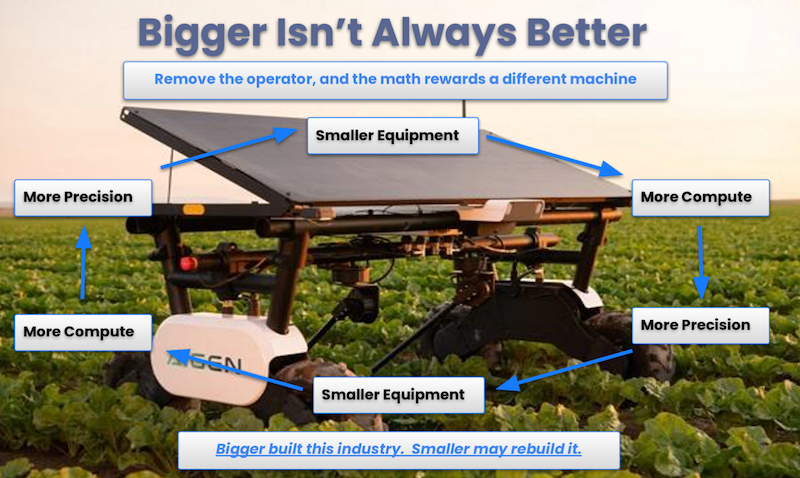
Technology can also allow for more precision, which is in turn enabled by more compute power. As compute power gets cheaper, more form factors get tried. As more form factors get tried, more compute power gets deployed. This is an economic idea known as Jevons Paradox, which I first heard described in the context of explaining why building better and higher capacity roads never seems to reduce traffic. When better roads are available, people drive more and they'll keep driving more until the traffic pain offsets the benefits of driving. The same thing is happening here. The more compute that is available for a cheaper cost, the more it will be deployed, which in turn is what enables more exotic and innovative precision automation.
Bigger built this industry over the course of decades. Smaller might be something that rebuilds it, but there’s still one wildcard that could change everything.
The Autonomy Wild Card
A startup called Figure AI, one of the leading humanoid robot companies, has raised $2.5 billion to date and currently has its humanoids deployed in BMW manufacturing facilities. In early May 2026, it had a live feed of one of its humanoids sorting packages in a warehouse. The humanoid was tasked with figuring out which side of the package had the shipping label on it and orienting it face-down on the conveyor. I checked the feed one morning, and the humanoid robot had sorted 204,000 packages in just under 164 hours. No breaks, no workers comp claims, no managerial issues. The humanoid was doing roughly one package every 3 seconds. They ran it head-to-head against a human intern, and the intern barely beat it by a couple dozen packages over 12 hours. These robots are getting smarter because of recursive and reinforcement learning. Tesla, Figure AI, Apptronik, Hyundai and many others are pouring money into this. The total global investment in the space to date is estimated to be between $30-$50 billion and a third of that is attributed to pure startups. If any of these companies solve general perception and manipulation in unstructured environments first, every form factor argument that I made earlier breaks. Existing tractors and implements become autonomous without any further redesign. This is the main justification behind the massive investment in these products. I believe these humanoids are already good enough to manipulate tractor controls. The question is whether you can train the humanoid to watch the implement and operating environment like a human. The short answer to that question is if you can see it with your eyes, you can train a camera to see it, too. OEMs’ unique access to machine data in their specific domain can become a real strategic asset in this endeavor as this training plays out. It's something they’re closest to and have more access to than anyone else does — if they’re capturing it. Even if half of this is right, an OEM’s strategy probably needs to consider a humanoid element, and there’s value in capturing existing machines’ operational data regardless of how autonomy shakes out. I think this is an OEM’s call option on the future.
Opportunities & Threats
Everyone in the industry has a specific opportunity and threat when it comes to autonomy.
Dealers’ business depends on iron volume and parts and service right now. As outcomes get sold, that backstop weakens. Dealers have a local presence, customer trust and operational knowledge that nobody else in the chain has. The opportunity is to stop only selling iron, lean into technology and become the deployment monitoring and uptime partner for whatever runs in their territory. If they don’t, somebody else probably will.
Tractor OEMs have the brand, the channel and the balance sheet. What they don’t have yet is integration completely past the drawbar in all cases. But tractor autonomy alone is a little bit of a cap. The win is to own the implement plus tractor system as one integrated outcome. Either build the autonomy in house or partner deeply and quickly with the people who already have the domain expertise. The Deere acquisition of GUSS in 2025 is one template. AGCO’s partnership with Trimble is another.
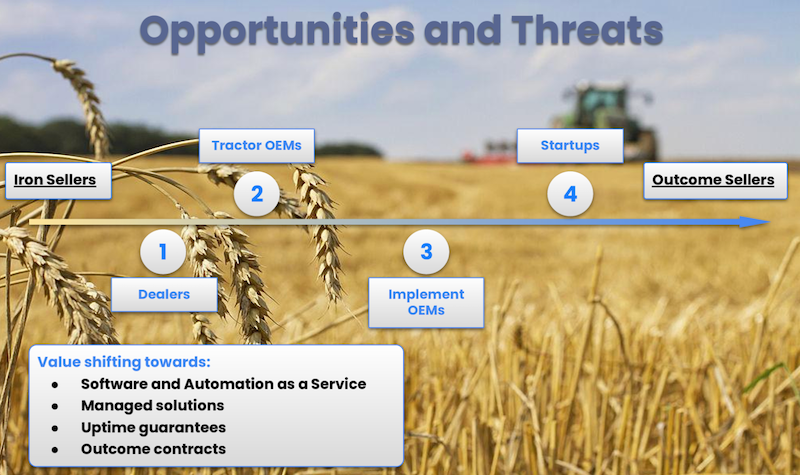
Implement OEMs have the domain expertise that others don’t, and they have access to operational data if they’re capturing it. They’re potentially the difference maker in all of the autonomy paths, regardless of how they play out, and that opportunity is enormous. But the threat is equally enormous. If implement OEMs don’t own autonomy for their space, their implement becomes a contract manufactured commodity bolted onto someone else’s autonomy stack. Forgive me for being blunt, but there may not be a second chance to rectify that.
Startups have the shortest distance to travel on the autonomy path, but they lack scale, and that’s a big hurdle.
Every segment in the industry can choose their path, but there’s no neutral position on the autonomy spectrum. Standing still is still potentially moving backward.
5 Strategic Questions
At the end of the day, there are 5 big questions to consider:
In 2030, what percentage of your revenue comes from autonomy?
Are you positioned to own implement autonomy — or lose it?
What’s your machine data strategy — do you have one?
Who’s your partner for what you can’t build alone?
How does your business change if humanoid robots arrive in 5 years instead of 15?
Ultimately, I don’t know who wins in ag autonomy. But I’m sure of this — the winners will be the ones asking these questions out loud inside their companies before the answer gets forced on them.

![[Technology Corner] Aligning ‘Smart Implements’ with Autonomous Tractors](https://www.precisionfarmingdealer.com/ext/resources/2026/10/01/Aligning-Smart-Implements-with-Autonomous-Tractors.webp?height=290&t=1790966217&width=400)

