
Purdue Univ. surveyed 400 farmers across the U.S. for its monthly Ag Economy Barometer in May. Only 14% of those farmers indicated their operations are better off today compared to a year ago, and looking ahead, 22% expect their farm to be better off financially a year from now.
So, what’s holding them back? Most said high input costs (45.5%), followed by weather risk (19%), low output prices (13.5%) and labor/equipment concerns (9%).
Now, with those numbers established, let's get to the Precision Farming Dealer-related angle here.
Periodically, the monthly survey includes a question about farm labor. This time around, participants were asked, “Given your current labor and equipment, how much would artificial intelligence (AI) tools improve your operation?”
About 59% said AI would not improve their situation at all, while 37% indicated it would help a little and 4% believed it would help a lot.
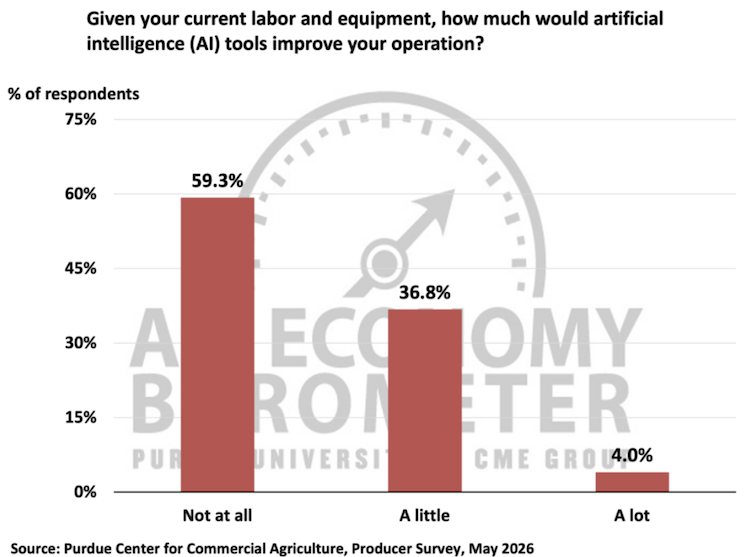
Thirty-six percent is a decent amount, but that 59% number is higher than I expected after everything I’ve seen and heard about AI over the past few months. I’d be interested to see how these numbers change — if at all — a year from now as AI in ag continues to pick up steam.
AI in the Field. Many farmers and dealers are already using generative AI programs like Gemini and ChatGPT to help with quick fixes and contract negotiations, but they’ve been slower to adopt agentic AI, which refers to autonomous systems that act on behalf of users to achieve specific goals, according to Jeremy Groeteke, global head of IT and digital strategy at Syngenta.
“That part hasn’t hit yet with growers unsurprisingly because it’s really new,” Groeteke told me during our conversation at the 2026 FEMA Supply Summit and Showcase. “The industry is really starting to internalize the agentic workflows, while growers are moving fast with the large language models like Gemini and ChatGPT. We’re seeing a rapid advancement. The future is here, it’s just not evenly distributed. We’re seeing autonomous machines in the orchard markets. But we still have a long way to go to achieve full autonomy. You can’t have a smart tractor with dumb equipment and vice versa. The whole system must work together.”
In my recent visit to Stotz Equipment in Buckeye, Ariz., I learned the AI-powered See & Spray technology is becoming more popular with customers across their 24-store footprint. The dealership is also using AI to help build on-farm data analytics reports for customers.
Those are just a couple “boots on the ground” observations and insights into how AI is currently being leveraged on farms.
But getting back to the question at hand of how AI could potentially solve labor/equipment challenges, there’s a young farmer in Kentucky who would be among the 4% saying it would help a lot.
Gaining Traction. Quint Pottinger became the first farmer in the Bluegrass State to plant an entire crop with a driverless tractor this growing season. He sold two big-frame 8000-series John Deere tractors and two 40-foot-planters that were costing him $100,000 a year in interest. He replaced them with a 130-horsepower tractor pulling a 20-foot planter and retrofitted it with the Sabanto autonomy kit to plant all his corn this spring.
“Last year, I was running a 16-row planter and averaging 60-70 acres a day,” Pottinger tells Kentucky Ag News. “So far, with an 8-row planter — half the width — we’re hitting close to 100 acres a day, and I’m not in it (driver’s seat)! I just hit the ‘go’ button the other day and watched it plant while I was in a meeting.
“It’s unbelievable. The dang thing runs 20 hours a day. We had cut costs everywhere we could. The only thing left was equipment. A farm in Kentucky could probably cut out $1 million of capex (capital expenditures) by using this system. We’re returning $400,000 back to the farm this year.”
Pottinger says if this technology works on his irregular shaped fields in Kentucky, then it can work anywhere. However, If the Purdue Ag Economy Barometer is any indication, most farmers aren’t sold yet. But as Groeteke told me at the FEMA Supply Summit and Showcase, it’s likely only a matter of time until they are.
“There’s no going back. The individual who leverages technology will outcompete the individual who doesn’t use technology.”

![[Technology Corner] Aligning ‘Smart Implements’ with Autonomous Tractors](https://www.precisionfarmingdealer.com/ext/resources/2026/10/01/Aligning-Smart-Implements-with-Autonomous-Tractors.webp?height=290&t=1790966217&width=400)

