
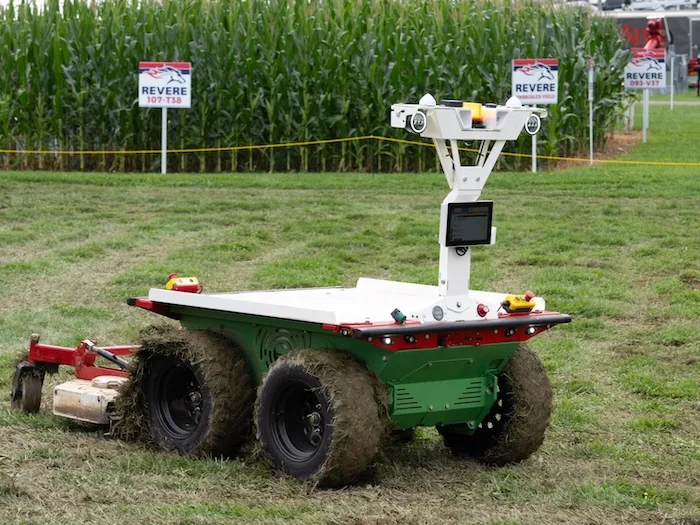
Penn State’s College of Agricultural Sciences has joined the Pennsylvania Department of Agriculture, Pennsylvania Department of Community and Economic Development, Team Pennsylvania, and Innovation Works/The Robotics Factory to launch the Keystone AgTech Alliance, a statewide partnership designed to accelerate agricultural innovation and position the commonwealth as a national leader in agricultural technology deployment.
The alliance will bring together research, industry, government and economic development partners to create a stakeholder-centered agricultural innovation ecosystem to hasten adoption of practical solutions to improve profitability, sustainability, workforce resilience and economic growth.
Penn State’s contribution to the alliance centers on its unique ability to move innovation from discovery to deployment — using its research facilities and farms to test and validate technologies under real-world conditions — and its statewide Penn State Extension network to help farmers evaluate and adopt solutions that work for their operations.
The partners announced the alliance at the FIRA Robotics Village exhibit during Penn State’s Ag Progress Days. Troy Ott, Peter and Ann Tombros Dean of the College of Agricultural Sciences, said the announcement of this collaboration was especially fitting as Ag Progress Days celebrates the 50th anniversary of its permanent home at the Russell E. Larson Agricultural Research Center at Rock Springs.
“For 50 years here at the Russell E. Larson Research Center, Ag Progress Days has brought together farmers, researchers, industry leaders and innovators to solve real-world challenges,” Ott said. “As we celebrate that legacy, we’re also looking ahead. At Penn State, we believe research has its greatest value when it moves beyond the lab to improve farms, businesses and communities.”
Ott added that turning discovery into real-world impact takes more than good science.
“It takes innovative research to generate new ideas and testing under real-world conditions to refine those ideas into solutions that work for Pennsylvania and the nation. It takes teaching and hands-on training to prepare the next generation of agricultural leaders, and extension to connect those innovations with producers,” he said. “Just as important are the partnerships that bring together universities, industry, government and the agricultural community to move promising ideas from discovery to adoption. That’s exactly what the Keystone AgTech Alliance is designed to do — and why it will help shape the next 50 years of agriculture.”
Gretta Tritch Roman, senior director of research development and initiatives in the college, said the alliance aligns closely with one of the college’s strategic priorities — the Technologies for Agriculture and Living Systems initiative, known as TALiS.
The initiative integrates robotics, artificial intelligence, precision agriculture and digital systems into the college’s research, teaching and extension mission by building testbeds, training the next generation, and working with industry to ensure new technologies are practical and address producers’ needs.
Tritch Roman said the Keystone AgTech Alliance is the statewide coordination needed to help TALiS reach its full potential.
“The college helps turn research into real-world solutions,” she said. “Through our research, field testing and Penn State Extension network, we connect innovation with the people who can put it to work. By bringing together Penn State’s research expertise, state investment, economic development partners, investment capital and advanced manufacturing, the Keystone AgTech Alliance will help accelerate technologies that strengthen Pennsylvania agriculture. We’re proud to advance this effort alongside our partners.”
The Pennsylvania Department of Agriculture will help guide strategic investment priorities, provide policy support and funding opportunities, and maintain a direct feedback loop with Pennsylvania producers.
Pennsylvania Agriculture Secretary Russell Redding said Pennsylvania’s unmatched crop diversity, world-class research at its academic institutions, and proximity to 60 million consumers uniquely position the commonwealth to serve as the nation’s proving ground for solutions to labor shortages, productivity pressures and long-term sustainability.
“This agreement is another step toward our shared goal of helping farmers address real-world challenges safely, effectively and efficiently,” Redding said during the gathering at Ag Progress Days. “Helping Pennsylvania farmers compete and continue leading the nation is the reason the Shapiro administration launched Ag Innovation Grants, and today we’re bringing the right partners to the table to continue making that vision a reality.”
Redding noted that the Keystone AgTech Alliance will further advance the Agricultural Innovation Grant Program, the first of its kind in the nation, which has invested $30 million to help farmers adopt cutting-edge technologies.
In its first year, the program funded 88 projects, including a drone-based precision spraying system at Penn State’s Fruit Research and Extension Center. Redding said the Shapiro administration also has invested in Penn State through Ag Resource Center Funding and supports Penn State in leading the Center for Plant Excellence, a partnership with Penn State Extension, to accelerate research, technology adoption and industry collaboration.
The Robotics Factory, a program under Innovations Works, an early-stage venture investor and startup catalyst headquartered in Pittsburgh, will contribute advanced robotics engineering, rapid prototyping and startup commercialization expertise to help address agricultural challenges and move promising technologies from development to deployment.
“One of the biggest challenges for robotics startups is getting new technologies in front of the people who can benefit from them most,” said Kevin Dowling, managing director of the Robotics Factory. “We are excited to be a part of this alliance to build the partnerships needed to move promising technologies from development to deployment at scale.”
Team Pennsylvania, a public-private nonprofit organization that advances economic growth across the commonwealth, will connect industry leaders, investors and cross-sector collaborators to help launch demonstration projects that support technology adoption and economic growth, said Abby Smith, president and chief executive officer of Team Pennsylvania.
“Pennsylvania's greatest strength has always been its ability to bring people together around a common purpose,” Smith said. “At Team Pennsylvania, we serve as a trusted partner, aligning industry, government and academia to advance initiatives that move agricultural innovation and economic growth across the commonwealth.”
She added that the Keystone AgTech Alliance is another example of what’s possible when organizations collaborate to advance agricultural innovation and strengthen Pennsylvania's economy.
“By leveraging our partners’ expertise, we’re creating opportunities and driving results that no single organization could accomplish alone,” Smith said.
DCED Secretary Rick Siger said Pennsylvania has always been a national leader in innovation, technology and agriculture.
“Bringing these industries together creates an outstanding opportunity to drive our economy forward,” he said. “While the Agriculture Innovation Fund was born out of the need to keep Pennsylvania agriculture competitive, the Keystone AgTech Alliance goes one step further — connecting the best innovative technology with Pennsylvania’s world-class academic institutions, creating a direct link for collaboration and creativity.”
![[Technology Corner] Aligning ‘Smart Implements’ with Autonomous Tractors](https://www.precisionfarmingdealer.com/ext/resources/2026/10/01/Aligning-Smart-Implements-with-Autonomous-Tractors.webp?height=290&t=1790966217&width=400)

