
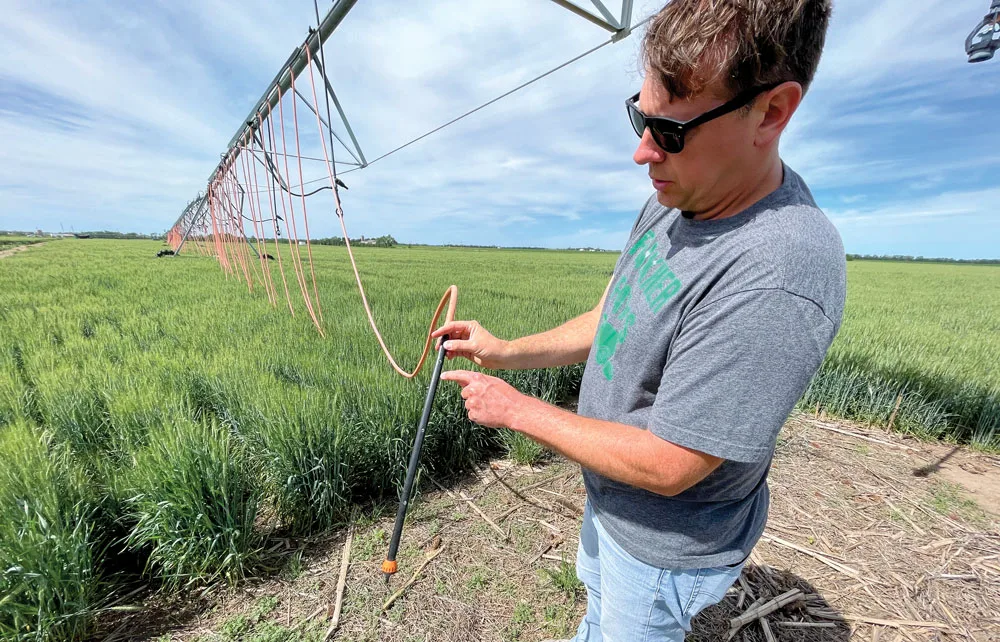
It’s hard to miss the giant Flickner Innovation Farm sign from the side of the road while driving around Ray and Ryan Flickner’s 1,000-acre corn, soybean and wheat operation in Moundridge, Kan. They’re putting cutting-edge technologies to the test with over a dozen ongoing research trials — conducted by universities and collaborators — at any given time.
Innovation is the name of the game for the father-son duo, who were among the first in the area to adopt strip-till in the early 2000s — just a few years after breaking the mold with subsurface drip irrigation (SDI).
“Being the first to do anything is like putting a bullseye on your back and saying, ‘Well, what can go wrong here?’ But I have several neighbors who say the reason they started strip-tilling is because they saw what we did and they liked the concept,” says Ray, who spent about 35 years working in ag finance in addition to farming. “We were the first ones in the area to install subsurface drip irrigation in 2001. Since then, we’ve seen an explosion of the technology in our county, which probably has the most acreage of subsurface drip anywhere in the state of Kansas.”
Every Drop Counts
Spend just a few minutes with Ray and Ryan and it doesn’t take long to see how important water conservation is to them. A recent study by Kansas State Univ. revealed the Flickners use about 40% less water than the county average.
“This kind of breaks my heart,” Ryan says while driving by a nearby field that’s being watered in early May. “Not to pick on anyone, but why are they watering wheat and corn right now? There’s a really good chance of rain on Sunday, Monday and Tuesday.”
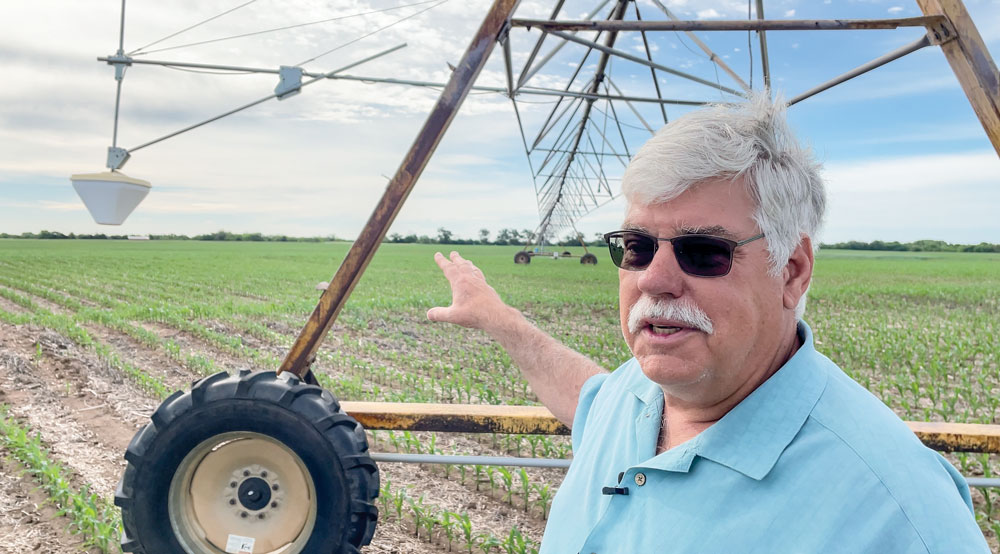
STRESS TEST. Ray Flickner points to an Autonomous Pivot tool that measures crop stress. The AI-driven platform, mounted on the pivot, uses sensors and cameras to provide up to 300 soil moisture readings without disturbing the soil. Noah Newman
“For a long time in the irrigation community, the idea was that you couldn’t put on too much water,” Ray says. “But we discovered that we could reduce the amount of irrigation application and still maintain yield and improve our profitability.”
“I’m an SOB — a son of a banker — and we both like our numbers,” Ryan adds. “Know your data. Are you trying to enter a yield contest or are you trying to be the most profitable? One of the numbers I enjoy crunching is our ‘water duty,’ the number of bushels that we’re able to produce divided by the total inches per acre (of water) that we put on.”
During a dry 2024 growing season, the Flickners produced about 26 bushels per inch of irrigation applied, about 10 bushels higher than the local average that year.
Below the Surface
The family used a gated pipe irrigation system for a long time, but by 2000, the health of Ray’s father Galen started declining, and Ray was on the road quite a bit for his full-time finance job. He knew something had to change.
“It became a labor issue, we just didn’t have the labor anymore,” Ray recalls. “Also, pivots don’t work on all our acres because we have some creek and farmstead obstacles in the way. We were ending up with a lot of wasted acres. I saw the subsurface drip irrigation concept in Arizona and California and decided it could work for us.”
Ray gave it a shot in 2001, installing a Netafim Subsurface Drip Irrigation system, which uses buried drip tape — installed 18 inches below the soil surface — to deliver water directly to the root zone throughout the growing season. They also use the system to inject fertilizer like UAN when the crop needs it.
“It’s an automated system, kind of like what you normally see with a residential sprinkler system,” Ray says. “There’s a control box. Originally, we were pneumatic, but we converted everything to radio frequency so I can control it from the house. We plug in which zones we want watered and for how long. It was an expensive proposition, but it’s paid off through labor savings and improved water use efficiency.”
The drip tape runs the length of the field and there’s 60 inches between each tape, which decreases the margin for error with strip-till. If corn is planted right on top of the drip tape, every other row would have a long way to go for water.
“Since there’s 60 inches between drip tape and we plant in 30-inch rows, we want the strips to be 15 inches away from the drip tape,” Ray says. “The concept is to match the distance from the plant to the drip tape and make sure that’s constant across the field.
“The biggest downfall with SDI is its inability to germinate a crop if you don’t have moisture at planting,” he adds. “But if we do get a rain in the summertime, the ground is like a sponge and there isn’t much runoff. Whereas if you have a wet surface from a pivot, there would be some runoff. I also think the drip irrigation improves weed control because if the weeds don’t have moisture, they won’t grow.”
No-Till, More Moisture
One of the big reasons why the Flickners started no-tilling and strip-tilling was to capture enough moisture in the spring for their crops to germinate.
“In April and May, we’ll typically have enough rain that we can get the crop to germinate,” Ray says. “We have neighbors that are still conventional tillage, and they have problems with getting the crop to sprout. So, we’re very conscious about minimum tillage largely because of moisture conservation in our area.”
The Flickners’ crop rotation consists of no-till drilling wheat into corn stalks, no-tilling double crop soybeans into the wheat stubble, and strip-tilling soybean stubble ahead of corn on the acres with irrigation pivots.
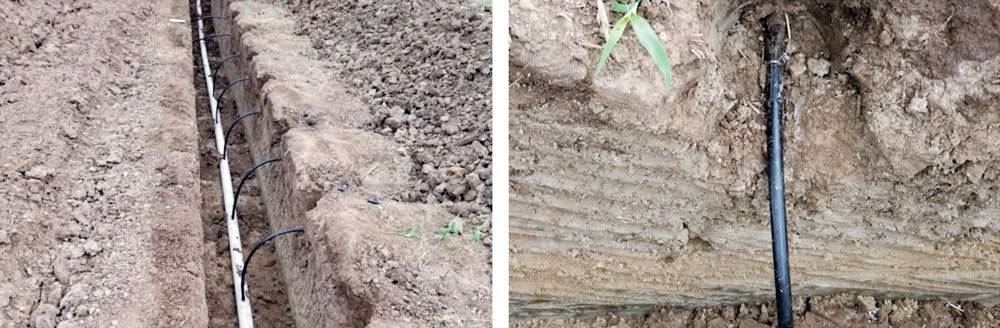
UNDERGROUND. Subsurface drip irrigation runs on about 60% of the Flickners’ acres. Drip tape, installed 18 inches below the soil surface, delivers water and nutrients directly to crops throughout the growing season. Ray Flickner
“We’re 13 inches below normal rainfall this year and we only average around 33 inches annually,” Ray says. “We had an inch of rain 10 days ago and that was the most we’ve had in almost 5 months. With the pivots, where we can apply water over the top, I do the corn-wheat-soybean rotation because we can water everything up to germinate. But it’s riskier with subsurface drip irrigation, which is why we use cover crops instead of wheat on those acres.”
On the 600 acres with subsurface drip irrigation, soybeans are often planted into a cover crop mix of cereal rye and turnips that’s drilled in late September. Ray planted green into chest-high cereal rye in the wet spring of 2019, but he usually terminates the cover crops about a month before planting if conditions are dry, like they have been the last 5 years.
“We’re growing 3 cash crops in 2 years,” Ray says. “We have a living root growing throughout the year with the exception being between soybeans and corn on some acres. I’m still searching for a cover crop mix that works well before corn on our farm.”
Cutting-Edge Tech
While about 60% of the farm has subsurface drip irrigation, the Flickners use different types of irrigation technology on the other 40% to maximize water use efficiency.
In 2019, they installed Netafim Precision Mobile Drip Irrigation (PMDI). The system retrofits to a pivot, combining the efficiency of drip irrigation with the flexibility of center pivot and linear move irrigation systems.
“With PMDI, we’ve added drip tapes to the pivot, and instead of blowing water out through the nozzle, we’re actually laying it on the ground through the drip line,” Ray says. “When you’ve got tall corn, the drip lines go through it nicely and the water goes down to the plant. It’s working very well for us so far.”
More recently, the Flickners became the first farmers in Kansas to run a 360 RAIN. The 3-wheeled autonomous irrigation and nutrient application machine provides water and nutrients to the base of the plant as it moves through the field. 360 RAIN is designed to use 40% of the water used by center pivot irrigation systems, can hold 3,000 feet of hose and draw from a variety of water sources, including direct well connection, pipeline-fed risers or surface water.
“It’s a 60-foot boom that matches up with our 24-row planter,” Ryan says. “It works really well on low volume wells. 360 RAIN would work great on a well that can produce about 200 gallons a minute, but if you have a well that’s still producing 1,000, you’re probably going to make a different management decision. The other thing that intrigues me with 360 RAIN, with the growing dairy industry in Kansas, this is a great opportunity to de-water a lagoon throughout the growing season.”
“I also wonder — if you can pump manure through the 360 RAIN, could you also interseed cover crops with it? I’m trying to figure out if I can get that done because that would be advantageous for us.”
To further prevent overapplying or underapplying water, the Flickners monitor crop stress with plant-based sensors from Phytech. The small sensors attach to the plant stems and deliver real-time insights to optimize water applications.
They’re also using an Autonomous Pivot on some fields. It’s an AI-driven platform, mounted on a pivot, that uses sensors and cameras to provide up to 300 soil moisture readings per rotation without disturbing the soil.
“The advantage of this system is it moves around with the pivot,” Ray says. “It gives us a better idea of the exact moisture content in the field, so we know if we need more water or if we’re watering too much.”


![[Technology Corner] Aligning ‘Smart Implements’ with Autonomous Tractors](https://www.precisionfarmingdealer.com/ext/resources/2026/10/01/Aligning-Smart-Implements-with-Autonomous-Tractors.webp?height=290&t=1790966217&width=400)

