
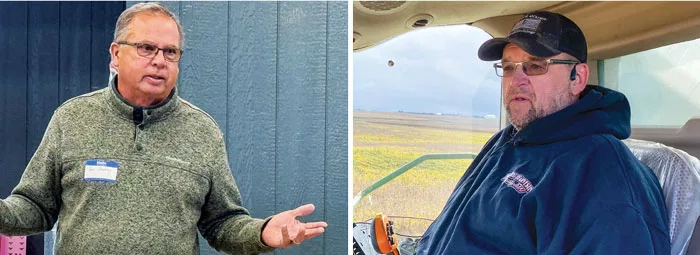
Dealers got a glimpse into the mind of a customer during a special “What Farmers Want from You” panel discussion at the 2025 Precision Farming Dealer Summit.
Brownsburg, Ind., farmer Mike Starkey and West Union, Iowa, farmer Loran Steinlage shared perspective on what it takes to earn their trust and business. Both farmers have been using precision tools and pushing the envelope with innovative conservation practices for several years.
Starkey is a 7th-generation farmer who grows 1,200 acres of corn, 1,500 acres of soybeans and 300 acres of wheat. Steinlage constantly experiments with advanced farming systems and technology on his 750-acre farm, where he grows corn, soybeans, wheat, buckwheat, rye, barley and sunflowers. Here are some highlights from the conversation.
What cutting-edge technology is giving you a winning edge on your farm?
Starkey: AirScout Thermal Imagery. We learned about the company at the National No-Tillage Conference a few years ago. They use a fixed wing manned aircraft to take thermal, visual and Advanced Difference Vegetative Index (ADVI) images of my fields every 2-3 weeks throughout the growing season. It helps me spot anomalies or patterns that require action and identify 5 zones for my second sidedress application of nitrogen (N): best corn, next best, medium, lower and worst corn.
When I go across the field with that second N application, I put more N on the better corn to get that 300-plus bushel yield. I back off on the corn I feel is going to be 180-200, depending on the year. It gives me the opportunity to make a prescription for that year, not from what I’ve done previously.
“Play the long game. That’s the best advice I can give to dealers. If you want to make that quick buck, it’s not going to last…”
Steinlage: One of the companies we’re working with right now has a satellite-based N management system and we did a lot of trials with them this year. It excelled better than they even expected. On my farm — with soil health systems in place — we proved that we didn’t need any more N (than what we were already applying).
We’re also working with a heavy-lift drone company that has a 1,000-pound payload drone. That’s going to be a game-changer. We’ve been working with drone systems since 2017. But with a 1,000-pound payload, I think we’d be able to start replacing ground rigs.
How do you decide which new products might be worth buying?
Steinlage: It’s all about seeing it in my field and making it work for my unique circumstances.
Starkey: I’m a numbers man. I like to do my own on-farm research. If there’s a new product, and someone is telling me to try it, I’m not going to bet my whole farm on it. I want to actually have on-farm research that proves its worth. How much did my yield increase to pay for the product?
A few years ago, the cost of N skyrocketed. That’s when the AirScout program really benefited me because I didn’t spend excess dollars for N that year, which is a huge expense.
Steinlage: A big advantage for us lately has come from learning and understanding the software systems that are available. John Deere Operations Center is the most open platform out there right now. We’re working with the Iowa Soybean Assn. on some projects, and the ability to retrieve the data is almost as critical as compiling the data. That’s a big challenge right now — trying to get somebody that can help me as a farmer learn and understand the data, so I don’t have to waste all my time trying to analyze it.
Looking ahead, what kind of purchases are you considering for 2026 & beyond?
Starkey: I’m looking at biologicals as the next cutting-edge opportunity out there. My overall goal is to have my soil provide the fertility needs of crop. I want to make sure my soil is as active as possible. I no-till. I use cover crops. I do a lot of research on biologicals. There’s a product called SOURCE by Sound Agriculture I used the last couple years that I think has a lot of potential.
Steinlage: I hired someone to plant all my acres last year. I love getting out in the field when it’s planting time, but I’m also foreseeing the day when full automation is coming. We had 4 different planters running in the field at the same time. They were all identical planters, but not a single one was set the same. We could program that out once we go to full automation. That’s where the biggest gains are going to start happening, and that’s what’s got me excited about the next couple of years planting.
Autonomy in Action
Emerging technology already has a place in Loran Steinlage’s operation. He thinks artificial intelligence (AI) and autonomous robots have the potential to change farming the same way that autosteer did.
“The biggest thing I’m keen on with the robots is doing things that I can’t do today,” Steinlage says. “I’m thinking about the row spacing changes I can make to squeeze something between the rows. If we can start running the robots down in between that corn 2-3 weeks before harvesting silage and get that next crop planted, that’s something that could help with the tight window in a broadacre conventional cropping system.”
Steinlage has done trials with RowBot, a 24-inch wide autonomous machine that runs between the rows seeding cover crops, mowing and weeding. Steinlage is also working with Greenfield Robotics, which currently offers autonomous weeder robots, to develop the capability for robotic soil sampling.
“AI scares a lot of people, but I look at it as a tool,” Steinlage says. “It’s just like social media. If you let it start controlling you, it can be a negative, but if you use it to your advantage, it becomes a success story.”
Precision technology also gives farmers the opportunity to share their success stories with the public, rather than becoming the scapegoats for environmental problems. Irrigation management software might not seem relevant to most Midwestern farmers, but the information from the sensors tells a valuable story — whether a field is irrigated or dryland, Steinlage says.
“Sensors in our field show that our farming practices actually improve water and filtration,” he says. “The first-year data off of that farm proved that if everybody used farming practices like us, we could mitigate flooding by 50%. If I could apply that technology to virtually the whole watershed, I could show that we farmers are doing good.”
One thing I really like about the swarm farming concept is that if one planter goes down, you still have 10 or 11 others going. If my 60-foot planter goes down, I’m done.
The swarm farming concept also gives a competitive edge to the smaller farmer. If I can contract my planting for X amount of dollars per acre, that’s a big difference for me. The minute I can’t take the time to fix stuff myself anymore, the game changes. When I could do all the wrenching, I had a competitive advantage over the guy who’s paying $200 per hour for the shop rate.
My custom-built planter cost me $50,000. That same planter right now costs a quarter million dollars at minimum, and it does the same thing my $50,000 planter does. I foresee the day when I won’t own a single piece of equipment. I’ll just hire it all out and that probably scares a lot of guys, but it’s coming more quickly than I think a lot of people would realize.
What expectations do you have for your precision dealer?
Steinlage: If you have a help number, answer the phone. If I’m going to pay extra for that service, I really want you to answer your phone.
Starkey: Service is number one. If something goes down and I can’t figure it out, I want somebody to fix it fast. Farmers aren’t very patient, and in the past, I haven’t had the patience to wait the whole day for something that could’ve been fixed within an hour.
I also think dealerships should host winter workshops to go over equipment and share what’s new for the upcoming year. Educational clinics are always great. My Deere dealer has combine and planter clinics. I think it’d be nice if precision dealers did that as well to review software updates and new technology.
Start the clinic at 9 a.m. End with lunch and get out of there. I think that would be enough. If you have an all-day event, you’re going to have people show up for lunch and then miss the morning session.
Starkey & Steinlage Answer Questions from Dealers
Mike Starkey and Loran Steinlage explained their approach to precision technology and shared their biggest pain points during a farmer-to-dealer panel discussion at the 2025 Precision Farming Dealer Summit. Click here to watch the full session. The PFDS Video Replays are sponsored by Ag Technology Solutions Group
Steinlage: I’m the contrarian farmer. I don’t like free lunches. Put a value to that meeting. If they’re coming for the free lunch, they’re not paying attention. You also build relationships with customers during on-farm clinics and training sessions. It’s hard to put a value on that long-term relationship, but it’s the best value you can have.
Play the long game. That’s the best advice I can give to dealers. If you want to make that quick buck, it’s not going to last. If your customer is in it for that quick buck, it’s not going to last. It’s the relationship that you’ve got to foster and build. It’s that simple. That’s the hard thing I learned over the years. Just working on that relationship is critical and if you say you’re going to do something, do it.
What can manufacturers and dealers do to get more farmers to invest in precision technology?
Steinlage: A properly run demo. Get a new product in the farmer’s hands and have the knowledge there to teach them how to use it from day one. Don’t just send a piece of equipment to someone and say, “Here, figure it out.” Send out your best tech with that piece of equipment and have it set up to optimize performance from day one.
I go back to my early days when I was strip-tilling. The best thing I ever did was host a strip-till field day. We had 15 different units in the field at the same time. It gave us a chance to see what works on our soil.

![[Technology Corner] Aligning ‘Smart Implements’ with Autonomous Tractors](https://www.precisionfarmingdealer.com/ext/resources/2026/10/01/Aligning-Smart-Implements-with-Autonomous-Tractors.webp?height=290&t=1790966217&width=400)

