
Takeaways
- Precision farming dealer internships provide valuable learning experiences in the shop and the field.
- Customer relationships don’t end with the sale; they begin with it. Follow-up visits go a long way towards building credibility and trust.
- Some farmers might not be aware of the precision technology that’s already installed in their equipment.
Our latest Day in the Cab odyssey takes us to Chilton, Wis., where harvest season is beginning to wind down for 14-store John Deere dealer Riesterer & Schnell.
Temperatures are approaching 60 degrees on this sunny mid-November day, continuing a stretch of good weather for local farmers as they put a bow on the 2025 growing season. Let’s get right to the action.
9:10 a.m.
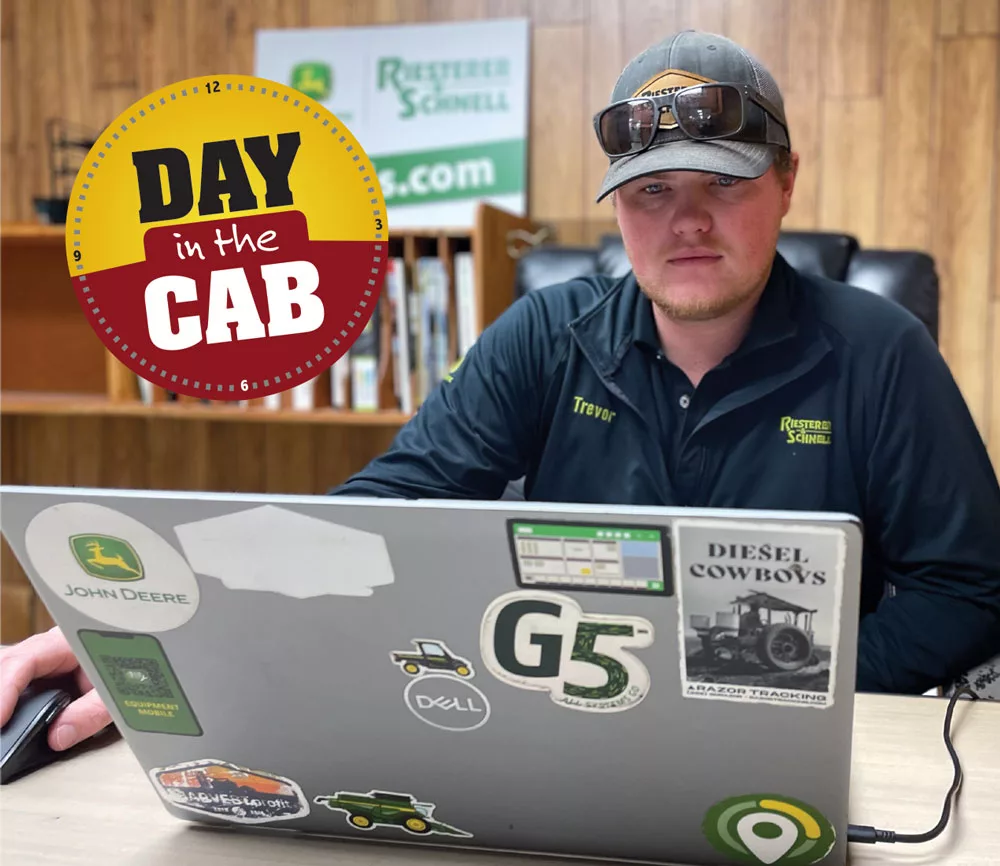
Digital specialist Trevor Balthazor is our fearless leader this morning. We meet in his office for a quick pre-game chat.
Balthazor is coming up on his 4-year anniversary with Riesterer & Schnell. He started as an intern during his junior year at the Univ. of Wisconsin-Rivers Falls.
“Those 6 months of my internship laid the groundwork for everything I know and do today,” Balthazor says. “I learned the ins and outs of the business. It was a great learning environment and a low stress way to break into this industry.”
He’s one of several All-Stars the internship program has produced over the years. And now Balthazor is mentoring his own intern, up-and-comer Matt Schneider, who’s also joining us this morning. We’ll meet him in just a bit.
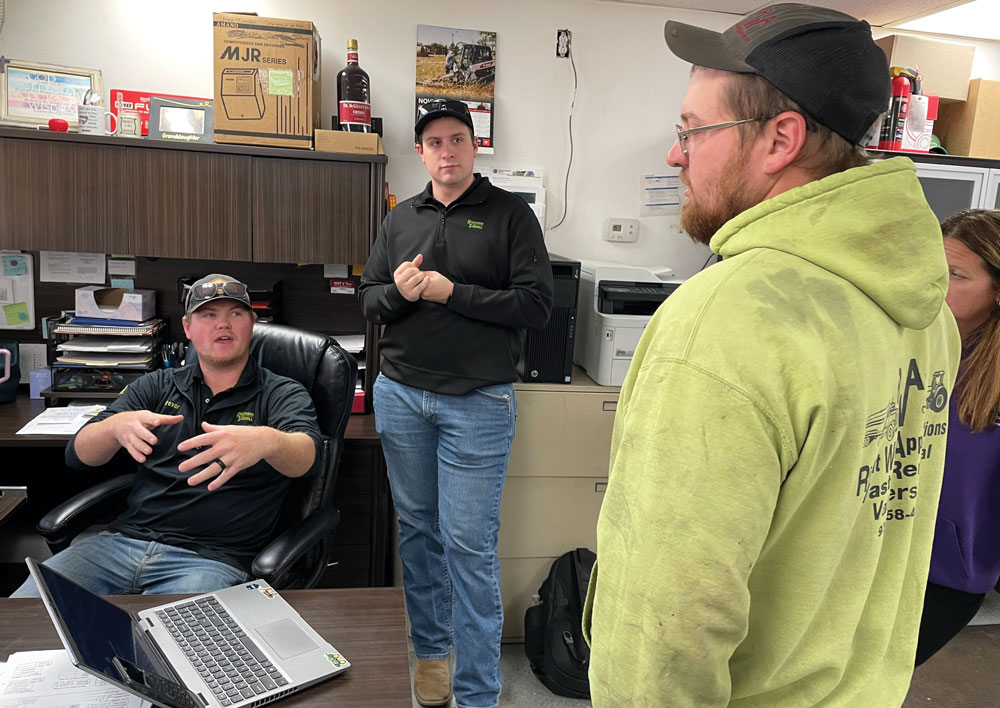
Balthazor and intern, Matt Schneider, help a customer who’s having trouble downloading manure application reports from the John Deere Operations Center. Noah Newman
“There are a lot of great people in our organization who started as interns,” Balthazor says. “We go to a lot of career fairs because it’s important to educate people about what we do. I get questions all the time from students about the skills they need to do this job. But it’s really just about getting into the business and showing your eagerness to learn because this industry is all about learning as you go.”
There are 7 members on the Riesterer & Schnell precision team spread across several locations. One of the perks of working for a dealership of this size is the ability to call on those teammates for advice when needed, Balthazor says.
“If you have something that you need help with there’s probably someone in the dealership that’s seen it already. There’s a lot of knowledge within the team, so it’s not always on you to figure everything out by yourself.”
9:21 a.m.
A precision department manager from another dealership once told me it’s imperative that his new hires have some sort of ag background on their resume, even if it’s just FFA in middle school, because that experience shows they understand the growing season calendar. Balthazor checks that box.
“Both of my grandparents farmed,” Balthazor says as he finishes typing an email on his laptop. “We have 25 beef cows and 140 steers that we raise on 180 acres. I used to show animals at the county fair when I was younger. It definitely helps having that mentality of a farmer and knowing where they’re coming from when you work with them.”
Balthazor’s favorite part of the job, he tells me, is the interaction with farmers. He enjoys introducing them to new technology, helping them use it and seeing smiles on faces when it pays off.
“I was demoing a combine and a tractor the other day, and the customer told me, ‘Man, I knew Deere has a lot of tech, but I didn’t realize what it could do and how easy it is to use.’”
9:37 a.m.
It’s time to pack up for our first visit of the day to a manure application company in the nearby town of St. Nazianz. They’re having trouble downloading application reports for customers.
“They pull the information for the reports from the John Deere Operations Center,” Balthazor says. “We’re going to try and find out what’s causing them issues.”
On the way to the car, I meet Balthazor’s right hand man, Matt Schneider, who’s in the third year of his internship with the dealership. Schneider grew up raising heifers on his family farm and he’s currently working toward a marketing degree at the Univ. of Wisconsin-Oshkosh.
Day in the Cab Video Series
We had the camera rolling during our visit with Trevor Balthazor and Matt Schneider. Go to PrecisionFarmingDealer.com/DITC to watch the Day in the Cab Video Series. Balthazor and Schneider showcase their problem-solving skills, share technology trends to keep an eye on in 2026 and discuss how to build a strong precision department through education and training.
His goal is to work for the dealership full-time after graduation. When he’s not in the classroom, he’s either at the dealership or on a farm. Those are the best places to learn, he tells me.
“You’ll make mistakes, but you’ll learn from them, that’s just the way it is,” Schneider says. “I really like what Trevor gets to do every day. Growing up, I knew animals weren’t my thing. The equipment side of the business is what I always wanted to get into.”
Balthazor agrees there’s only so much you can learn in the classroom that will prepare you for a career in the precision dealer world. The most valuable lessons happen in the field.
“I have a bachelor’s degree in ag business, and I’m not saying it doesn’t help me today, but most of my knowledge I picked up was through my internship and on the job,” Balthazor says.
9:43 a.m.
On the way to St. Nazianz, the conversation briefly shifts to the Green Bay Packers’ 10-7 loss to the Philadelphia Eagles on Monday Night Football earlier in the week.
“Tough loss. Are you guys big Packers fans?” I ask.
“I am, but not a die-hard. I don’t get upset or cry when they lose,” Balthazor says.
“My dad was actually at the game Monday,” Schneider says. “He says it wasn’t that cold.”
It’s usually freezing cold at Lambeau Field during primetime games late in the fall. But it’s been unseasonably warm the past few weeks. Mid-60s in Wisconsin in the middle of November? We’ll take that any day of the week.
“There were a couple rainy days here and there, but it’s been pretty dry,” Balthazor says. “Yields have been good or above average for sure. This is the slower part of the fall for me. I’m usually front loaded — I set everything up, explain it to the customer, get them in the field and then once they get the hang of it, they don’t need me out there bugging them. I got a question on calibrating yield monitors this morning, but otherwise there haven’t been many issues.
“We have support plans and yearly service packages,” he adds. “We do some diagnosing, but we like to push most of that to the service department.”
I ask Balthazor about the challenges of staying fresh during planting and harvest seasons. He says pre-season maintenance and customer training help alleviate service stress during those busy parts of the year. Setting realistic expectations with customers and leaning on teammates for assistance are other crucial pieces to the burnout prevention puzzle.
“We also have a John Deere mobile app that runs customers through all the ‘how-to’s.’ It’s available for any customer to download and it shows them how to do things on their own like calibrating yield, switching settings from soybeans to corn, setting up guidance lines and more,” says Balthazor, who points to the app as a good way to preemptively cut down on service calls.
10:01 a.m.
We arrive at our destination — a business called Right Way Applications — and head inside. Balthazor hops on the customer’s computer and begins trying to diagnose why they’re unable to download the manure application reports.
Why are these reports so critical? Not only are they used for billing, Balthazor explains, but the customers are required to show them to the Department of Natural Resources and the county land and water conservation departments that regulate manure applications.
“Those 6 months of my internship laid the groundwork for everything I know & do today…”
Balthazor clears the cookies on the customer’s computer, which fixes the problem to an extent. The reports are now downloading, but they’re still not fully accessible.
“Now we have to get with Deere and fill them in on the situation to see if they can solve it,” Balthazor explains. “We’ll see if it’s just a glitch or if it’s something we need to do differently on our end.
“That’s a lot of the job — working through the problems with Deere,” Balthazor tells me as we head back to the car. “There are dealer chats that allow you to talk to someone directly. We can also submit cases to Deere, and they have dedicated people who will look at it and respond to you.”
10:33 a.m.
We’re back on the road and on our way to visit a farmer who’s custom harvesting a cornfield in the nearby town of Whitelaw. Balthazor installed AutoPath on his planter earlier in the year and he’s finally getting to harvest the field that he used it on.
“I want to make sure he’s getting the most out of his technology,” Balthazor says. “I might show him how to use MachineSync as well, which his combine is already set up for. It just needs a free activation.”
“Does most equipment come factory fit with all this new technology now and it’s just a matter of activating it and knowing how to use it?” I ask.
“Yep, it’s pretty much integrated and ready to go,” he says. “It’s hard to order equipment without it actually.”
10:46 a.m.
We pull up to a field covered in heavy residue and park the car. A John Deere combine in the distance is getting ready to finish harvesting the rest of the field. Balthazor navigates his way through knee-high cornstalks to the combine to meet up with the customer, while Schneider and I stay behind to submit that case report to Deere for the previous customer.
Schneider tells me a family friend helped land him a shadowing opportunity with Riesterer & Schnell when he was still in high school. He started out in the shop, got hooked and has been working as an intern ever since.
“I wouldn’t trade that first year in the shop for anything,” he says as he works on the case report on his laptop. The car hood serves as his de facto desk. “There are things I wouldn’t have learned if I didn’t experience that. You also gain a lot of respect for what those techs are doing.
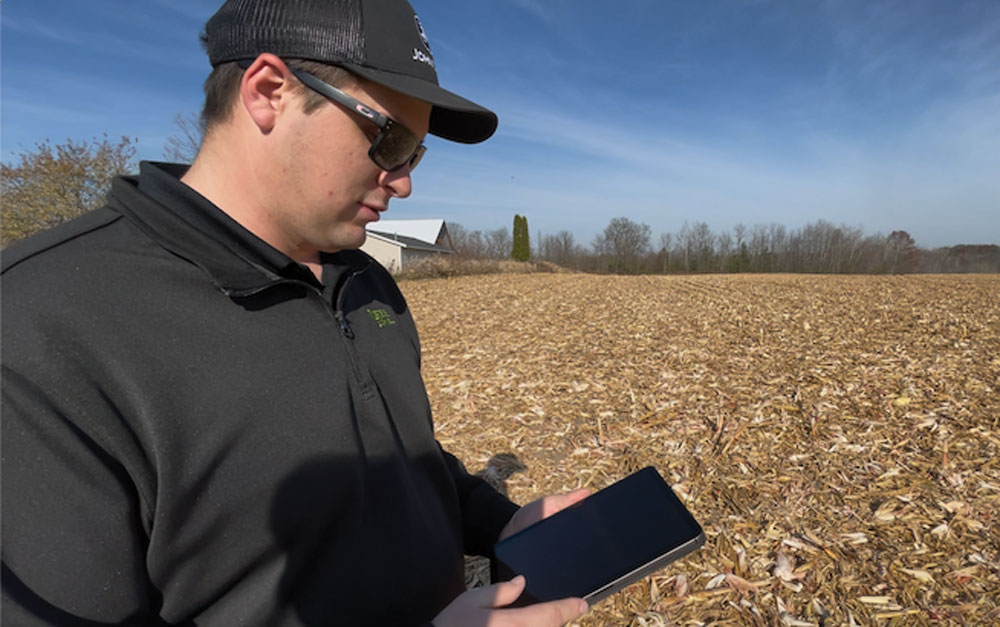
Schneider uses a remote service tool on his tablet to follow along with the customer and Balthazor in the combine. He’s able to see what they see on the in-cab display in real time. Noah Newman
“Don’t be afraid to start in the shop, that’s my advice to others,” he adds. “I got comfortable with the inner workings of equipment in the shop. That helped me build credibility and now I can talk to customers about other aspects of their equipment, not just precision technology.”
Schneider gets to spend most of his days in the field with the precision team now, which is exactly where he wants to be. He likes how every day brings something different, especially during busy season.
“I enjoy the variety of what I’m doing,” he says as we watch the combine running through the field. “I enjoy the sales portion of the job and getting to see precision technology in action. I’m not just showing up when things go wrong. I still put out fires, but it’s not every day.”
You would never guess Schneider is an intern, as he’s able to answer all my questions confidently about autonomy, AutoPath, customer buying trends and more. He should keep his sunglasses on because his future in this business appears to be very bright.
11:09 a.m.
Balthazor returns after spending about 25 minutes in the cab with the customer. His main goal was to make sure the technology on the combine was performing up to expectations.
“It’s always important to follow up with customers,” Balthazor says. “He was really appreciative that I stopped out. It means a lot to him. He’s a technology-driven farmer who’s always looking for the next piece to add.”
Balthazor says AutoPath, which creates precise guidance plans for the entire growing season, has been one of his hottest sellers in 2025. Once customers use it, they often question why they didn’t start using it earlier, he says.
“I wouldn’t trade that first year in the shop for anything. There are things I wouldn’t have learned if I didn’t experience that…”
“What about autonomy and See & Spray?” I ask.
“I see both of those really taking off,” Balthazor says. “Crop prices aren’t great, so every penny counts and those technologies can make a big difference. If you can justify what you’re selling and show the results, a lot of customers will buy into it. In northeast Wisconsin, I don’t see autonomy replacing people due to our field size and conditions but it’s ultimately going to make the farmer more efficient and productive.”
“Do you guys do anything with drones?” I ask
“No, not really,” Balthazor says. “We stay away from that as of right now.”
“Think Deere will get into the drone game?”
“I could see it,” he says. “If there’s a market for anything, they want to be in it.”
11:36 a.m.
Although busy season is ending, there’s still plenty to do before planting season rolls around. Balthazor says his team will focus on clinics, winter meetings, customer coverage improvements and sales.
“We shift into sales mode from now until March,” Balthazor says while driving us back to the dealership. “It’s not that long of an offseason. We have some potato guys that will want to be rolling before the end of March. They plant when there’s still snow on the ground sometimes.”
12:03 p.m.
We’re back at Riesterer & Schnell’s Chilton location. Balthazor and Schneider are putting together a list of customers to visit later this afternoon. They’re going to go over some new technology options with them to see if there’s something they can add for next year.
Before we say our goodbyes, Balthazor thanks me for sharing his story and spreading awareness about what the job of a precision specialist entails.
“In the past, when I’ve told people I work at Riesterer & Schnell they say, ‘Oh, you wrench on equipment!’ No, that’s not what I do, I tell them,” Balthazor says with a laugh. “I always joke that if I can’t fix it with a computer then it’s above me. There’s this mentality that you have to be full of grease every day to work in agriculture, and the only thing you can do is fix equipment. That is absolutely not the case.”

![[Technology Corner] Aligning ‘Smart Implements’ with Autonomous Tractors](https://www.precisionfarmingdealer.com/ext/resources/2026/10/01/Aligning-Smart-Implements-with-Autonomous-Tractors.webp?height=290&t=1790966217&width=400)

