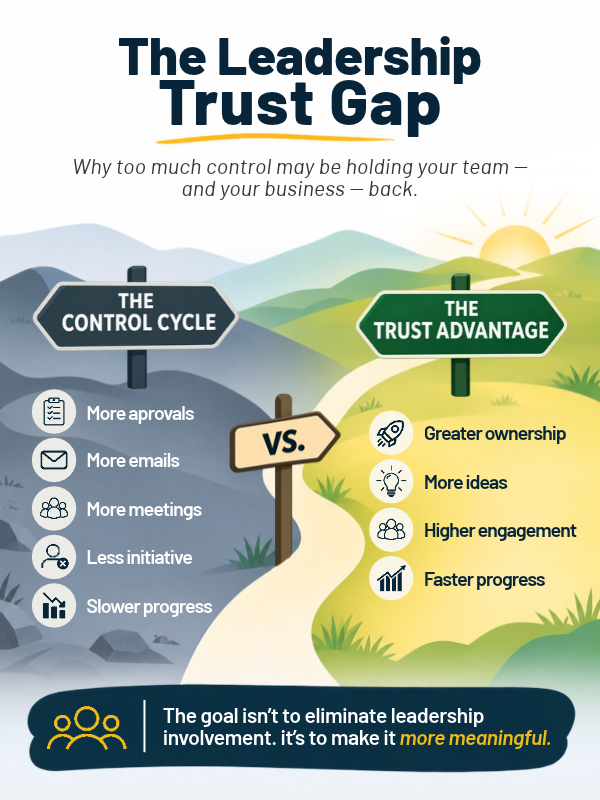

Every leader wants employees who take initiative, solve problems, make smart decisions and take ownership of their work. Yet many leaders unknowingly create an environment that discourages those very behaviors.
The problem isn't always poor leadership or bad intentions. Often, it's a lack of trust.
Trust is one of the most misunderstood elements of leadership. While employees must earn trust through performance and accountability, leaders must also be willing to extend it.
Without that balance, even good leaders can hinder the progress they're trying to create.
When Good Intentions Become Bottlenecks
It often starts small. A manager reviews a proposal before it reaches a client. A business owner wants to be copied on emails. A department head requires approval on routine decisions.
Individually, these actions seem reasonable. But over time, more projects require approval, more meetings are scheduled and more decisions land on the leader's desk.
The explanation is usually simple: "I just want to make sure it's done correctly."
Unfortunately, employees may hear something different: "You don't trust me to do my job."
As a result, employees hesitate to make decisions, share ideas or take initiative. Ironically, leaders may see this as proof they aren't ready for more responsibility.
The cycle continues. Leaders become overwhelmed, employees become disengaged and productivity slows. What began as an effort to maintain quality becomes a barrier to growth.
Trust Doesn't Mean Lowering Standards
Successful leaders know trust doesn't eliminate accountability. It means setting clear expectations, providing resources and giving capable people the freedom to deliver results.
Consider a marketing manager overseeing a campaign. They can control every detail or set clear goals, budgets and expectations, then empower their team to execute.
Both provide oversight, but only one fosters ownership, creativity and growth.
The goal isn't to eliminate leadership involvement. It's to make it more meaningful.
When leaders spend less time controlling routine decisions, they have more time to focus on strategy, innovation and developing their people.
5 Leadership Takeaways
- Trust is a force multiplier. Organizations move faster when capable employees have the authority to make decisions without unnecessary approvals.
- Micromanagement creates dependency. Employees who are constantly second-guessed eventually stop taking initiative.
- More communication isn't always better communication. Excessive emails, meetings and follow-ups can create confusion rather than clarity.
- Ownership doesn't mean thinking like an owner. Employees need clear expectations, accountability and opportunities to succeed, not the same responsibilities as business owners.
- Being indispensable isn't always a strength. If your team struggles without you, the issue may be how responsibility and trust are distributed.
Many leaders believe their greatest responsibility is making decisions. But perhaps it's creating an environment where others can make decisions confidently and effectively.
No organization can grow sustainably when every decision must flow through one person.
Leadership isn't measured by how many things require your involvement. It's measured by how many things continue moving forward when you're not involved at all.
How Lessiter Media Can Help
Through our publications, events, research and executive communities, Lessiter Media connects business leaders with practical ideas and proven strategies to strengthen leadership, empower employees and create sustainable growth.
Because the strongest organizations aren't built on control. They're built on trust.