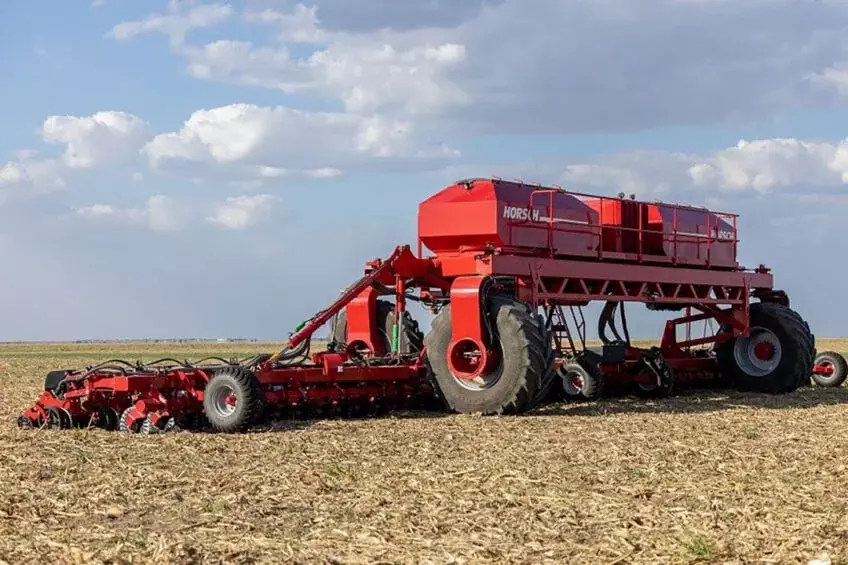
The German company Horsch chose Brazil, more specifically the Bahia Farm Show, in Luís Eduardo Magalhães, Bahia, to present to the world its autonomous planter concept, the Gantry RO G 500, as reported by Future Farming.
The project that began 20 years ago is coming to fruition because of the evolution of computer science, sensors and several other cutting-edge technologies in agribusiness and vehicle autonomy.
The presentation was after the machine spent the entire second half of 2022 working on soybean areas in the Mantopiba region(Maranhão, Tocantins, Piauí, and Bahia), in Northeastern Brazil, to validate its entire technology set.
“The Horsch RO G 500 is a self-propelled seeder with the ability to autonomously traverse lines previously planned on the computer. The machine presented to the public now allows Horsch to take significant steps towards full automation and autonomy in the field”, says the CEO of the company in Brazil, Rodrigo Duck.
What's the Autonomous Planter Horsch RO G 500?
The Horsch RO G 500 has a centralized motor unit, positioned just above the planting rows. The traction is located in the front and rear, with the wheel spacing of 11 and 4 meters, respectively.
This configuration of large wheelsets only passes once in the foreseen line to avoid compaction, in humid soils mainly. It also has central seed tanks with a total capacity of 12,000 liters.
They were developed for sowing soybeans, where large volumes of seed compartments are useful to increase the operation efficiency by reducing stop times for refueling”, says Michael Horsch, founder of the company and responsible for the development of the machine.
Planting lines from the Horsch Maestro series are mounted, totaling a working width of 24 meters under the motorization unit. The double V-discs with the depth limiting wheel ensure precise seed placement and constant maintenance of the sowing depth.
The height of the chassis then, allows the planting bar to copy irregularities of the soil and terraces.
The concept of the Horsch RO G 500 seeder is designed to allow working widths of up to 36 meters. In addition, there is the possibility of exchanging the summer planting bars for winter crops.
Why starting point in Brazil?
Horsch said Brazil is a highly interesting starting point for Gantry. According to him, the areas are becoming bigger and bigger in the country and it makes perfect sense to have self-propelled seeder when there are two harvests per year.
The development project for the Horsch Gantry RO G 500 is being continued as a high priority at Horsch. The focus is also on detection and environmental safety, in addition to GPS technology and improved traffic planning for more efficiency.
For that specifically, several technologies are being tested and evaluated. “I’m especially concerned about optimal integration with a robot into the operational workflow,” says Mr. Horsch.
New and modern operation
In Horsch's view, the opportunity to use a piece of autonomous machinery for example resides in the fact that farming employees can carry out multiple tasks.
“In the practical use of the Horsch Gantry, the emphasis is mainly on autonomy and logistics,” he points out.
Michael also said that in many agricultural regions, finding young farm workers is becoming increasingly challenging.
“Autonomy brings the advantage of being able to operate highly advanced systems through digital tools such as smartphones and tablets, taking advantage of agronomic expertise and, thus, creating a new and modern operating model”, he concludes.