
As AI-driven precision application gains adoption and moves toward becoming the new standard in modern farming, it enables plant-by-plant spraying instead of field-level treatment — reducing unnecessary spray volume, improving targeting accuracy, minimizing drift and crop stress, and ultimately supporting higher yields.
In the 2025 season, the University of Nebraska–Lincoln (UNL) conducted replicated field trials to evaluate two different approaches to deploying AI-driven precision spraying:
1) Dual-Line System enables broadcast application of residual herbicides, while simultaneously enabling targeted application of non-residual herbicides only on weeds using an AI vision system, thereby maintaining industry-recommended agronomic best practices.
2) Single-Line system maintains the standard sprayer configuration (one tank + one plumbing line). This setup does not allow separate application of residual and non-residual products. In practice, it forces growers to either drop residual herbicides from POST, or eliminate residual herbicides altogether.
Trial Design and Chemical Program
UNL conducted replicated trials in corn and soybean at the South Central Ag Lab near Clay Center, NE. Primary weeds included Palmer amaranth and Green foxtail.
The trial compared three two-pass program structures*:
1. Residual in PRE & POST
2. Residual in PRE only
3. No residual at all
Key Findings
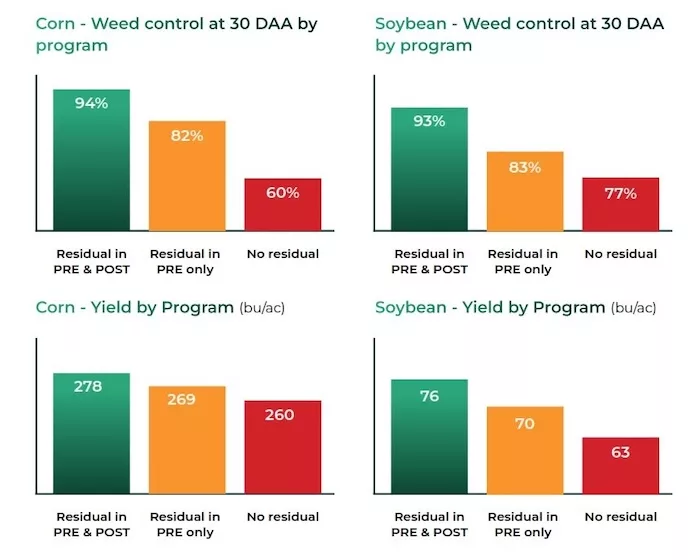
The results 30 days after application (30 DAA) revealed:
Corn
• Residual in PRE & POST: 278 bushels per ac (bu/ac); 94% weed control
• Residual in PRE only: 269 bu/ac (–9 bu/ac); 82% weed control
• No residual: 260 bu/ac (–18 bu/ac); 60% weed control
Soybean
• Residual in PRE & POST: 76 bu/ac; 93% weed control
• Residual in PRE only: 70 bu/ac (–6 bu/ ac); 83% weed control
• No residual: 63 bu/ac (–13 bu/ac); 77% weed control
The Takeaway
AI-driven precision application offers significant value to growers. However, to ensure farmers realize the full benefit in weed control and yield protection, it must be implemented in a way that does not compromise fundamental agronomic principles required for consistent performance.
The UNL results reinforce a clear conclusion: a dual-line precision spraying system is the most agronomically sound approach. It enables growers to capture the savings and efficiency of AI-driven precision spraying while maintaining a best-practice herbicide program, including residuals in both PRE and POST.
In addition, dual-line precision spraying can support yield gains by reducing unnecessary whole-canopy exposure to post-emergence chemistry. When residuals are broadcast and non-residual burndown products are applied only where weeds are present, the crop experiences less exposure to post-emergence herbicides, lowering the risk of crop response under certain conditions.
*The herbicides used in the three two-pass program structures were as follows:
Residual in PRE & POST
- Corn
- PRE: Residuals + burndown [Harness Maxx + Aatrex + Roundup]
- POST: Residuals + burndown [Zidua SC + Roundup + Status]
- Soybean
- PRE: Residuals + burndown [Fierce MTZ + Roundup]
- POST: Residuals + burndown [Warrant + Liberty + Select Max]
Residual in PRE only
- Corn
- PRE: Residuals + burndown [Harness Maxx + Aatrex + Roundup]
- POST: Burndown only [Roundup + Status]
- Soybean
- PRE: Residuals + burndown [Fierce MTZ + Roundup]
- POST: Burndown only [Liberty +Select Max]
No residual
- Corn
- PRE: Burndown only [Roundup]
- POST: Burndown only [Roundup + Status]
- Early POST + Late POST timing variant: [Roundup + Status] then [Liberty + Impact]
- Soybean
- PRE: Burndown only [Roundup]
- POST: Burndown only [Liberty + Select Max]

![[Technology Corner] Aligning ‘Smart Implements’ with Autonomous Tractors](https://www.precisionfarmingdealer.com/ext/resources/2026/10/01/Aligning-Smart-Implements-with-Autonomous-Tractors.webp?height=290&t=1790966217&width=400)

