
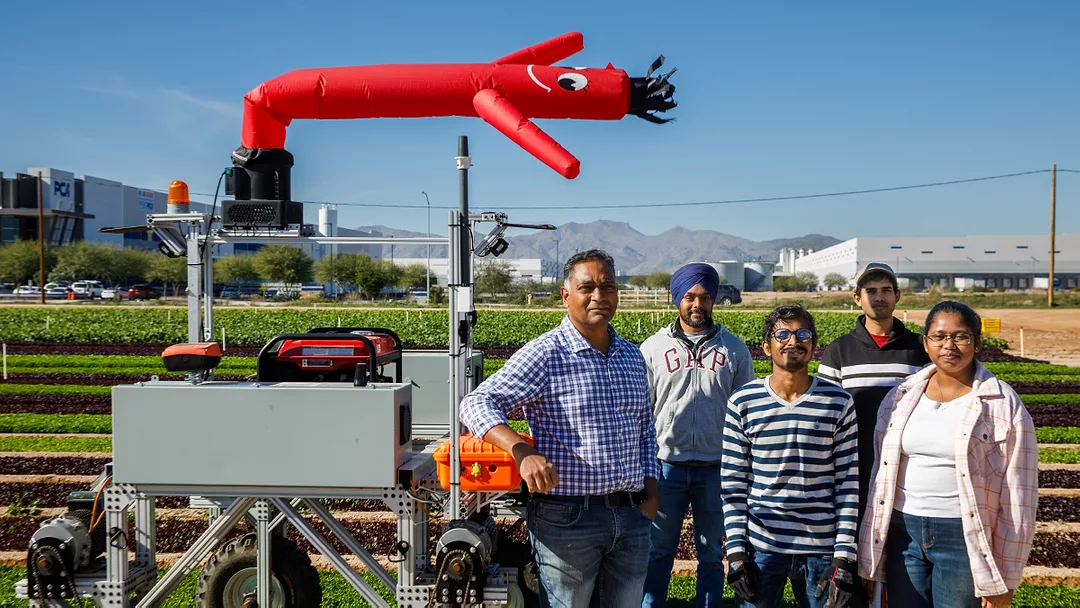
Raghu Nandivada was visiting family in rural south India in 2018 when, after a long day of work, his mother challenged him to invent a robot that removed weeds.
Nandivada comes from a family of farmers who harvest Indian staples like pulses, rice, red chilis and other vegetables. He reminded his mother he was not a robotics engineer — yet.
“Well, can you try?” she asked.
Nearly 10 years later, Nandivada is well on his way to answering his mother's challenge. His company, Padma AgRobotics, has developed several smart farming products for agriculture and is working to revolutionize the industry with robotic tools and artificial intelligence.
Sowing the Seeds of Success
After completing his undergraduate degree in computer engineering in India, Nandivada came to Arizona State University in 2001 to pursue a master’s degree in electrical engineering in the Ira A. Fulton Schools of Engineering. After graduating in 2003, he went to work in the semiconductor industry, returning to ASU in 2008 to earn his MBA from the W. P. Carey School of Business while still working.
“I've been associated with ASU forever,” Nandivada said. “Through this whole journey, ASU has been a big part of it.”
By 2020, Nandivada said he noticed more Waymo driverless cars on the street and figured someone must have already built a weed-removing robot. But he was wrong.
Seeing rising agricultural labor costs and the resulting strain on farmers, Nandivada began exploring the need for products like the weed-pulling machine his mom suggested.
“Farmers are being squeezed and automation is one way to help them be sustainable,” he said.
With little existing AI innovation in agriculture at the time, Nandivada spent a year doing customer discovery — “old school salesman stuff,” as he put it — knocking on doors to learn what problems farmers faced and how best to solve them.
At that time, he was still a principal engineer working in the semiconductor industry, so he would do his research in the evenings and over the weekend. Once he understood the problem, he came back to ASU.
“Everything comes back to ASU,” he said.
Weed-Pulling Robots
Nandivada met his Padma AgRobotics co-founder, Cole Brauer, in 2020. They learned about Venture Devils that same year.
Venture Devils is a program at J. Orin Edson Entrepreneurship + Innovation Institute that provides resources and support to entrepreneurs working on for-profit or nonprofit enterprises. At the time, Venture Devils was actively seeking innovative projects to support and welcomed applications from both ASU students and the wider community.
So Nandivada and Brauer wrote a business plan for their weed-pulling robot concept and applied.
When COVID-19 hit, the Venture Devils competition results were announced online. Nandivada’s team won first place, earning $15,000 instead of the original $10,000 after judges recognized the project’s urgent value to farmers.
“Now it's not a side gig anymore,” he said. “This is serious business. It means there’s more responsibility to make it happen.”
The two-man operation of Nandivada and Brauer worked out of a garage between 2020 and 2023 while they developed the robotic weed-pulling technology. They were in constant communication with customers who gave them feedback and suggestions.
Then Padma AgRobotics was a finalist at the 2023 Venture Madness conference, where Nandivada met Kristin Slice, director of community entrepreneurship at Edson E+I.
The institute serves a wide variety of audiences, collaborating with funders, university partners and community organizations to create a range of accelerators, incubators and programs. Slice said once someone becomes part of their ecosystem, they can access a suite of resources that evolve with their venture.
Later in 2023, Nandivada joined Edson E+I’s Cultivate PHX: Agrifood Tech Incubator, also led by Slice, focusing on food and agriculture startups.
“Innovation takes time and often requires different kinds of support along the way — from faculty expertise and Small Business Innovation Research resources to funding and mentorship,” Slice said. “We’re proud of how our ecosystem has grown to help founders like Padma access these different opportunities.”
Source: Padma AgRobotics
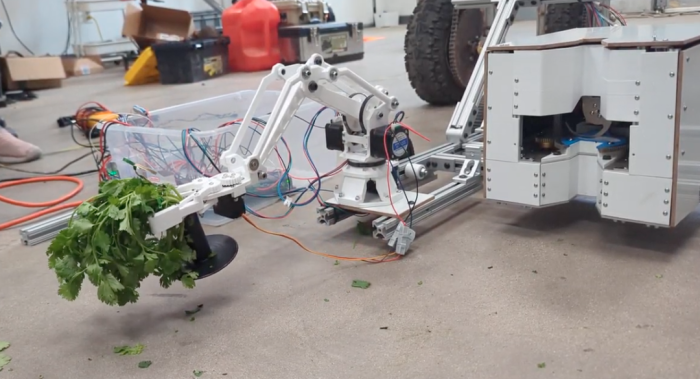
Another suggestion for the team at Padma from customers was the need for more efficient cilantro harvesting, so that became another project in Padma AgRobotics’ pipeline.
The team applied to the Small Business Innovation Research program in 2023 and received funding. They applied for funding from the U.S. Department of Agriculture — and got it. And they were awarded a $175,000 grant from the Arizona Innovation Challenge, going on to earn several more from the organization.
Now Padma AgRobotics is developing a robot that can harvest, bunch and wrap cilantro.
Padma AgRobotics has moved out of their garage to an office in Mesa, Arizona, and they have expanded their clients beyond Nandivada’s mom. The company now works with Blue Sky Organic Farms, Duncan Family Farms and Desert Premium.
Other customers requested that Padma Agrobotics build an autonomous system to spray crops.
The team is working with Duncan Family Farms, one of the largest organic farms in the country, based in Surprise, Arizona, to build an autonomous spraying machine with funding from Cultivate PHX.
Scarecrows Get a Glow-Up
The Padma AgRobotics team is also developing an AI scarecrow with Blue Sky Organic Farms, conducting field tests to optimize the robotics.
This idea took root after one of Nandivada’s site visits to the farm. He noticed a man walking up and down the crops, working as a makeshift scarecrow. The farm’s owner, David Vose, challenged the Padma AgRobotics team to build an AI scarecrow — and the challenge was accepted.
“They work hard,” Vose said. “They've been out here maybe 30 to 40 different times. They've made significant improvements to it.”
Vose said he needed something that could replicate a moving scarecrow for eight to 10 hours a day.
“It’s expensive to have someone walking around all day scaring birds,” he said.
Other farmers echoed the need for better bird deterrence.
“We were surprised by how many customers said they wanted a scarecrow,” Nandivada said.
His innovation, which uses an inflatable tube man, can replace a human walking up and down a row of crops scaring birds. Vose said the key is unpredictability, because birds grow immune to any threat once they become used to it.
“Scarecrows won’t work because you have to pursue the birds where they are. Replacing them with a moving robot that's doing the same job and can do it endlessly — 12 hours a day — makes a lot of sense,” he said.
Nandivada’s team developed the AI scarecrow earlier this year. He said it took them about six months because they wanted to make sure it was safe.
The team then tested the AI scarecrow in the fall when planting began at Blue Sky Organic Farms.
A Changing Workforce
Agricultural automation is becoming increasingly attractive as the sector faces significant labor shortages in the U.S. and farmers struggle to retain workers.
“Labor is so expensive, and it just keeps going up. They don’t want to be there. This is a physically demanding job,” said Vose, who often works the fields on an open tractor in triple-digit heat. “It's just hard to find anybody that's going to embrace growing food.”
Padma AgRobotics is continuing to explore and develop technologies that can help farmers with these physically demanding tasks. Nandivada said the holy grail for his company is to build a lettuce harvester. The robot would identify the lettuce, harvest it and put it in a box.
To advance its technologies, Padma AgRobotics hires interns through ASU and Edson E + I. Most have become full-time employees.
In fact, Nandivada said the primary reason for choosing their office location in Mesa was its proximity to ASU and convenient access to the light rail station. For many of their engineering team members who started as ASU interns, the light rail is still their primary mode of transportation.
Intern Ethan Young graduated in spring 2025 from ASU's Fulton Schools of Engineering with a bachelor’s degree in robotics. He said the culture at ASU embraces innovation, and that mindset can make a big difference for startups, encouraging companies to keep up in a rapidly evolving industry by giving them the confidence to try new ideas.
“I like being able to apply my skills and actively contribute to innovative projects at Padma AgRobotics,” Young said. “Agriculture will always be essential, and it’s exciting to see all of the ways technology is helping it innovate and adapt.”
![[Technology Corner] Aligning ‘Smart Implements’ with Autonomous Tractors](https://www.precisionfarmingdealer.com/ext/resources/2026/10/01/Aligning-Smart-Implements-with-Autonomous-Tractors.webp?height=290&t=1790966217&width=400)

