
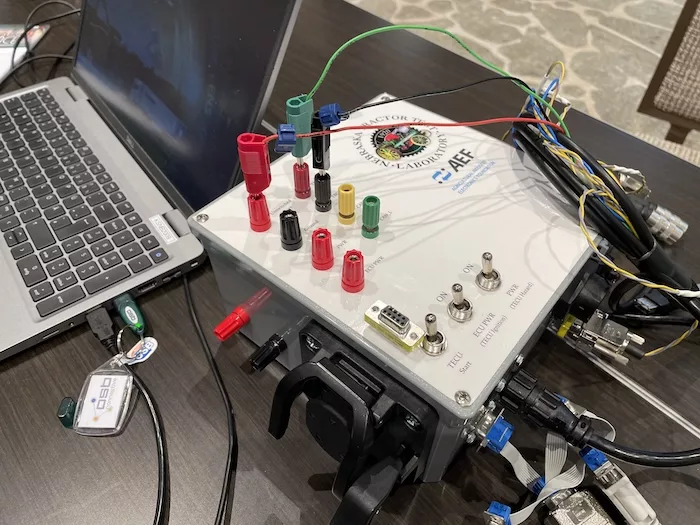
Technical teams from over 20 competing manufacturers gathered at the Westin in downtown Milwaukee to test, validate and prove interoperability across machines and platforms during the Agricultural Industry Electronics Foundation (AEF) Spring Plugfest this week.
“It’s like speed dating for tractors and implements,” says Ryan Milligan of AEF and Powell Electronics. “The tractor is the server in the relationship; the implement is the client. Servers stay stationary at a table, and the implement manufacturers move from table to table every 45 minutes to make sure they’re getting the results they want on their displays.”
Over the course of the 3-day event, precision ag software engineers temporarily put aside competition to test the cross-brand interoperability of their ISOBUS products.
“Side-by-side testing allows companies to identify inconsistencies and resolve compatibility issues,” says Norbert Schlingmann, AEF general manager. “There are also opportunities to engage with emerging technologies like High Speed ISOBUS, digital camera communication, and other advanced in-machine capabilities.”
Thirteen different tractor platforms and 15 different implements or auxiliary devices were put to the test with over 150 unique combinations. Some new products were also tested for ISOBUS certification.
“This is my first Plugfest and I wasn’t quite sure what to expect,” says Britney Salmon, product technology specialist at CNH Industrial. “It’s nice that we can perform testing here and not have to have the actual implement on site to check compatibility. We want to ensure our displays and implements are compatible and can work with third-party OEMs. This benefits both us and the end users, but from an end user’s perspective — we can find bugs and defects before they do.”
AEF PLUGFEST: Ryan Milligan from AEF and Powell Electronics shares some perspective on how the interoperability testing at Spring Plugfest ultimately impacts farmers and dealers. pic.twitter.com/DLAkPpr2d6
— Precision Farming Dealer (@PFDeditors) March 18, 2026
In addition to ISOBUS compatibility testing, Spring Plugfest also featured a High Speed ISOBUS (HSI) discovery station, where electronic control units and switches from multiple manufacturers were connected as software engineers tested whether their components are discoverable on the new HSI architecture.
HSI, as described by AEF, is roughly 4,000 times faster than the current ISOBUS technology. It uses Single-Pair Ethernet to achieve 1 gigabit/second speeds, enabling real-time data, high-definition cameras, complex sensors and autonomous implement control.
David Smart, AEF HSI project lead, was on hand to lead the HSI discovery station and share updates on the new technology. He says the goal is for HSI 1.0 to be ready by 2028.
“If we’re early, we’ll have a great story for Agritechnica 2027,” Smart says.
AEF Spring Plugfest: David Smart is the lead for AEF's High Speed Isobus (HSI) project. We asked him about the ultimate impact HSI can have on equipment/technology. It's roughly 4,000 times faster than the current ISOBUS technology. The goal is to have HSI 1.0 ready by 2028. pic.twitter.com/8aF2KyEElX
— Precision Farming Dealer (@PFDeditors) March 18, 2026
"If we want higher levels of automation. If we want to move towards autonomous systems because we just don't have enough operators to keep things going. This is one of the significant paths that'll help with both of those," he adds.
AEF Plugfests have grown to be biannual events held in the U.S. and Europe, attracting hundreds of attendees and participants, including AEF member companies AGCO, CNH, CLAAS, John Deere, Kubota, KUHN, and SAME DEUTZ-FAHR, among others. Milligan says the event has grown leaps and bounds since its inception in 2001, as mixed fleets become more common in the U.S.
“My first Plugfest was in 2014 and there were about 30 total people there,” he says. "We’ve tripled those attendance numbers, with over 100 people when it takes place at the Commodity Classic. The number of machines and companies participating have also tripled along with that.
“In the early 2000s — around the time AEF was founded — mixed fleets were part of the farming culture in Europe,” Milligan adds. “All the OEMs saw the writing on the wall, mixed fleets would become more common everywhere because of specialized equipment, different crops and regions. We’d like farmers to be able to plug their equipment together and get the right results.”

![[Technology Corner] Aligning ‘Smart Implements’ with Autonomous Tractors](https://www.precisionfarmingdealer.com/ext/resources/2026/10/01/Aligning-Smart-Implements-with-Autonomous-Tractors.webp?height=290&t=1790966217&width=400)

