
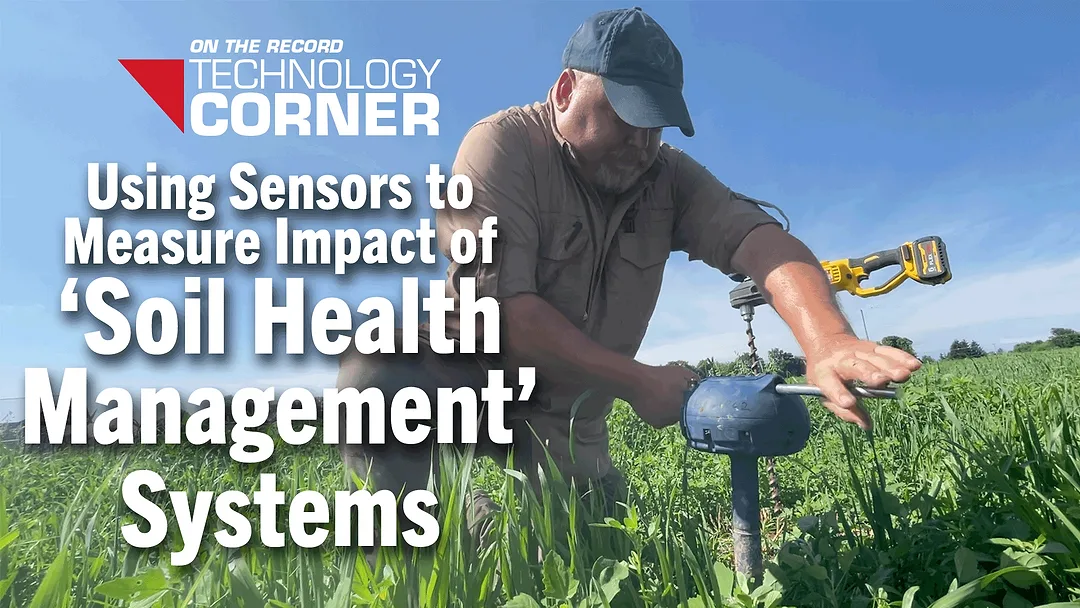
Sand County Foundation, a national nonprofit conservation organization, is leveraging some cutting-edge precision technology to measure the true impacts of soil health management practices.
I had the chance to tag along with Greg Olson, field projects director, as he installed CropX sensors in Jackson, Wis., on a hot July morning. These sensors measure moisture and temperature at depths of 4-, 12- and 22-inches. They’re being installed on 24 fields across the Lake Michigan Basin. And the idea here is to compare data on fields where soil health management principles have been implemented with data from conventionally managed fields, to give farmers a better understanding of how each practice impacts water infiltration, leaching potential, aggregate stability and more.
“As a critical part of our data collection, we’re using these CropX soil moisture and temperature sensors. We put two in at each of the sites for comparison. When we install them at 4 inches and 12 inches, they’re reading both soil moisture and temperature, and then at 22 inches, they measure soil moisture and electroconductivity which helps calibrate the sensor to actually keep it reading correctly. When the antennas are installed, this all gets transmitted so you can look at it in relatively real time. It’s going to be a 3–6-hour delay, but basically you can look at what’s happening in any given day.”
Wisconsin farmers have dealt with spring hail, persistent rainfall and severe drought in recent years. The results from this project will address some of the growing management concerns in areas challenged by extreme precipitation events.


![[Technology Corner] Aligning ‘Smart Implements’ with Autonomous Tractors](https://www.precisionfarmingdealer.com/ext/resources/2026/10/01/Aligning-Smart-Implements-with-Autonomous-Tractors.webp?height=290&t=1790966217&width=400)

