Summer is typically a prime timeframe for precision salespeople to engage customers on future purchasing decisions. But with many regions dealing with delayed planting this spring, precision specialists have perhaps put off having conversations with customers about technology additions or upgrades.
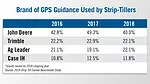
Strip-till farmers have typically been among the most progressive adopters of precision technology, embracing tools including variable-rate seeding, implement guidance and unmanned aerial vehicles. But RTK-level correction is often referred to as the most essential technology in a successful strip-till system, given the importance of accurately planting into a narrow strip of soil.
Based on findings from the 2019 Precision Farming Dealer Survey, this year shows a four-year low for dealers offering precision service packages to farmers. However, there was a shift on how dealers are billing their support.
Talking with precision dealers about their revenue outlook during the last several months, most have shared variations of the same story — cautious optimism with a caveat. A challenging spring in many areas is compounding the prolonged effect of the slumping ag economy, a combination precision dealers cited as a concern.
Equipment compatibility continues to pose challenges for manufacturers, dealers and farmers. But for the last decade-plus, the Agricultural Electronics Foundation has worked to improve functionality between precision systems, while also increasing awareness of ISOBUS-certified components.
One of the reasons behind growing interest in optical sensor technologies, or in sensor technology as a whole, is increasing input costs, which are creating tighter margins for farmers. While there is still plenty of theoretical outcomes, farmers are most interested in practical impacts that sensing technology can provide, according to Dr. Ray Asebedo, agronomic consultant.
The types of ag technology that manufacturers are developing, dealers are selling and farmers are adopting is changing. A combination of factors are contributing to the evolution, including market instability, commercial momentum for increased machine automation and more connectivity with technology.
While there is still a mix of optimism and skepticism surrounding the overall farm economy, one bright spot could be the precision farming segment. Respondents to the recently released 11th annual No-Till Farmer Operational Benchmark Study, forecast increased adoption of 11 different precision technologies in 2019, compared to last year.
One of the key aspects to advancing wireless machine-to-machine communication is the capability to have reliable cellular coverage, especially in rural areas.
With equipment automation and data connectivity areas of trending importance for manufacturers, at last week’s National Farming Machinery Show in Louisville, we invited companies to offer a perspective on how and when blockchain will emerge in ag.
From technician to service manager to now chief technology officer, Layne Richins has pretty much seen it all in his 20-plus year career with Stotz Equipment. And now he’s at the forefront of implementing AI at the 24-store John Deere dealership.
DigiFarm VBN is a proven leader in providing RTK Correction Services across the Midwest and beyond, via cellular based RTK network. We have been in business since 2011 working with farmers, Ag retailers, and precision Ag dealers
We leverage our years of experience and industry knowledge to deliver solutions that keep you moving forward. For more than 30 years, our team of entrepreneurs and technicians have focused on understanding the hurdles you face. Then we brainstorm possibilities. Whether it’s offering a replacement part, repairing parts that aren’t working or creating custom solutions for your challenge. We’re experts in ag equipment electronic parts and systems. But more importantly, we make connections to keep your operation moving forward.
Hexagon is the global leader in digital reality solutions, combining sensor, software and autonomous technologies. We are putting data to work to boost efficiency, productivity, quality and safety across industrial, manufacturing, infrastructure, public sector, and mobility applications.