
Takeaways
- Develop strong, personal relationships with local farmers who are leading the way in precision technology adoption and capable of communicating the benefits to other farmers.
- Everyone at the dealership should be knowledgeable about commonly used precision tools. This will take some of the weight off the shoulders of the precision department and give them the capacity to get a handle on advanced technology before it becomes mainstream.
- Prove ROI, or farmers won’t buy in, no matter how impressive the new product looks on paper.
We’re off to the Sunflower State during the height of planting season for an action-packed Day in the Cab with PrairieLand Partners.
The John Deere dealer has 15 locations across central and southeast Kansas. With so much ground to cover, we’re splitting our visit up into 2 days and 2 locations with 2 different precision specialists.
Bryan Berggren, product innovation specialist, is working with local farmers Ray and Ryan Flickner on a large-scale technology trial in Moundridge, Kan., while Jonathan Born, regional product support specialist, is in Iola, Kan., helping a mixed fleet customer solve his rural connectivity issues.
Thursday
9:39 a.m.
Our 2-day odyssey begins at Ray Flickner’s 1,000-acre corn, soybean and wheat operation, which we’re touring for an upcoming feature in our sister grower publication, Strip-Till Farmer.
Ray is the 2025 recipient of the Strip-Till Innovator Award. The jovial 5th-generation farmer was one of the first in the area to adopt strip-till in the early 2000s, just a few years after breaking the mold with subsurface drip irrigation.
“Being the first (to try strip-till and subsurface drip irrigation) is like putting a bullseye on your back and saying, ‘Well, what can go wrong here?’ But I have several neighbors who say the reason they started strip-tilling is because they saw what I did and they liked the concept,” Flickner says.
9:51 a.m.
Ray’s son Ryan is also joining us today. As we drive over to an 80-acre test plot to meet up with Berggren, the Flickners tell me about the cutting-edge technologies that are helping them use 40% less water than the county average.
Ray installed Netafim Subsurface Drip Irrigation in 2001. The system uses buried drip tape — installed 18 inches below the soil surface — to deliver water directly to the root zone throughout the growing season. They also use it to inject fertilizer when needed.
“It’s an automated system, kind of like what you normally see with a residential sprinkler system,” Ray says. “There’s a control box. Originally, we were pneumatic, but we converted everything to radio frequency, so we can control it from the house. We plug in which zones we want watered and for how long. It was expensive to install, but it pays off through labor savings and improved water use efficiency.”
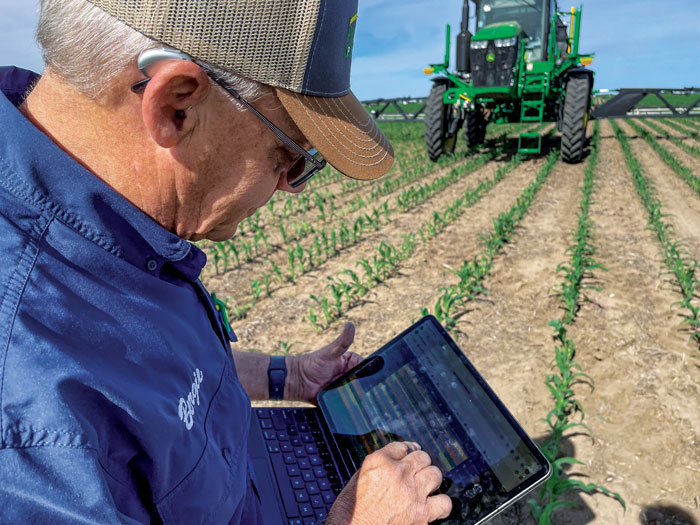
Berggren pulls up data from a John Deere See & Spray trial at the Flickner Innovation Farm. Berggren says the technology is becoming more widespread, with nearly 50 active See & Spray systems in his coverage area. Noah Newman
About 60% of their farm has subsurface drip irrigation. They’re using multiple forms of precision technology on the other 40%, like Netafim Precision Mobile Drip Irrigation, which retrofits to a pivot, combining the efficiency of drip irrigation with the flexibility of center pivot irrigation systems.
The Flickners recently became the first farmers in Kansas to run a 360 RAIN autonomous irrigation system from 360 Yield Center. They also have an Autonomous Pivot on some fields. It’s an AI-driven platform that uses sensors and cameras to provide up to 300 soil moisture readings per rotation without disturbing the soil.
“The advantage of the Autonomous Pivot is it moves around with the pivot,” Ray says. “It gives us a better idea of the exact moisture content in the field, so we know if we need more water or if we’re watering too much.”
10:01 a.m.
We eventually arrive at the Flickner Innovation Farm, launched by the family in 2019 as a testing ground for new farming technology and large-scale conservation practices. Ray reveals there are over a dozen research trials taking place simultaneously on the 80-acre fields as we speak.
The Flickners are partnering — pun intended — with PrairieLand Partners for one of those trials to test John Deere See & Spray, ExactShot and Predictive Ground Speed Automation during the 2025 growing season.
Berggren, or “Bergie” as he’s called by his customers and friends, hops out of a brand-new See & Spray Ultimate to greet us.
Berggren’s job as a production innovation specialist is to learn about new technology, lead training sessions with co-workers and customers, and conduct demos to show the value of new products as they hit the market.
Day in the Cab Video Series
Click here or go to PrecisionFarmingDealer.com/ditc to go behind the scenes with Jonathan Born, regional product support specialist for PrairieLand Partners in Kansas. Born, who’s a farmer himself, explains how his role has changed drastically since he entered the precision farming world over a decade ago.
He also touches on why precision technology is becoming more widespread on smaller acreage farms, gives us the scoop on how JDLink has been a game-changer for the dealership, discusses the importance of training every department on new technology and shares his thoughts on how autonomy and AI will impact customers in the next 5 years.
“Some of this machinery costs half-a-million dollars, so you’ve got to prove the ROI, or nobody will be interested in it,” Berggren says.
“Kansas State helps us conduct the research, so all the data is coming from a third party,” he adds. “Farming is an ongoing learning curve and that’s why we appreciate the ability to work with people like Ray and Ryan. It’s hard to find partnerships like this. It just doesn’t happen often.”
“There’s only so many of us, and a lot of farmers don’t want to share their information,” Ryan says. “We make our yield maps and data public. That was a decision we made to help the neighborhood, the community and agriculture as a whole. Mom and Dad were educators, so it was always near and dear to their heart to have that philosophy of sharing what we learn with an external audience.”
10:12 a.m.
Berggren opens his tablet to show me some prescription maps for the trials while Ray breaks out his shovel to dig up early emerging corn roots.
“One of the things we’re noticing with ExactShot is there’s more of this hairy stuff (on the roots) when the fertilizer is applied in a concentrated shot,” Berggren points out as he helps Ray dig up one of the corn plants. “You’d be hard-pressed to see any difference across the field here, and that’s what we’re trying to prove. We did a trial on an irrigated field up north last year, and the yield was one bushel less. But if you factor in the fertilizer savings, there was about a $14 per acre advantage with ExactShot.”
ExactShot’s early returns are promising and See & Spray is starting to take off in the area, Berggren says. Some of his customers have seen up to 68% chemical savings with the technology.
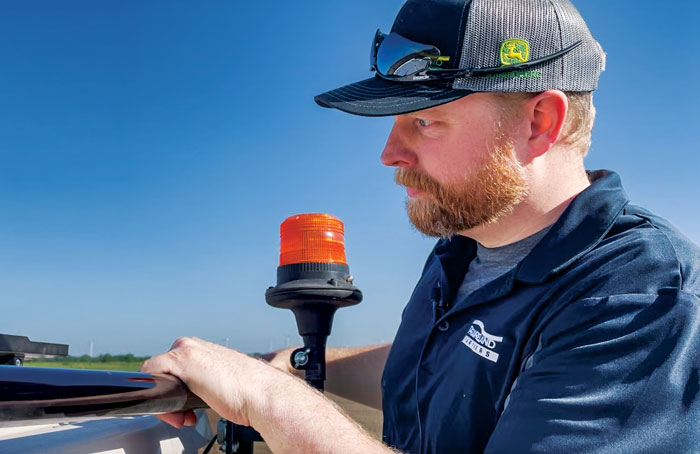
Jonathan Born, regional product support specialist for PrairieLand Partners, inspects a JDLink Boost that was recently installed on a Fendt tractor. Noah Newman
“Two years ago, PrairieLand had 4 See & Spray machines,” Berggren says. “Last year, we had about 20, and this year we have 50 machines in our AOR, which is central Kansas to the east. See & Spray is gaining quite a bit of traction.”
Berggren says a change in John Deere’s pricing structure for See & Spray could help move the needle even further. Previously, farmers paid a per-acre fee for the entire area covered by the sprayer, regardless of whether it was actively spraying. Now, the fee is only applied to acres where the technology is actively engaged.
“That brings it way down to an acceptable price point,” Berggren says. “People want this technology. They want to save money on chemicals and be responsible with the land.
“There are several other companies developing this type of technology, and it’s gaining momentum in the industry,” Berggren adds. “Personally, I was very skeptical at first because I ran a sprayer for almost 30 years working for some commercial applicators. But it never ceases to amaze me what this technology can do. It sees more than we can with our own eyes, even when it’s moving 12-15 mph through the field, recognizing a crop vs. a weed, it’s unbelievable.”
12:04 p.m.
After finishing up our Strip-Till Farmer tour with the Flickners, they take me out to lunch at a local spot called The Hub Brick Oven & Brewery. Berggren joins the party.
As we’re enjoying some elite brick oven pizza, and discussing the recent success of Kansas State football, Berggren shares high praise for his co-worker Jonathan Born and says I’ll have a good time shadowing him for part two of Day in the Cab.
Friday
9:01 a.m.
After a scenic 2-hour drive through the heart of Kansas from my hotel in Wichita, I arrive a few minutes early at our rendezvous point in Iola, Kan. I call Born to make sure I’m in the right place. The connection is bad, and I hang up after 6 or 7 “Can you hear me now’s?”
Rural connectivity is clearly an issue in this area. A text from Born eventually comes through, saying he’s about 5 minutes away.
“Some of this machinery costs half-a-million dollars, so you’ve got to prove the ROI or nobody will be interested in it…”
While waiting for Born’s arrival, I read up on JDLink Boost. It’s a Deere connectivity solution that uses Starlink’s satellite network to provide reliable data connection for equipment in areas with limited or no cellular coverage.
9:09 a.m.
Born arrives! I hop in his PrairieLand Partners truck for our morning mission, which is to complete the activation of a recently installed JDLink Boost on a Fendt tractor.
“This customer was green up until a year or two ago,” Born says. “Then he started adding Fendt equipment to his fleet. He was with another dealership, then we recently acquired him. We’re trying to win him back into the Deere realm because he still has a lot of Deere equipment.”
The Fendt tractor is nowhere in sight. An employee of the customer informs us it’s parked down the road about a mile away on a soon-to-be-planted soybean field. Off we go.
9:13 a.m.
Born fills me in on his PrairieLand origin story during the truck ride over. He joined the company as a high schooler, back when it was known as Deer Trail Implement in the early 2000s. He started working for Concordia Tractor in 2009 after graduating from Kansas State. Not too long after that, he joined the team at O’Malley Equipment, where he worked in parts and sales before joining the precision department in 2015. PrairieLand eventually merged with Concordia Tractor and acquired O’Malley Equipment.
“So, every dealership I’ve ever worked for is now underneath the same umbrella,” says Born, who seems to have experienced every side of the business before the age of 40.
9:21 a.m.
We pull up to the Fendt tractor on a field that’s adjacent to a wind farm. One of the wind turbines is being worked on by a couple maintenance guys.
There’s a Kinze planter attached to the tractor. So, we’ve got a Fendt tractor with a Kinze planter and a JDLink modem. A mixed fleet, indeed.
Born climbs atop the tractor and shows me the JDLink Boost setup.
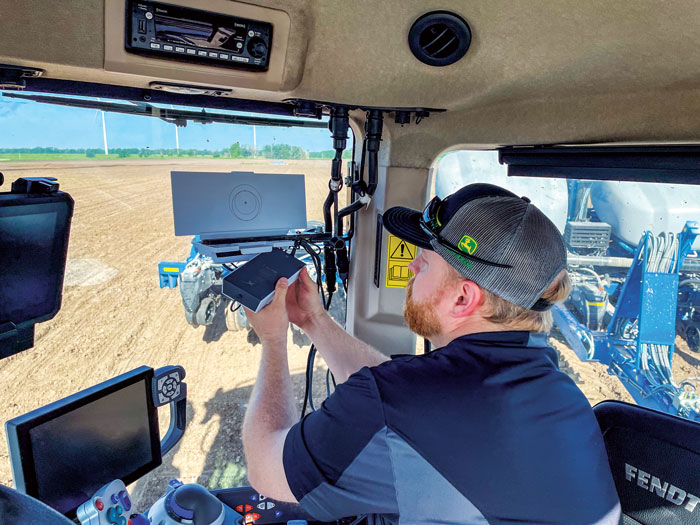
Born works on the JDLink Boost activation process from inside the cab of his customer’s Fendt tractor. Noah Newman
“It looks like they did a pretty good job installing it,” he says. “This is the Starlink antenna on top, and there’s the JDLink modem inside the cab. I’m thinking they’re using it to transfer their prescriptions back and forth.”
He takes a photo of the serial number on the modem, as he begins the process of trying to activate the JDLink Boost. Born admits he’s still relatively new to the process because the product hasn’t even been on the market for a full year yet. The fact that he’s dealing with a mixed fleet adds another layer of complexity.
“Software and machine compatibility can be hard to keep up with sometimes,” Born says. “Green on green is easier to support because when there’s a problem with a monitor, there’s nobody else to blame. Is Kinze blaming Fendt for an issue or vice versa? So, there can be some finger pointing in that situation. When it’s green on green, it’s a one-stop shop for everything.”
9:30 a.m.
As Born continues to work on the JDLink Boost, I pepper him with questions about the business.
“Are you on the road all the time?”
“Yes, but I don’t really have a set schedule,” says Born, who racks up roughly 1,000 miles a week during busy season. “I bounce between 5 different stores. I answer calls from the support line. I also perform what we call ‘optimizations.’ When a customer buys a new piece of equipment, I’ll go out there and make sure they’re using it to the best of their ability.”
“What’s changed the most with your job since you started working in precision?”
“Technology is now embedded more frequently in equipment whereas before it was something farmers added on,” Born says. “Now, everybody at the dealership is expected to have a good understanding of electronics and precision products. If you still have that one precision person who’s expected to have all the answers, they won’t have a good work-life balance because everybody will be calling them all time. They’ll get burned out.
“Deere talks about how we’re going to see more leaps in technology in the next 5 years than we’ve had in the last 50 years, and I think that’s a pretty accurate statement,” he adds. “There are things coming down the pipeline that are going to make these new technologies more accessible to everyone. We must teach the basics to sales, service and parts people so that we’ll have the capacity to handle the next big thing when it comes along.”
10:01 a.m.
The JDLink Boost activation process hits a snag. It sounds like there’s an issue pairing the system with the Starlink network. Born connects with one of his co-workers in the centralized call center for some assistance.
“Can you see if this JDLink has been registered?” Born asks his co-worker.
“The machine shows it was paired, but now it’s not,” his co-worker responds. “Oh, OK. It auto-paired to the AGCO serial number. There should be a network called Starlink that you can connect it to, and that’s what completes the activation process.”
“Everybody at the dealership is expected to have a good understanding of electronics and precision…”
After a few troubleshooting attempts, Born and his co-worker eventually file a case in Deere’s online Dealer Technical Assistance Center.
“We have an internal team that monitors all these cases,” Born says. “We filed this one under ‘JDLink Boost.’ By doing this, everything is documented. The team at Deere can go back and look at all the cases from the past and hopefully make bulletins or corrections to their equipment.”
10:12 a.m.
The morning turns into a true day in the cab. As Born waits for someone from Deere to call back, he fills me in on his agenda for the rest of the day.
Born’s next stop will take him to the town of Thayer, where a customer is having a problem with downforce technology on his air drill.
“I’m going to meet a technician over there and help him identify and solve the problem,” Born says. “Hopefully he’s going to learn more about the system, so the next time around when something like this happens, he’ll know how to fix it.
“Then for my third stop, the customer has one of those retrofit universal steering wheels, and it’s not communicating with the display,” he says. “One of our technicians went out there and fixed it, but it stopped working again after he left. So, that’s a mystery.”
“You’ll put your problem-solving skills to the test with that one,” I say.
“Oh yeah, those are always the fun ones.”
Born’s most important stop of the day will be his fourth one — his daughter’s softball game.
11:01 a.m.
The guy who was hired to plant the field shows up. Born gets out of the cab to meet him.
“I’ll get out of your way so you can get to work,” Born tells him. “We were trying to get the JDLink Boost working, but it’s still not letting us connect. I can’t connect it to my phone, which means you won’t be able to connect it to your Kinze monitor.”
The two exchange numbers. Born says he’ll get in touch with him as soon as he gets an answer from the Deere dealer support team.
11:15 a.m.
Born’s day is just getting started, but it’s time to go our separate ways because I have an afternoon flight back to Precision Farming Dealer headquarters. We shoot a couple quick videos for the Day in the Cab video series before Born hits the road for his next adventure.

![[Technology Corner] Aligning ‘Smart Implements’ with Autonomous Tractors](https://www.precisionfarmingdealer.com/ext/resources/2026/10/01/Aligning-Smart-Implements-with-Autonomous-Tractors.webp?height=290&t=1790966217&width=400)

