
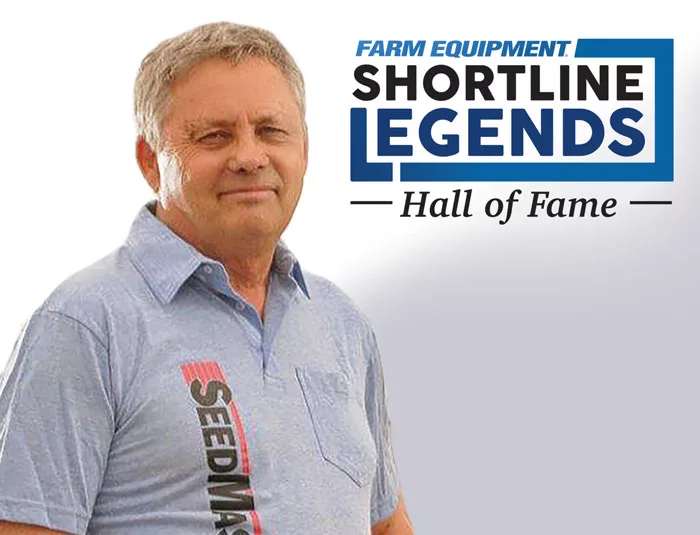
A self-proclaimed “designer at heart,” Norbert Beaujot, founder of Seed Hawk, SeedMaster and DOT, has spent his career creating revolutionary farm equipment in the western prairies of Canada.
“Don’t be afraid of failure. That’s a big part of innovation,” Beaujot said during an interview for Farm Equipment’s How We Did It podcast. “We’ve been at the forefront of no-till in Canada. It’s the way of the future and I think a lot of the bigger companies in the beginning saw it as a gimmick. But now it’s become the conventional way of farming in many parts of the world.”
Norbert Beaujot
Founder of Seed Hawk (1992), SeedMaster (2002) and DOT (2017)
Claim to Fame: Inventor of active hydraulic, ground-following opener that revolutionized the no-till farming industry. Launched DOT Technology Corp. and created the autonomous DOT Power Platform.
Growing up on an 800-acre farm between Kenosee Lake and Whitewood in Saskatchewan, Beaujot developed an unrelenting passion for farming and soil health. There was no question about his next move after earning an ag engineering degree from the Univ. of Saskatchewan.
“I always felt that I’d end up back at the farm,” says Beaujot, who returned full-time after his dad, Leon, retired in 1985. “While taking over the farm, I had a passion for efficiency and perfection. It doesn’t matter what I’m touching, I’m always trying to improve it.
“It all started with openers,” Beaujot recalls. “At harvest one year, I dragged a screwdriver through the soil and thought to myself, ‘This can’t be that complicated. We should be able to build a better way of putting seed in the ground.’”
Canola First
Air seeders were the top option on many wheat farms in western Canada at the time. But by the early 90s, canola was becoming more popular in Saskatchewan, which called for a different kind of seeding tool.
“I realized the current methods of seeding were terrible for that kind of crop,” Beaujot recalls. “In Saskatchewan, we struggle with a short growing season, so the efficiency of a seeding operation is critical to the farmer’s survival. Canola is very sensitive to improper seed depth, and when you’re no-tilling, you have that precious amount of moisture right at the surface that if you deal with it properly, it’ll get the crop going well.”
Beaujot sprang into action, pioneering the world’s first active hydraulic, ground-following, individual row opener, which minimized soil disturbance by seeding directly into the previous year’s stubble. It was the first of many breakthroughs to come over the next several decades.
“I’m a fairly cautious person. I never try to get in a position where we’re in financial danger, but there have been some surprises with the components we buy from suppliers. Several years ago, we had a terrible batch of hydraulic cylinders. It cost us a lot of money, but we did everything we could to switch them all out. Some of those hardships became part of the success story, too, because farmers and dealers realized that we went above and beyond what a larger company might’ve done…”
“We’ve spent the past 30-plus years perfecting the art of no-till seeding, whether it’s metering, putting it in the ground or the placement of fertilizer,” Beaujot says. “We’ve focused completely on seeding, and when you’re that focused, you’re either in the wrong business or you should become the best at it.”
The Early Days
Beaujot launched Seed Hawk with his brother, Patrick, in 1992, after building and testing the first active hydraulic opener prototype.
“I don’t think there was ever a doubt in my mind that I would make the opener commercially available,” Beaujot recalls. “We moved fast. Once I had workable paper drawings, I got a hold of my friend, Brian Kent, to help build it. Within a few months, we built the first one and planted the first 1,200 acres on our farm right out of the box.
“Prior to that, cultivator and disc type units had a very coarse adjustment for depth. We went to a very long arm with the gauge wheel at the back that acts as the packer wheel, and that long arm gave us very precise seed depth on an individual row basis. With the use of hydraulics, we were able to get the same force against the soil with each packer wheel.”
Patrick handled the marketing side of the business while Norbert focused on design and manufacturing. They sold directly to farmers in the early days, which meant a lot of time spent on the road at farm shows.
Click here to continue reading the article on Farm-Equipment.com.

![[Technology Corner] Aligning ‘Smart Implements’ with Autonomous Tractors](https://www.precisionfarmingdealer.com/ext/resources/2026/10/01/Aligning-Smart-Implements-with-Autonomous-Tractors.webp?height=290&t=1790966217&width=400)

