
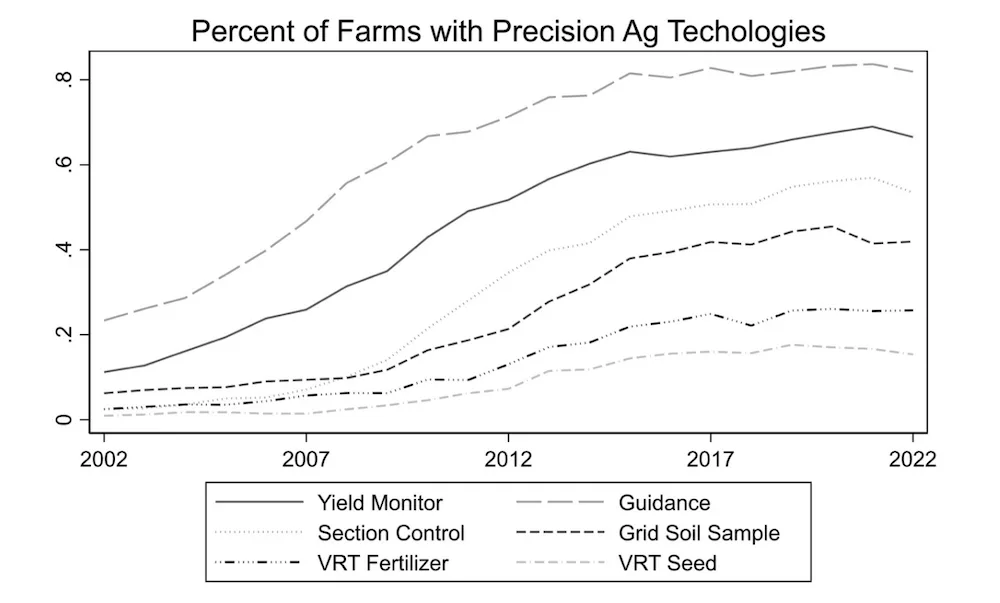
Precision agriculture technology (tools like automated guidance, yield monitors, grid soil sampling, section control, and variable rate application) is widely seen as a path toward more efficient, more profitable farming. Yet farmers themselves often struggle to identify exactly what financial return they get from these investments. In a recent study, we examined whether using these technologies actually made Kansas farms more efficient at generating gross revenue, and for what type of farms the benefits are most likely to show up.
What We Found
On average, precision agriculture technology does not broadly improve farm efficiency. Across the seventeen technology combinations we studied, most were not associated with meaningful gains in the ability to generate revenue relative to costs. The added expense of adopting these tools was not offset by higher revenue.
Two exceptions stand out: automated guidance, and the combination of yield monitors with grid soil sampling. Automated guidance works largely on its own once installed, requiring little learning to unlock its benefits. Yield monitors and grid soil sampling, by contrast, generate information that farmers must learn to act on. These two technologies have been commercially available for many years and farmers have likely learned how to extract value. However, this finding suggests that emerging information-generating technologies may have long-run potential, but to fully realize that potential, farmers will experience a learning process.
Less efficient farms gain the most from precision agriculture technology. Farms in the lower end of the efficiency distribution saw meaningful gains from several technology combinations, while highly efficient farms saw little to none. This finding suggests a catch-up effect, where technology helps close management gaps that better-run operations have already addressed.
What We Measured and How
Using detailed financial records from 570 individual Kansas farms participating in the Kansas Farm Management Association throughout a 21-year time period (2002–2022), we measured farm efficiency as the ability to generate gross revenue while minimizing costs. This definition of efficiency captures both what a farm produces and what it spends to produce it. A farm that adds revenue through technology but also adds costs may see no net gain in efficiency.
To estimate efficiency, we used a method called data envelopment analysis (DEA), which compares each farm to the best-performing farms in the same year. This produces four efficiency scores: overall efficiency (the broadest measure), pure technical efficiency (how well inputs are converted to outputs), scale efficiency (whether the farm is operating at its optimal size), and allocative efficiency (whether the farm is using the right mix of inputs). We then examined whether adopting different bundles of precision agriculture technology was associated with changes in these scores within the same farm over time.
Precision Agriculture use on Kansas Farms
Figure 1 reports the growth of reported use of precision agriculture technology within our data. By 2022, automated guidance was reportedly used by nearly 80% of farms in our data sample. Yield monitors were used by more than 60%, section control by approximately 50%, grid soil sampling by 40%, variable rate fertilizer by more than 20%, and variable rate seed by 15%. These reported usage rates are similar to adoption rates in USDA data and the CropLife-Purdue Precision Agriculture Dealership Survey.
To read the full article, click here.

![[Technology Corner] Aligning ‘Smart Implements’ with Autonomous Tractors](https://www.precisionfarmingdealer.com/ext/resources/2026/10/01/Aligning-Smart-Implements-with-Autonomous-Tractors.webp?height=290&t=1790966217&width=400)

