
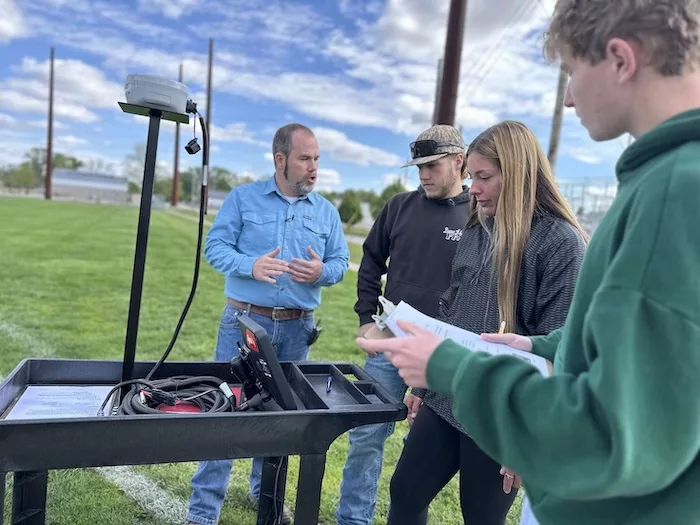
Students from Jim Fitzgerald’s precision agriculture class at Boone High School pushed a utility cart across one of the school’s athletic fields on a recent sunny spring morning, trying their best to roll along a straight but invisible line. Without assistance from the cart’s GPS-powered tools, it was a tough mark to hit.
“We were off by 17 feet after a single pass, so think how much we’d be off over a whole field,” Fitzgerald told the students. The return pass – this time, with GPS – hewed the line, driving home the value of guidance and steering systems widely used by farmers.
This was Fitzgerald’s first year teaching the curriculum designed for the precision ag cart, which can simulate various types of agricultural machinery. Learn-by-doing exposure to the basics of digital agriculture has been an engaging and often surprising introduction to modern farming advancements, Fitzgerald said.
“There have been a lot of eye-opening experiences for students, seeing the technology that goes into agricultural equipment and production,” he said.
Opening eyes was part of what Iowa State University’s Digital Ag Innovation Lab was aiming for in creating the Precision Ag Technology Curriculum for High Schools (PATCH) program, which debuted this school year in 22 high school agriculture classrooms in Iowa and will expand to another round of schools across the state this fall.
“We are showing these students there are so many STEM career options in agriculture. It takes all kinds of people with a variety of skills to develop, deploy and utilize these technologies,” said Kate Groe, a Digital Ag Innovation Lab test engineer who helped establish PATCH.
Plan Comes Together
The Digital Ag Innovation Lab, one of the nation’s top ag-tech research groups, has a staff of more than 65 professionals and graduate students who develop technological solutions to make agriculture more efficient and sustainable, in collaboration with industry partners. The lab’s work has led to more than 100 patents and tech transfer licenses, has contributed to 75 commercially available ag-tech products and annually accounts for about 60% of Iowa State’s industry-sponsored research.
Digital Ag offers numerous learning opportunities for Iowa State students and has for years supported a busy roster of outreach for industry and farmers, such as its popular Planter University workshops. But for advice on how to share its precision ag expertise with high schoolers, lab staff turned to the experts: high school agriculture teachers. The value of hands-on, in-class activities was the key takeaway from initial discussions, said digital agronomy research manager Ryan Huffman, who teamed up with Groe to lead the project.
Because the resources, depth and focus of high school ag programs run the gamut – some are largely classroom-based and don’t touch on machinery, while others use equipment or even farm their own land – PATCH needed to be customizable, with modules that teachers could easily adapt to their existing curriculum, Huffman said. Carts mounted with a GPS receiver and a light bar for guidance, also a feature of introductory precision ag classes at Iowa State, can demonstrate core concepts while providing flexibility for teachers.
“We wanted to cover the same principles taught here on campus but apply them at a level where it doesn’t take so much technical background,” Huffman said.
The carts were equipped with a grant from the CHS Foundation, the nonprofit arm of the largest farmer-owned cooperative in the U.S. Ag Leader, the Ames-based precision ag tech company, helped Digital Ag stretch the funding to outfit each school with about $15,000 in hardware and software. Teachers who have machinery available can mount the equipment on a tractor instead of the cart, if they’d like.
“This is real-world technology farmers are actually using today,” Groe said.
To develop the learning modules connected to the gear, project leaders incorporated input from a survey of ag teachers across Iowa, agricultural education and studies faculty at Iowa State, and the Curriculum for Agricultural Science Education (CASE), a national initiative to provide course plans and training for middle school and high school ag instructors. Iowa State agricultural education undergraduate students ensured the lessons meet state education standards.
CASE is a popular resource used by many ag teachers, but it doesn’t offer any courses specifically about precision or digital agriculture, showing the need for programs such as PATCH, Groe said.
“It’s such a new field that I think they just haven't caught up to it yet,” she said.
In PATCH’s first year, 39 teachers applied for 22 available spots. The selected instructors met for a two-day workshop in Ames last July to learn about the technology and related curriculum, which teachers could use as continuing education or graduate school credits.
Engaged Learning
Micah Weber, agriculture education teacher at Rock Valley High School, was one of the first-year teachers. Rock Valley has a robust ag department, including a 25-acre “land lab.” The PATCH lessons were rolled into Weber’s ag power and technology class, which already featured some drone use. Adding hands-on opportunities with GPS tools significantly improved the precision ag instruction, Weber said.
“Anytime you can get kids to apply what they’ve learned in theory, the level of learning just goes through the roof. When they’re seeing it with their eyes and doing it with their hands, that’s when that higher-order thinking comes in. Those are the ‘aha’ moments,” he said.
Despite having land and equipment to learn on in Rock Valley, carts are helpful because it’s a lower-risk environment than running real machines on production acres, Weber said. Plus, students learning through simulations can see how technology is used in different ways throughout a growing season while still generating data to analyze.
Huffman and Groe said having students create their own data was a common suggestion from teachers. Working with the data gives the experiential activities meaning, said Fitzgerald, whose new precision ag class used PATCH to expand what was before an independent study option.
“I think you appreciate it more when you understand the why and the how behind things,” Fitzgerald said.
Delaney Good, a Boone High senior, said she was surprised by the complexity of the systems they used in Fitzgerald’s precision ag class – and how similar they are to what her father relies on in his farming operation.
“There's so much information and data that goes into it,” she said.
Emersyn Zehner, a Boone High sophomore, said the class changed how she perceived production agriculture.
“Going into this, I really thought farming was kind of just sitting in a tractor turning the steering wheel. I didn't realize there were so many components to making each thing go right,” she said.
Eye to the Future
Weber said he has been looking for ways to introduce students to digital and precision agriculture, in part because he expects it to be a growing career path.
“I think it’s a huge career opportunity for a lot of people in rural areas who maybe aren't going to be in on-farm production but want a career involved with agriculture,” he said.
Fitzgerald said there’s a big demand for skilled workers in tech-related ag jobs in the Boone area.
“We keep hearing from employers that they want students who have precision ag knowledge and tech knowledge, and you can apply that in so many different fields,” he said.
Learning about precision ag caught Zehner’s attention. She had been thinking about pursuing a career as a mechanic, but the technology in agriculture appeals to her.
“It has definitely made me more interested,” she said. “Knowing that everything's reliant on ag, I’d like to be a part of the system that keeps everything moving.”
Digital Ag plans to keep PATCH moving, too. About 25 more Iowa ag teachers will be selected for the second cohort, in part thanks to a grant from the John Deere Foundation. And the Iowa FFA Foundation has some limited funding to cover travel stipends for teachers.
Huffman said the program is designed to be sustainable for years to come.
“When we commit to an initiative like PATCH, we want to ensure it is positioned for long-term success,” he said.
![[Technology Corner] Aligning ‘Smart Implements’ with Autonomous Tractors](https://www.precisionfarmingdealer.com/ext/resources/2026/10/01/Aligning-Smart-Implements-with-Autonomous-Tractors.webp?height=290&t=1790966217&width=400)

