
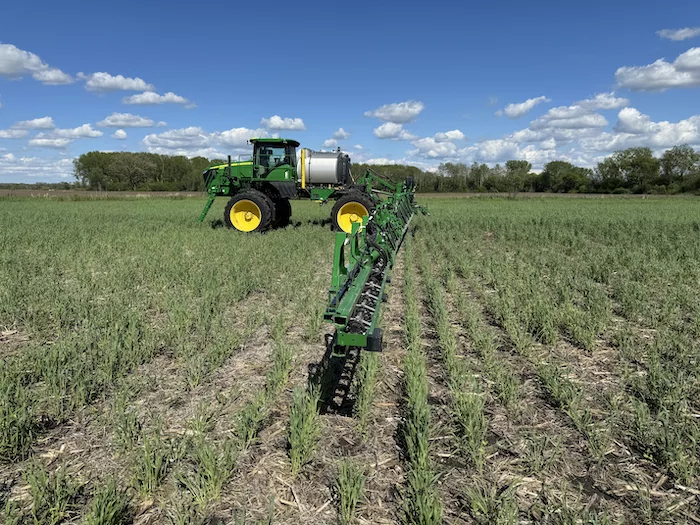
The industrial revolution of artificial intelligence (AI) is turning inroads into 6-lane highways in agriculture as equipment makers create “smarter” machinery primed with increasing amounts of background data and digital circuitry patterned after the human brain.
In a recent interview about the use of AI in production agriculture, John Deere’s President of Lifecycle Solutions, Justin Rose, said AI is essential to his company’s goal of helping farmers be more profitable and sustainable while using fewer resources: less land, chemicals and labor.
“Take corn and soybean production as an example. Twelve trillion plants are grown in the U.S. each year. The best farms produce about 200 bushels per acre of corn, but top growers have achieved over 600. If we could optimize each plant individually, we could dramatically increase yields.
“How do you do that at such an enormous scale? That’s where AI comes in,” he explains.
Rose points to Deere’s See & Spray technology and its use of AI to boost productivity through improved crop protection chemical use.
“Traditional sprayers treat entire fields with herbicides, but our system uses 36 cameras and advanced machine learning to identify and spray only the weeds — while moving at 12-15 mph, covering three football field lengths per minute,” he says. He notes the system uses 70% less chemical than traditional application practices for significant improvements in profitability, sustainability and efficiency.
The neural systems included in the smart sprayer are programmed with scores of thousands of images of weed species in various stages of growth and development. Those images are compared with real-time images produced by the on-board cameras “scouting” for weeds in crop rows. Programmed logic in the system is used thousands of times per second to order “spray” or “no-spray” — almost instantaneously
60,000 Images
A recent research proposal by Egyptian agricultural engineers calls for a center-pivot irrigation/chemigation sprinkler system equipped with both irrigation water plumbing, as well as a crop-protection chemical delivery system. Both systems would be controlled by an interactive on-board computer responding to crop monitoring span-mounted cameras and sensors.
The proposed system calls for the use of nearly 60,000 digital images of healthy and diseased crop plants at various stages of development to be capable of identifying and treating plant diseases automatically as the pivot passes across the circle.
The results: No scouting trips to and across the field for personal “crop house call visits” by consultants, fewer misdiagnosed plant disease issues, and in the case of disease hot-spots within a field, fewer units of fungicides applied.
Discussions of the Egyptian proposal cite correlations of pivot-collected data and proper identification of various plant pathogen infections in separate studies to be well over 90%.
More Onions, Fewer Weeds
Seattle, Wash.’s Carbon Robotics has enjoyed much success with its Laser Weeder, a 20-foot pull-behind first generation machine which uses 42 high-resolution cameras (and an AI system comparing images of weeds and crop plants) controlling 30 carbon dioxide lasers that fire up to every 50 milliseconds to kill up to 300,000 weeds per hour with sub-millimeter accuracy in high value vegetable crops.
Company officials say the first-generation weeder is being supplanted by a second-generation model in working widths up to 60 feet and equipped with more efficient lasers to allow much faster field speeds.
University of Wisconsin professor Jed Colquhoun tested the laser weeder in replicated field trials in direct-seeded dry bulb onions in 2024 against various treatments with conventional pre- and post-emergent herbicide applications against yellow nutsedge, spotted spurge and large crabgrass.
“In our conventional herbicide treatment, we only used five applications,” he explains, but had we planted earlier, more typical of the rest of the commercial farm, we likely would have used 10-12 herbicide applications.”
Colquhoun says no differences were seen in weed management among any of the treatments where the grower conventional herbicide was used without laser weeding, laser weeding alone, or laser weeding combined with reduced herbicide applications.
“When it came to onion development, however, we saw significant cumulative injury (18% by June) in multiple grower conventional applications, compared to no injury where laser weeding was used alone,” he explained.
Also, he reported smaller onion populations in grower conventional management compared with where the laser weeder was used. And, in laser weeder treatments the onions had more leaves than in conventional treatments which led to fewer smaller (less desirable in the market) diameter onions at season’s end.
“This technology promises potential stand and yield increases along with reduced herbicide use, even in high-weed-intensity onions,” Colquhoun explains.
‘40,000 Opportunities’
Deere’s Rose says the examples of AI in agriculture are many, with ranks growing rapidly each year, but before farmers can benefit from these developments, they must first become familiar with the technology, how to operate it, configure settings, plan their season around the equipment and make in-season adjustments.
“AI is helping with this challenge also,” he explains. “Farmers don’t have endless opportunities to get everything right, but with AI helping with on-the-go control and internal machine operation, we can turn a farm career’s 40 harvests into 40,000 opportunities to learn and optimize.
“Whether it’s precision application equipment like See & Spray or digital tools to help ensure tasks get done efficiently and on time, technology is leading the charge for productivity,” he says. “For instance, diagnosing a machine issue can take hours, sifting through thousands of pages of manuals and repair records. AI-powered tools can instantly analyze all that data, offering precise diagnostics, parts lists and repair instructions – making growers’ and dealers’ jobs much easier.”
Rose says the AI race has just begun.
“This is the slowest it’s ever going to go, and we’re all going to have to raise our game and move more quickly all the time,” he explains. That involves those who design and program AI applications, those who depend upon them, and those who sell and service them.
The world has changed.


![[Technology Corner] Aligning ‘Smart Implements’ with Autonomous Tractors](https://www.precisionfarmingdealer.com/ext/resources/2026/10/01/Aligning-Smart-Implements-with-Autonomous-Tractors.webp?height=290&t=1790966217&width=400)

