

Takeaways
- Electro-herb technology can bring immediate effects without the need for chemicals or disturbing the soil
- Laser-weed machines eliminate hand labor in specialty crops and can also eliminate herbicide use
- Light waves can destroy weed seeds during harvest, and AI innovations can spot-spray weeds and provide control in a variety of situations
While chemists have done most of the heavy lifting in agriculture’s battle with weeds since World War II, electrical and mechanical engineers are increasingly supporting the fight with innovations to make herbicides more efficient, and in some cases, bypass chemistry altogether.
Throughout history, mechanical tillage provided the most effective method to separate the crop from the tares.
Fighting weeds was simple, but hoeing and cultivating were wearisome, and quietly contributed mightily to worn-out farms, as disturbed, bare topsoil washed or blew away. The degradation of the soil was accepted as part of doing business.
By the middle of the 20th Century, however, chemistry provided some of the first compounds — namely 2,4-D — to kill broadleaf weeds with a spray. Killing weeds got easier, but as recent history has proven, keeping farm fields free of weeds began to get a lot more complex.
“Nobody likes complex,” says Univ. of Missouri weed specialist Kevin Bradley, “but weed control is going to continue to get more complex as we move forward. We’re faced with implementing more integrated approaches to weed management. It’s not that I dislike herbicides, since they are still going to be a fundamental part of the way we do weed control, but I’ve seen effective herbicides quickly fail due to resistance.”
Bradley says the complexity likely will continue to demand agronomic weed management like conservation tillage methods that do not disturb the soil and the use of cover crops to suppress weeds, as well as technology to selectively target weeds and their seeds in ways unimaginable when 2,4-D first arrived.
“Blue light will become a regular tool for weed control in farming…”
Although on-farm chemistry and rural electrification in the U.S. arrived about the same time, weed-control chemistry jumped from the gate quickly as labs eagerly turned their attention to problem grasses by introducing the so-called “yellow (Dinitro) herbicides” and increased emphasis on pre-emergence control of all weeds.
Even through the development of broad-spectrum non-selective compounds, such as Monsanto’s Roundup and soon-to-follow glyphosate-resistant hybrids — which helped make no-till farming a common practice — the use of electricity to control weeds remained largely in a field of dreams.
Today, however, with chronic problems of herbicide resistance appearing across the spectrum of chemical modes of action, electricity is catching up in the 80-year-old history of modern weed control.
Electroshocking
Equipment makers on both sides of the Atlantic are busy fielding “electroherb” systems using tractor-mounted generators to produce current to pass through weeds on-the-go.
The systems destroy chlorophyll in target species, and in some cases, wreck the cell walls of the weeds’ vascular system. Treated weeds are affected immediately and usually dessicate within hours.
Switzerland’s Zasso Group AG pioneered the electroherb technology and received global recognition for it in 2019 before collaborating with partner Case New Holland in 2021 to develop the XPower system.
The system uses a front-mounted set of electrodes to apply high-current electricity to target species and a ground electrode to complete the circuit. A rear-mounted diesel-powered generator supplies the current.
The XPower system operates from 48-120-inch widths and uses on-board sensors and camera-based guidance to apply electro-shock therapy to in-row and adjacent weeds. The process does not disturb the soil or beneficial insects, and it can be accomplished at three times the speed of field cultivation. Developers say it’s also more practical, safer and cheaper than flaming weeds with burner systems.
In Germany, Crop.Zone’s electro-weeding applicators feature a low-voltage system used in combination with a proprietary conductive-enhancing solution to control pre-plant weeds, potato crop desiccation and post-harvest weed management. The system was introduced first in the Netherlands, Belgium and Luxembourg in 2021.
“Customers see a 1–3-year ROI because of the machine’s ability to reduce hand labor and herbicide costs…”
Crop.Zone’s solution is registered in the European Union as an “organic friendly” conductive-enhancing solution sold under the name of Hybrid Herbicide.
It’s a blend of humic products, sugars, biochar and oil esters designed as a pre-treatment to help electron flow through the plant by coating the stems and penetrating leaf stoma to provide expanded surface area for the electro-weeding process.
The company is developing markets for its system in Australia and presumably someday the U.S. through its Nufarm crop protection and specialty seed company. It also has outlets in South Africa.
Laser Power
Carbon Robotics has become an important player in modern weed control with its LaserWeeder proving itself on more than 50 farms in the U.S. and Canada since 2021.
The machine is a computer-driven laser “weed gunship” that uses artificial intelligence (AI) to recognize and destroy weeds, leaving adjacent high-value crops unharmed, all the while running at field speeds nearly comparable to those of a boom applicator.
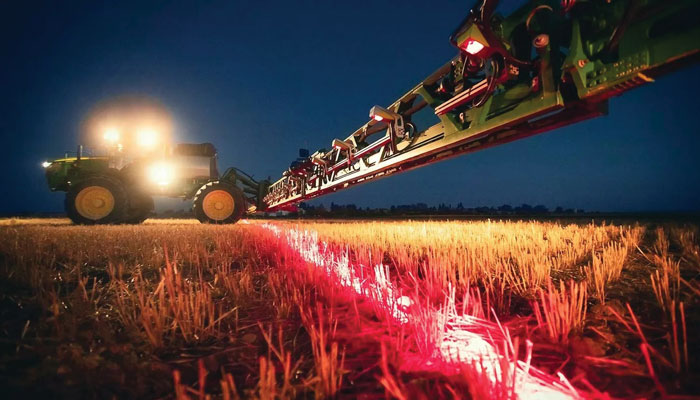
A retrofit application smart sprayer from the Netherlands, the WEED-IT Quadro spot-sprayer is aimed at modifying all types of pull-type or self-propelled sprayers with working widths up to 120 feet. Source: WEED-IT
The LaserWeeder carries a PTO-powered generator to energize rotating laser turrets that lock onto weed species and destroy them with heat energy.
Carbon Robotics CEO Paul Mikesell says the current 20-foot-wide machine works on 60–84-inch row spacing, eliminates hand labor and replaces expensive, regulation-ridden herbicides.
“The LaserWeeder can operate within a millimeter of crop plants, eliminating the potential for collateral damage of rotating blades found with mechanical weeders,” he says.
Mikesell says initial orders for the machine are going to vegetable and other specialty-crop producers in Western Canada and the Pacific Northwest area, but the company is planning to expand soon into Colorado and farms on the U.S. East Coast. He says the technology also could conceivably fit into the fight with Palmer amaranth and marestail in the Corn Belt and Mississippi Delta.
“Our producer customers see a 1–3-year ROI because of the machine’s ability to reduce hand labor and herbicide-related costs,” he says.
Blue Light
Jon Jackson, CEO of Global Neighbor Inc. (GNI), says directed energy (DE) light waves have a bright future in the fight against herbicide-resistant weed species. His company created the Weed Seed Destroyer, a combine add-on that treats weed seeds at harvest, rendering them unable to germinate after they leave the machine.
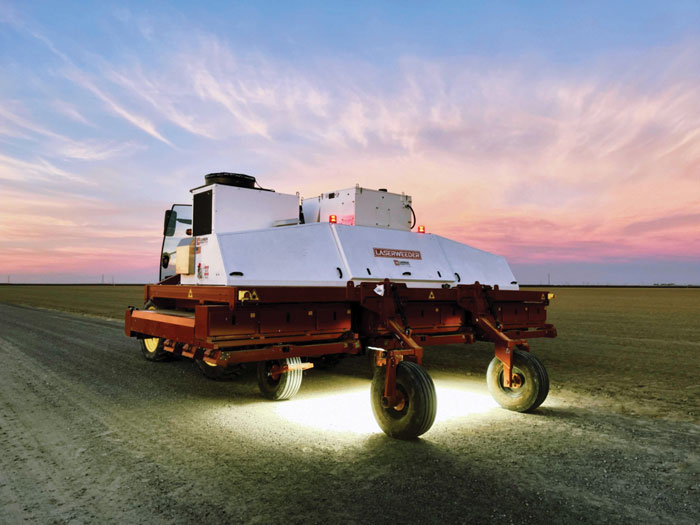
The LaserWeeder by Carbon Robotics uses artificial intelligence to recognize and destroy weeds with lasers, leaving adjacent high-value crops unharmed. Source: Carbon Robotics
The Weed Seed Destroyer uses a mild-warming infra-red treatment and then an intense LED blue light to saturate seeds passing through a combine with chaff during harvest. Test units significantly decreased the average percent total germination for morning glory, fox millet, common ragweed and pigweed. For seeds treated with directed energy for 4 seconds, average total germination was reduced 97-99%.
“Blue light will become a regular tool for weed control in farming,” Jackson predicts.
Strangely, Jackson says in developing the technology behind the Weed Seed Destroyer, researchers found the same blue light used to destroy the viability of seeds, when applied at rates of about half those of the fatal dose, tended to quicken seed germination and boost post-germination plant growth. That discovery has allowed GNI to begin working on plant viability enhancement technology using DE. GNI is also developing products for terminating cover crops and controlling weeds that persist through the terminated cover crop mat.
AI Chemical Systems
Blending modern AI technology with real-time electronic sensing, several equipment builders are building smart sprayers that can detect weeds in the field on-the-go with sensor cameras and spray the selected weeds, leaving the cash crop unaffected.
Majors in the smart sprayer category include John Deere with its See & Spray, WEED-IT Quadro from the Netherlands, Greeneye Technology in Israel and AGCO’s North American/European collaboration with Bosch BASF known as One Smart Spray.
Typically, these systems use a dual-tank design, which allows spot spraying and broadcast spraying, depending upon crops and management systems.
“Mechanical post-emergence weeding is less expensive than herbicides…”
Research indicates significant herbicide savings result, as well as increased weed control efficacy in both green-on-green and green-on-brown applications.
Deere reports its system showed a 7% improvement in weed control over a broadcast single tank-mix application in Illinois trials on soybeans.
The See & Spray Ultimate introduce d in 2022 has been used in corn, soybeans and cotton, and it shows savings of more than two-thirds the spray volume needed for traditional in-season weed control.
Similarly, 2022 results from Israel’s Greeneye Technology showed its proprietary AI system could save growers more than $60 per acre in herbicide costs over traditional post-emergence broadcast applications.
University of Nebraska-Lincoln tests indicated an 87% reduction in post-emergence herbicide use with the same or similar levels of efficacy compared with broadcast spraying.
In burndown trials, the system provided a 94% reduction in chemical use. Greeneye is targeting the aftermarket with a system designed to seamlessly adapt to any brand or size commercial sprayer as a retrofit.
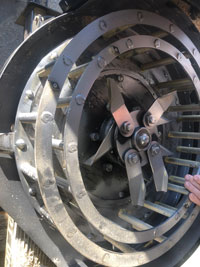
The rotating mill on the back of Nick Weber’s combine makes fine work of small-grain seeds to practically eliminate volunteer growth after harvest. Source: Weber Farms
Residue Chopper Does the Trick for Palouse No-Tiller
Farming on 45-degree inclines on hills that climb 300 feet presents challenges when it comes to uniform residue management behind a combine.
No-tiller Nick Weber and his father, Martin, farm in the Palouse region of eastern Washington near Pullman. They fought with uneven straw and residue windrows behind their 8230 Case IH combine until they installed a Redekop chopper to turn the chaff into an almost powder-like substance.
The “straw” spreads evenly across the 40-foot width of their MacDon 40-foot draper header, even on steep banks that are common on their hilly 2,500-acre farm. “We leave only 5-6 inches of stubble, and our 40-foot AGPRO no-till drill has no problem producing even stands,” Nick says.
As a bonus, the weed destroyer component of the Redekop machine, a rotating impact mill, proved itself during the first season the Webers ran it in 2021. In the fall, they saw a distinct reduction in volunteer wheat.
“It had been a dry, light crop year, and there was little residue after harvest, but when we re-cropped fall wheat, we didn’t have to spray Roundup, and you could see only little green rows of emerging wheat with very little competition,” Nick says. “We usually fallow all winter, but that fall, we didn’t see the usual problems with Italian ryegrass or volunteer wheat. The chopper and weed destroyer take extra horsepower and diesel fuel, but even that first year, we saved a herbicide treatment.”
— Dan Crummett, Contributing Editor
The One Smart Spray system from AGCO and Bosch BASF use AI to identify and spot spray weeds. It offers day or night-time operational capability, and promises to enhance decision making and improve yields in the long-run for growers who collect data. It is slated for use on the Fendt Rogator beginning in 2024.
WEED-IT’s dual-tank system, used globally, allows for spot spraying, spot-spraying and broadcast dual application, and full coverage options. The system is available for any type of ground sprayer, pulled or self-propelled, with working widths up to 120 feet.
Robotic Mechanical Weeding
Greenfield Inc. is one of many entities developing small mechanical weeders to work in teams or swarms to reduce labor and chemical in farm weed control.
Weeding is done with spinning blades that work within an inch of crop plants. The machines can work day or night, leave no residue and generally work very close to the cash crop without causing collateral damage.
Clint Brauer, CEO of south-central Kansas startup, is convinced his robotic mechanical weeders have a vital place in weed control, particularly used in the software as a service business model.
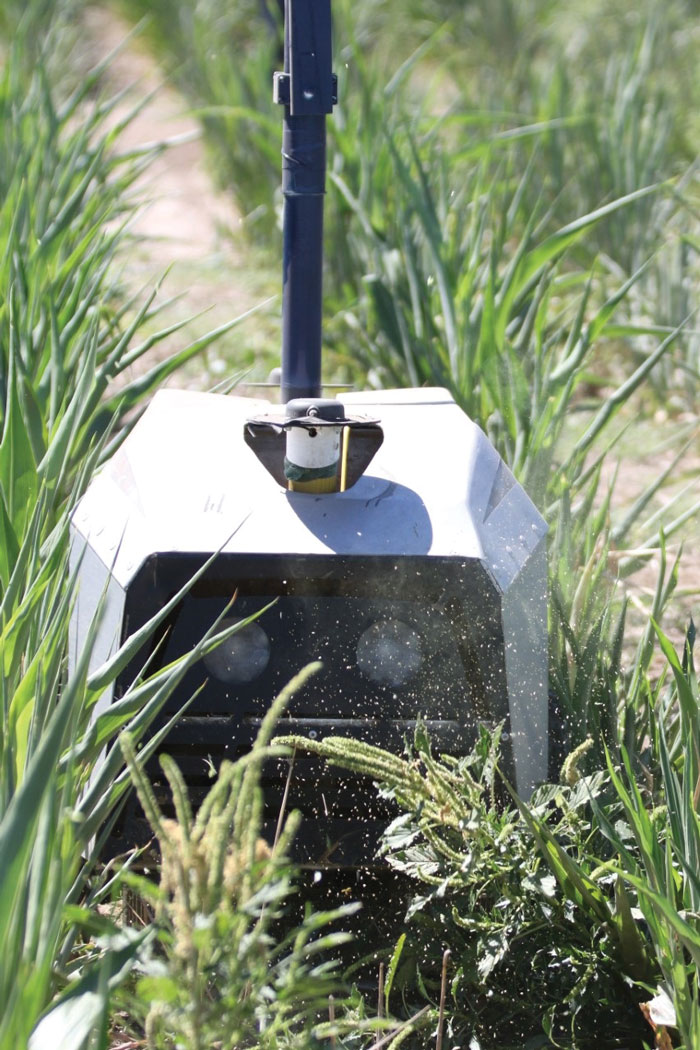
Greenfield Inc.’s robotic mechanical weeders offer herbicide-free weed trim jobs within 1 inch of the cash crop. Machines, available on a rental service agreement, are capable of seeding cover crops and limited spot spraying or wicking for problem areas in non-food crop fields. Source: Greenfield, Inc.
“Instead of a grower having to purchase and maintain equipment, they basically rent it,” Brauer says. “It changes their balance sheet and allows them to use operating capital instead of having to make capital purchases and service it with interest on top of the debt.”
Brauer says the company used that model as a foundation when working with MKC Co-op in Kansas to deploy the machines and pick them up after they finish working as long as needed to weed a field.
“Renting our robots to do mechanical post-emergence weeding is much less expensive than using herbicides,” he says.
Greenfield’s battery-powered machines weigh about 350 pounds each and are designed to work about an acre an hour – guided by lidar, proprietary RTK signals and AI. Often, field maps from previous drone flights guide the machines. Brauer says the robots work in swarms of about 10 at a time, and his service agreement includes swapping batteries after 4-8 hours of service, depending upon the need.
“With 10 machines, we’re able to weed 10 acres per hour,” he says. “This year, we’re looking at servicing 5,000-10,000 acres as our first year as a viable commercial operation.”
While Greenfield’s robots currently are aimed at post-emergence weed control, Brauer says trials on his family’s farm prove the machines can eliminate the need for a burndown herbicide application, as well as residual sprays. With that kind of performance, Greenfield is working with food companies to provide the traceability to contract certified herbicide-free commodities.


![[Technology Corner] Aligning ‘Smart Implements’ with Autonomous Tractors](https://www.precisionfarmingdealer.com/ext/resources/2026/10/01/Aligning-Smart-Implements-with-Autonomous-Tractors.webp?height=290&t=1790966217&width=400)

