
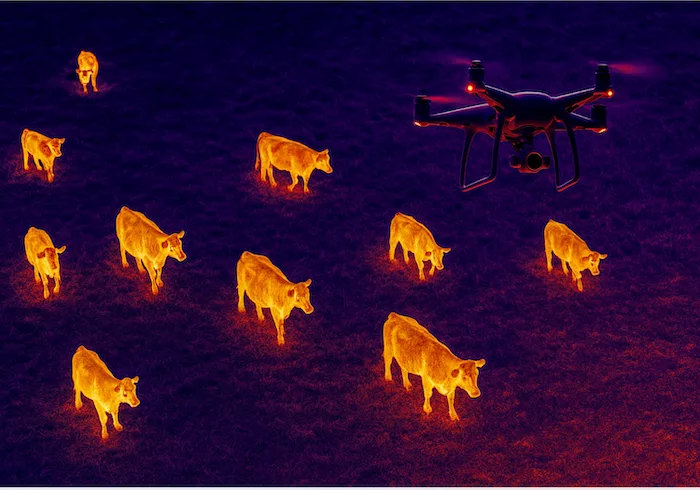
Farmers wanting to introduce livestock to their operations to boost soil health and add more economic diversity shouldn’t overlook the importance of rapidly-developing “ranch-related” drone technology.
There are many benefits of a grazing component in a farming operation including: improved soil structure and nutrient cycling; residue management and rotational flexibility; and market diversity through the sale of meat, milk, wool and other animal products. Still, someone must manage the additional enterprise, and usually that means hiring at least some additional hard-to-find labor.
Just as in the service industry and manufacturing, where qualified labor is a serious bottleneck, technology is offering growers robotic help in the form of unmanned aerial vehicles (UAVs) capable of working as cowboys. As drones have become common-place on many farms, their abilities are just now catching on with ranchers and graziers.
Many Capabilities
The National Grazing Lands Coalition recently posted an article outlining the way UAVs equipped with cutting-edge technology like thermal cameras, LiDAR (light detection and ranging), and spraying systems are transforming the way livestock operations are run. They include:
- Locating animals day or night. With drones producers can find missing animals quickly over long distances and in rugged terrain. Aerial surveillance can help monitor calving and lambing, as well as pinpoint animals suffering from heat stress or illness.
- Better pasture planning. Using LiDAR mapping, ranchers can optimize fencing and water placement within pastures, identify erosion zones and uneven ground, monitor forage conditions to improve rotation grazing schedules and paddock sizes.
- Precision applications for parasites and weeds. UAVs can identify and treat noxious weeds without harming surrounding forage. With drones, graziers can target pest-prone areas like shaded corners or wooded edges with insecticides. Such precision-targeted applications reduce runoff and chemical overspray in systems that prioritize pasture health.
- Unmanned guard duty. Drones can monitor perimeter fencing, detect movement night or day, and can provide live camera feeds to smartphones or base stations.
For day-to-day herd management drones can be used to save time and costs in monitoring forage conditions reducing the need for ground-based pasture inspections. Also they can inspect herds, check for estrus, monitor calving and conditions of water sources and, in some cases, they can herd livestock.
University of Kentucky researchers are early-into a 5-year study on drone use for herding, monitoring and collecting physiological data from beef cattle.
“We’ve worked in the past on cattle monitoring with drones, but now we’re exploring how they can be used for herding,” explains Josh Jackson, assistant extension professor. He says by developing a system to control drones semi-autonomously near cattle they intend to study physiological responses of cattle to drones, particularly how different breeds react to the drones’ presence and movement.
“For instance, we’ve seen one drone flying 30 feet above ground doesn’t bother them much, but if you add a second drone or change the flight patterns, cattle responses change.”
Jackson says he is also interested in developing an accurate weight measurement system based on aerial observation to streamline cattle management practices.
“If we can get within 5% weight-estimate-accuracy using UAVs, it could revolutionize how farmers monitor the health and growth of their herds.”
Solutions in Pipeline
In Brazil, Cargill developed its UAV-based CattleView system to help growers there better monitor their herds and feedlots over long distances with less labor.
The system combines drones, artificial intelligence (AI) and cloud computing to give producers real-time data on their animals’ welfare and behavior, says Gilson Regadas, a global insights data leader for Cargill. The drones are set for autonomous flights to capture aerial images of feedlot pens.
“Those images are uploaded to an on-line platform and analyzed by AI. The system shares a visual report on the current needs of the cattle — by color-coded pen outlines — allowing ranch employees to take immediate action,” Regadas adds. The technology saves about a third of the time it once took the staff to respond.
The South American feedlot experience with CattleView shows a $1 per head per year reduction in labor costs, and a reduction in feed waste by $1 per animal per year, for an overall ranch profit improvement of $6 per head per year.
While a major downside of drone use is startup costs (MSRPs on ag drones range from $500-$7,000, depending upon how they are equipped and their lift capacity) and FAA licensing requirements and regulations. To legally fly a drone for ag purposes a Part 107 license is required which costs $175 and a passing score on an FAA test. Additional requirements are in force for pesticide application with a UAV.
Research Intelo — an information service for the financial industry — says such costs, along with lack of technical expertise in drone use and data interpretation, remain hurdles for smaller operations. The publication notes leasing operations and the emergence of drone-as-a-service (DaaS) is likely to make access to drone technology much more accessible to a growing number of producers.
ROI Estimate?
Every operation’s financial picture is different, and every livestock enterprise brings its own challenges and opportunities, but even the cost of a $7,000 drone can be quickly amortized by with timely attention to downed cows, lost calves, sick animals, and missed breeding.
And having mechanical eyes in the sky can also reduce overall annual labor and operation costs by reducing in-person field visits.

![[Technology Corner] Aligning ‘Smart Implements’ with Autonomous Tractors](https://www.precisionfarmingdealer.com/ext/resources/2026/10/01/Aligning-Smart-Implements-with-Autonomous-Tractors.webp?height=290&t=1790966217&width=400)

