
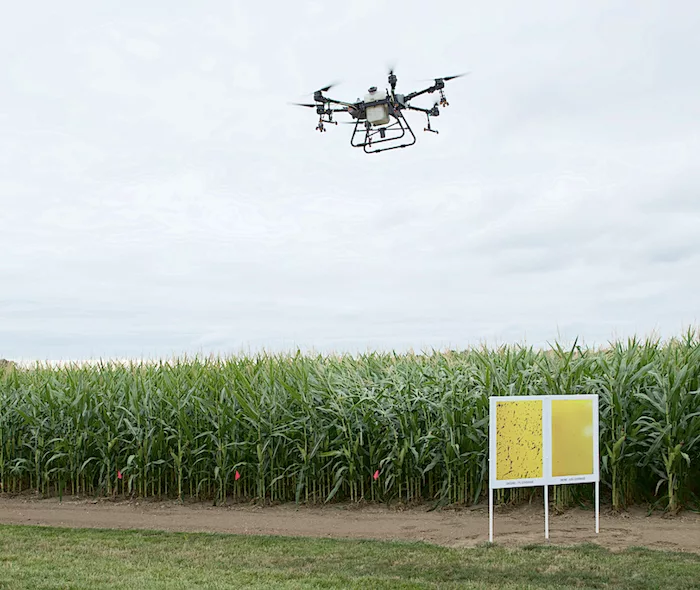
Drones are quickly becoming a valued tool for growers for many tasks, such as seeding cover crops in a timely manner after harvest, crop scouting or monitoring livestock.
But applying crop protection products, including fungicides, is another possibility as technology and reliability improves. Researchers at Beck’s Hybrids say they’ve been getting many questions about whether drones are just as effective as ground rigs, helicopters or planes.
Over the last 2 years, trials have found drones have consistently performed the same or better as a ground rig. Growers must still think about logistics, as far as the time of day to spray, how batteries, parts and service will be handled and how the drone will be hauled. But drones are expanding the toolbox.
“If someone says to me, ‘I need to spray and I have a choice between the drone, plane and a ground rig.’ I'm going to say, ‘They all work. Go for it,’” says Luke Schulte, a field agronomist for Beck’s in Ohio. “I'm not ready to tell anybody to buy a drone yet, but I’m surprised, shocked, and pleasantly happy that drones work just as well.”
Surprising Results
In Beck’s on-farm spray trial locations in Indiana, central Illinois and Ohio, 2025 was the first year researchers experienced heavy disease pressure, leading to concern that drones wouldn’t perform well.
Control plots with no fungicide recorded a yield of 227 bushels per acre. Corn where the ground rig applied fungicides at 10-20 gallons per acre was harvested at 235 bushels, and with a drone applying 2-3 gallons an acre clocked in at 237 bushels. Corn prices were $4.42 and the fungicide cost was about $26 per acre.
With moderate to heavy disease pressure at many of Beck’s testing locations, researchers said they were pleasantly surprised at drone performance compared to planes and helicopters in some situations.
“If someone says to me, ‘I need to spray and I have a choice between the drone, plane and a ground rig.’ I'm going to say, ‘They all work. Go for it...’”
Their tests showed fungicide applications overall are a good investment when disease pressure is higher, but here’s how each application method panned out:
* Corn at 16.6% moisture with no fungicide applied yielded 236 bushels per acre in corn.
* Fungicide applied with a ground rig at 15-20 gallons per acre, at 17.7% moisture, produced 247 bushels per acre.
* Fungicide applied at a rate of 2 gallons per acre with a plane, at 17.6% moisture, yielded 246 bushels per acre.
* Drone application of fungicide at 2 gallons per acre at 17.8% moisture produced 248 bushels per acre, a higher return than with other methods.
Beck’s return on investment (ROI) on the practices came out to $8.44 for the ground rig, $3.13 for the plane and $13.17 for the drone.
Corn prices were $4.42 per bushel, and fungicide cost was $25.78 per acre. One factor in the drone application that might help overcome the low use rate is canopy disturbance, which helps move droplets into the canopy, researchers said.
Beck’s also looked at a how a helicopter performed relative to a drone or ground rig. In a 3-year multi-location study, all 3 modes produced about 259 bushels per acre and a similar ROI. Drone ROI was $16.53 vs. $8.48 for the helicopter and $14.10 for the ground rig.
Same Story in Soybeans
For soybeans, researchers looked at two different aspects with drone applications: the efficacy of a ground rig vs. drone, and a treatment that compared the two application modes based on the pH of the chemical applied.
The theory behind the pH treatment, Beck’s says, was that the drone droplets may be more concentrated and have a lower pH — potentially explaining why drone applications are performing well.
At this 3-year multi-location study (with mostly light disease pressure), soybeans treated with no fungicide yielded 81 bushels per acre. Soybeans treated with 8 ounces of Revytek with a ground rig at a pH of 7.2, at a rate of 20 gallons per acre, yielded 83 bushels.
The drone application at 2 gallons per acre, with a pH of 7.1, produced nearly the same yield. When researchers added Alpha Shot, a pH buffer, to the applications to lower the pH to 5.2, little difference was found with yield.
With soybeans paying at $10.33 a bushel, and a cost of $431 per gallon of Revytek and $35 for Alpha Shot, the already negative ROI was reduced further with the additive. Overall, the drone applications registered a $12.26 advantage vs. a $1.88 loss per acre for the ground rig.
Atomizers vs. Nozzles
A key difference with drone application of fungicides is the use of atomizers, which produce smaller, more uniform droplet sizes. This technology is potentially a good fit for low-volume applications, Beck’s says.
The first year of studies in Lewiston, Ill., last year comparing the application of Atticus Aquila XL, applied by atomizers or nozzles (XR 1006 flat fans) showed a slight advantage at 267.7 bushels per acre for atomizers on corn vs. 265 bushels for nozzles. This took place in heavy disease pressure from Southern rust, and light tar spot and Northern corn leaf blight pressure.
Either way, fungicides produced a 21 to 24 bushel-per-acre increase over the control strip with no fungicides, producing an ROI of $89 for nozzles vs. $100 per acre for atomizers. Corn prices were $4.42 and the cost for Aquila was $55 per gallon.
Carriers Important
Researchers also found Beck’s Green Lightning nitrogen solution used as a fungicide spray carrier slightly improved the application of Veltyma in corn vs. just water, but the effect was more pronounced with drones, with a 4-bushel-per-acre difference vs. water.
Field variability could come into play however, as in one field the ROI on Green Lightning carrier was less than water, but it was more than $5 per acre higher in another field ($19.09 vs. $13.87). Disease pressure was light to moderate at the Green Lighting plots.
In a third field with heavy Southern rust pressure and light to moderate tar spot and Northern corn leaf blight pressure, Aquila applied with Green Lightning produced an ROI of $99.54 vs. $48.35 for a water carrier.
Summing it Up
Here are some salient points Beck’s researchers shared after the research was completed:
- The fields at Beck’s PFR farm are divided up into 30 or 40-foot sections, are systematically tiled and grain cart aren’t being run over them. Smaller equipment is used.
- Ground rigs used 10 times as much water as the drone, but droplet coverage wasn’t 10 times as good.
- Research showed that lowering the pH of water in the ground rig didn’t produce the same results as the drone, and that’s possibly due to turbulence from the drone “ripping the corn canopy open and getting the fungicide deeper, underneath the leaves and all around.”
- Speed does matter with drone applications. Researched showed the results of droplet coverage at 24% speed vs. 27%, and coverage suffered. “When you spray with a drone or am going to have somebody else spray with it, it needs to be calibrated. They need to know how to set that drone up, and we know it can be most effective,” Schulte says. “It’s no different than setting sprayers up, right?”


![[Technology Corner] Aligning ‘Smart Implements’ with Autonomous Tractors](https://www.precisionfarmingdealer.com/ext/resources/2026/10/01/Aligning-Smart-Implements-with-Autonomous-Tractors.webp?height=290&t=1790966217&width=400)

