
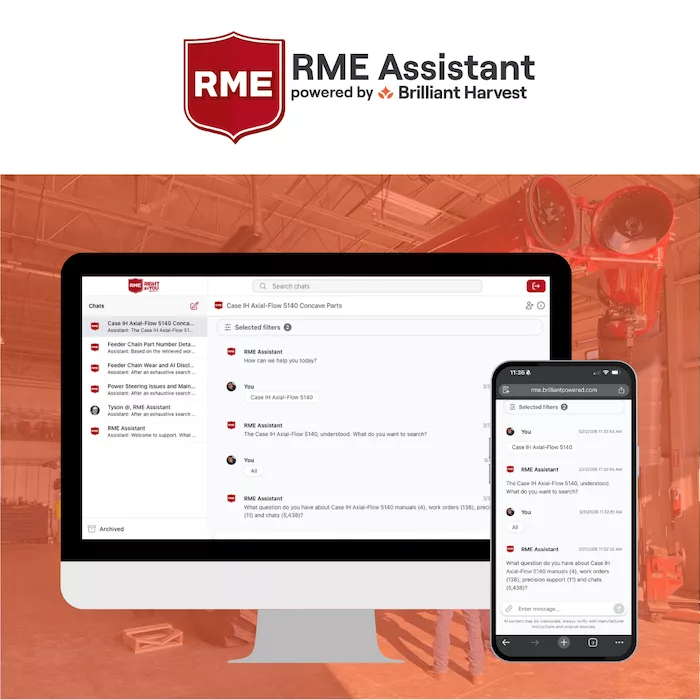
In farm equipment dealerships, service managers are expected to know a little bit about everything.
They field calls from frustrated customers, support technicians diagnosing machines in the field and help newer staff navigate unfamiliar equipment. All of this often happens while juggling multiple service requests at once.
But what happens when the service manager isn’t a mechanic by trade?
That was the situation facing Dawn Andrew, service manager at Rocky Mountain Equipment’s Moosomin, Saskatchewan location. Like many dealerships, Rocky Mountain Equipment works hard to ensure they hire the right team members to best serve their customers.
“Everybody’s learning a new system. Everybody’s learning new equipment,” Andrew says. “The skill set that we’re hiring, sometimes we’re training because they haven’t worked on this type of equipment before.”
For Andrew, the challenge was compounded by her own background.
“I’m not a mechanic myself by trade,” she says. “So, in trying to help these guys, we run into the question: how do we get everybody the information they need?”
Like many dealerships, the answer historically meant digging through manuals, searching old work orders or spending valuable time tracking down information.
Two recent experiences at Rocky Mountain Equipment illustrate how faster access to service knowledge can change that dynamic.
Dealer Victory #1: Preventing a $1,000 Guess
One of Andrew’s customers called about a recurring issue on an older tractor. The machine had already had its control panel replaced once, and the customer was frustrated to see the same problem reappear.
“He said, ‘I changed this control panel 200 hours ago. It failed again. What’s going on?’” Andrew recalls.
The customer was ready to simply replace the part again.
“He was like, ‘I’ll just spend the $1,000 and put the new part in again and see if it lasts longer this time.’”
Rather than guess, Andrew decided to look deeper.
While still on the phone with the customer, she entered the fault code into the dealership’s Brilliant Harvest-powered RME Assistant. The tool scanned the relevant service manuals and technical documentation much faster than manually searching through them.
Within minutes, Andrew found diagnostic guidance that suggested a different path.
“I was able to do what I would've done eventually — but far quicker, while still on the phone with the customer…”
“I was able to reassure him and tell him, ‘Let’s come out and do these quick tests first and confirm whether we actually need to replace the control panel,’” she says.
The tone of the conversation shifted immediately.
“He went from, ‘I need someone that knows what they’re doing, and this is costing me so much money,’ to ‘That sounds like a plan. When’s your service tech going to be here?’”
Before the technician left the shop, Andrew pulled together the diagnostic steps and shared them with the technician through the RME Assistant. With limited connectivity in the field, having that information accessible ahead of time ensured the technician was prepared before heading out.
“There was no more research for me to do,” Andrew says. “It was ready to go.”
The technician followed the diagnostic steps in the field, confirmed the issue and completed the repair with confidence.
For the dealership, the outcome wasn’t just about solving the technical issue.
The interaction also strengthened trust between the customer and the service department.
Watch how Dawn stops a $1,000 misdiagnosis while still on the phone.
Dealer Victory #2: Learning from Other Technicians’ Work Orders
Another Rocky Mountain Equipment employee, Ken McEvoy, has spent more than two decades working with the company. Over that time, he has seen firsthand how difficult it can be to track down useful historical service information.
“A lot of it was finding old work orders and trying to collect that information quickly,” McEvoy says. “You’d be filing through work orders trying to find what someone else had done.”
That changed when the dealership began using the RME Assistant to search across work orders.
“We had a fuel system problem with a combine,” McEvoy recalls. “The technician had done the work he thought was going to fix it, but it didn’t correct the problem.”
Instead of starting the troubleshooting process from scratch, McEvoy searched previous work orders associated with the same fault code.
Using the RME Assistant, he quickly found records from other technicians who had encountered similar issues.
“We found some more work orders with the same fault code and read what they had done,” he says. “We used their part numbers and tracked down the information.”
That historical knowledge helped the team solve the issue far more quickly.
“We found more work orders with the same fault code and used that information to solve the issue much faster…”
“We were able to solve it a lot faster than second-guessing ourselves and doing a bunch of testing that led nowhere,” McEvoy says.
The experience changed how he approaches service research.
“Now it’s one of the first places I go,” he says.
For Rocky Mountain Equipment leadership, that shift stood out.
Regional Manager John Dziver put it simply: if a technician with decades of experience is finding value in the tool, it signals something bigger.
“If Ken — the guy who already knows everything — is finding value in this,” Dziver said, “what is everyone else missing out on?”
Watch how Ken uses past work orders to solve issues faster.
Turning Knowledge into a Team Resource
Both experiences highlight a broader operational challenge facing many equipment dealerships: valuable knowledge is often buried in manuals, service bulletins and historical work orders.
That information exists, but it can be difficult to retrieve when technicians or service advisors need it most.
For Andrew, having faster access to that knowledge has made it easier to support technicians in the field, especially those newer to the equipment.
In one case, she was able to help a technician prepare for a job before leaving the shop.
“I can get a code, look it up, and share the information with him,” Andrew says. “I don’t have to pick out what I think are the important highlights. The whole conversation is there for him.”
That approach helps technicians spend less time searching and more time working on the machine.
It also helps service managers operate more efficiently.
“I was able to do what I would have done eventually,” Andrew says. “But I did it far quicker.”
Faster Answers, Better Service
For many dealerships, staffing shortages and increasingly complex equipment have made technical knowledge harder to manage.
Technicians are expected to troubleshoot advanced systems. Service advisors are expected to answer customer questions quickly. And service managers must help both groups succeed.
Rocky Mountain Equipment’s experience suggests that improving access to existing knowledge can have an immediate impact. In one case, it helped prevent an unnecessary parts replacement and improved a customer interaction. In another, it helped technicians learn from previous work done across the dealership network.
For McEvoy, the benefit ultimately comes down to speed.
“It’s just the speed of finding solutions,” he says.
And in the fast-paced world of equipment service departments, faster answers make a significant difference to team efficiency and customer satisfaction.
![[Technology Corner] Aligning ‘Smart Implements’ with Autonomous Tractors](https://www.precisionfarmingdealer.com/ext/resources/2026/10/01/Aligning-Smart-Implements-with-Autonomous-Tractors.webp?height=290&t=1790966217&width=400)

