
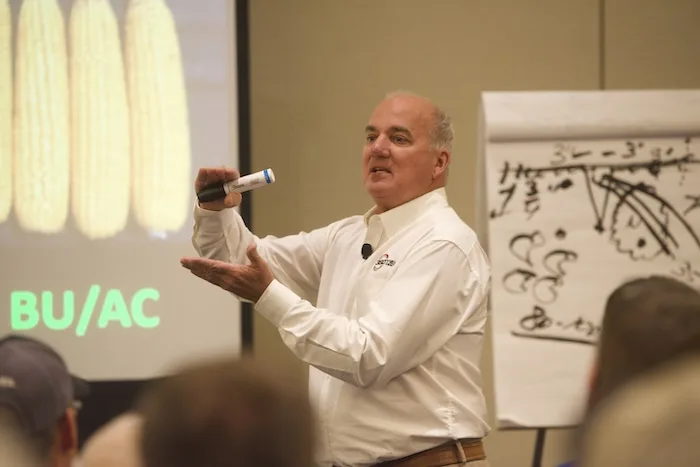
It’s a busy week here at Lessiter Media headquarters as we put the finishing touches on the September Shortline Legends Hall of Fame edition of Farm Equipment (Precision Farming Dealer’s sister publication), which includes in-depth profiles of the 2026 Legends — Gerry Bourgault, Harley Summers, Jim Hellbusch, Ricky Brown and Gregg Sauder.
I was lucky enough to take on Sauder’s story and the goldmine of inspirational life lessons that come with it.
Before launching two revolutionary ag tech companies (Precision Planting and 360 Yield Center), Sauder was a struggling farmer who became an inventor out of necessity. He was never satisfied with the way equipment ran and always thought there was room for improvement in his operation.
“I remember long before we even had a farm shop, I’d be laying out in a white rock drive with nothing but a vice grip and a crescent wrench, trying to re-shape, re-build and re-weld,” Sauder says.
He also remembers a few sleepless nights spent worrying about a five-figure financial hole and inaccurate planters costing him yield.
“Lord, I didn’t marry Cindy to bankrupt her,” Sauder recalls praying one night. “I was stressed because I couldn’t figure out how I was going to earn. It wasn’t because I didn’t have energy. I wasn’t generating income, despite working 16-hour days.”
His prayers were answered in the form of a phone call from Eugene Keeton, inventor of the Keeton Seed Firmer, which eventually became the founding product of Precision Planting. The Kentucky No-Till Legend heard about Sauder’s challenges and asked if he could pay him a visit.
“Thankfully, I had enough wisdom to let him come,” Sauder says. “It would’ve been just as easy for me to say, ‘I’m too busy. I’m too important. I don’t have time in the middle of planting season.’
“He told me he had 5 seed firmers,” Sauder recalls. “I planted that spring with all 5 duct-taped on, and it was amazing.”
That’s where Sauder’s precision ag story begins. Stay tuned for the rest in the upcoming edition of Farm Equipment. But until then, here are 3 big lessons from the innovator’s journey that really stuck with me.
1. It’s Never Too Late to Restart
Sauder could’ve been relaxing on a beach somewhere after selling Precision Planting to Monsanto for $250 million in 2012. But that’s just not in his DNA. The Hall of Famer’s competitive drive and deep-rooted passion for helping farmers succeed pushes him to keep innovating as founder and president of 360.
“I’ve been very competitive my entire life. I’m just driven,” says Sauder, who founded Precision Planting in 1993 with his wife Cindy in Tremont, Ill. “We’re probably working harder now than we’ve ever worked in our lives, and we were pretty busy before. It was never a question of whether we’re going to take this income and just relax. The question was how can we change ag?”
Sauder reminds us it’s never too late — even at age 69 — to change directions and build something completely new. He launched 360 Yield Center (rebranded as 360 in 2026) after a drought resulted in the worst growing season in the history of his family farm. Sauder wanted to equip his farm, and others, with cutting-edge tools to knock Mother Nature’s curveballs out of the park.
“It’s not easy to start over and we had a great team at Precision Planting,” he says. “You quickly learn in business it’s never about yourself. It’s about the team that surrounds you. We built Precision Planting one step at a time from the ground up. When we started 360, I realized I don’t have all that much more time, so we did the opposite and started from the top down. I enjoyed the challenge of getting the company where it needed to be. We’ve brought in the right talent, and it’s working for us.”
2. Treat the Janitor the Same as the CEO
In my past life as a sports broadcaster, I always respected the big-name coaches, athletes and reporters who treated everyone the same. The ones who were as nice to the janitor as they were to the CEO. I see the same qualities in Sauder, who credits a close-knit, family-like culture as a big key to his company’s success.
“You’ve got to surround yourself with innovative, free-thinking people and it’s amazing how hard they’ll work,” Sauder says. “But you’ve got to notice them and talk to them. There’s nothing wrong with saying, ‘You’re doing a really good job and I appreciate it.’ That matters. I know you’re paying them, but I rarely met people that didn’t like to be thanked.”
Every summer, Sauder opens his home to all 175 employees for a massive gathering that feels more like a family reunion than a company event.
“We had over 600 people there last time. I tell everyone to bring their parents, grandparents, friends, kids,” Sauder says. “We do fireworks right before the 4th of July. We feed everybody and have tons of toys and games for the kids. I want them to see how much we value them. I like to create that family culture.”
3. Block Out the Noise
It’s human nature to let negativity affect you, especially when it come from others who have been in the game for a long time. Sometimes criticism can be constructive, but when it’s not, just block it out and keep grinding. That’s what Sauder did when he was getting started with Precision Planting.
“The first farm show I ever went to, a prominent businessman said to us, ‘It’s exciting to see what you’re doing, but you’ll never make it. You’re going to starve.’ I just smiled and told him, ‘I appreciate that,’ because he didn’t know the constitution of Gregg and Cindy. We home schooled our kids, and they were raised at farm shows. Cindy is 90% of the reason for my success. She wouldn’t give up. She knew the business and we’d work until 1 a.m. processing invoices in a motel while the kids were sleeping.
“I never listened to the outside noise. We need small businesses. If we think the Deeres, Cases, Kubotas and AGCOs have all the answers, we’re mistaken. We need small inventors of products who are willing to take a shot.”

![[Technology Corner] Aligning ‘Smart Implements’ with Autonomous Tractors](https://www.precisionfarmingdealer.com/ext/resources/2026/10/01/Aligning-Smart-Implements-with-Autonomous-Tractors.webp?height=290&t=1790966217&width=400)

