
If you’ve ever played a video game the “hard way,” you know the feeling: you’re moving through a new level, reading the environment for clues and trying to figure out what’s around the next corner. A flicker on the screen, a weird sound, a change in terrain — those small hints tell you what to do next. Now imagine you suddenly unlock a cheat code: a mini-map that reveals the whole board or a clue that trouble is around the corner before it happens.
When Diagnostic Trouble Codes (DTCs) are paired with the right tools and the right people, connected machines don’t just generate data; they tell a story. The “cheat code” is knowing how to interpret that story fast enough to change the outcome.
The level starts with a connection.
Telematics — technology like GPS and machine sensors — has been helping contractors and growers track equipment for decades and fleet management platforms have made that data easier to act on. In today’s world, JDLink and VermeerOne connected equipment can continuously send machine health and diagnostic information to a Fleet Management System (FMS) platform like John Deere Operations Center, so owners and teams can see alerts and DTCs without being in the cab.
At RDO, that connectivity is the foundation of Connected Support — where teams combine technology, proactive service and local expertise to keep machines productive. With more than 56,000 connected machines managed through RDO’s system, the goal isn’t just “more data,” it’s fewer surprises.
Diagnostic Trouble Codes (DTC) Explained
A Diagnostic Trouble Code (DTC) is the machine’s way of raising its hand to say, “Something is out of range.” DTCs come from onboard controllers and sensors and they help point technicians toward specific systems that may need attention.
On many John Deere or VermeerOne platforms, fault codes commonly follow the industry-style structure that uses SPNs (Suspect Parameter Numbers) and FMIs (Failure Mode Identifiers). In John Deere documentation, the SPN helps identify what parameter is involved and the FMI helps define how it’s failing (for example, extremely high, extremely low, invalid, out of range, etc.).
This matters because the difference between “keep running” and “stop now” often lives inside that code context and the patterns around it. Being able to see DTCs remotely in Operations Center combined with RDO's in-house alert experts helps fleet managers to filter the data to make effective decisions to manage a machine's uptime.
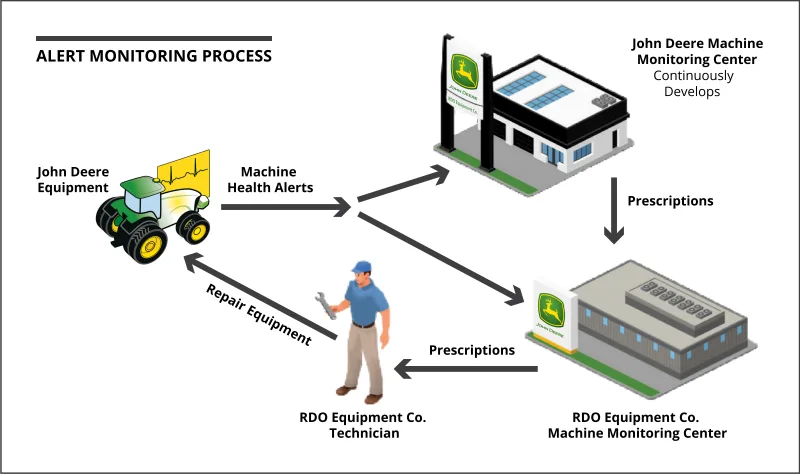
RDO’s monitoring group is a centralized team of experts who oversee the health of connected equipment across all RDO locations, watching DTCs in near real time and looking for patterns that could impact performance. They manage data from more than 55,000 active machines every day. And they’ve created purpose-built, in-house software designed to handle up to 15,000 machine alerts per day.
That triage isn’t random. RDO’s workflow follows a simple cycle: Sensors trigger DTCs that arrive quickly, alerts are evaluated for severity and patterns using RDO’s custom software, the team writes a “prescription” (the recommended fix), and they coordinate with the customer’s local RDO store so so customers can be informed, the local store can be prepared with parts, and technicians before downtime hits.
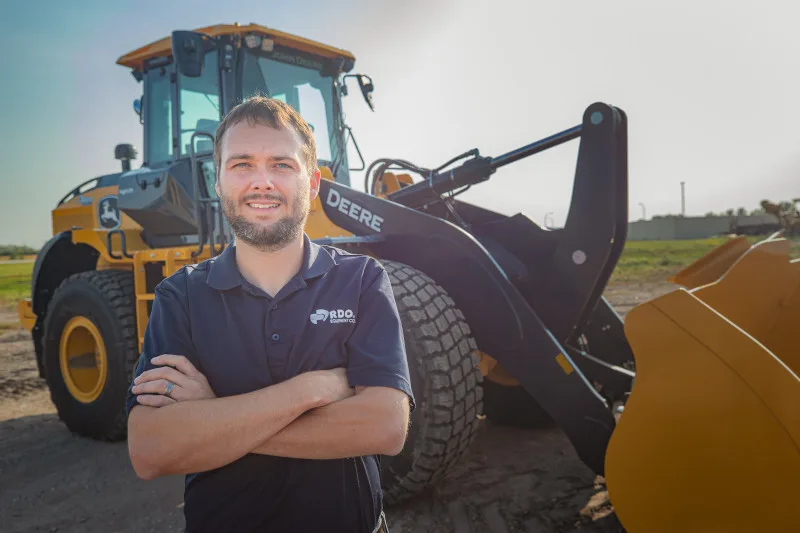
RDO Machine Health Manager Derrick Rygg described monitoring more than 55,000 machines daily and prioritizing high-risk fault codes such as engine oil pressure, because those are the codes that can turn expensive fast.
“Machine health means staying ahead of problems and being proactive," Rygg said. “We work with field team members to quickly address the issue”
Over time, that combination of data plus experience gets extremely effective. Rygg said his team can be about 95 percent certain they have the solution before a technician is even in the field.
Reading the environment: why conditions change the “answer”.
In video games, the same enemy behaves differently depending on the level — ice world, desert world and swamp world. Heavy equipment is similar in some ways.
RDO’s monitoring doesn’t treat every alert the same everywhere. Their software considers regional operating conditions, including cold-weather-related issues in the Midwest and silica-related wear in the Southwest, so the team can prioritize issues with better real-world context.
That’s the difference between “a code exists” and “this code is likely to matter right now, in these conditions, on this job."
Pairing The Cheat Code with Planned Maintenance
Even the best diagnostics can’t replace the fundamentals. In Connected Support, Planned Maintenance is the “save point” — the discipline that makes the whole system more predictable.
RDO’s Planned Maintenance (PM) program is powered by a centralized team that tracks machine hours and service intervals on connected equipment and partners with local stores to schedule service before issues arise. A proactive PM approach supports consistent uptime, reduces long-term repair costs, helps protect warranties with on-time maintenance, and improves performance through regular inspection.
For customers enrolled in pay-as-you-go or prepaid maintenance plans, benefits like coordinated scheduling and parts being ordered ahead of time help reduce downtime and make service more predictable. RDO’s Connected Support philosophy is simple: sometimes you need a dedicated team watching your fleet so you can focus on building, growing and finishing the job.
In RDO’s Connected Support overview, the company describes the value of having “an extra set of eyes” focused on machine health and performance, with the option for customers to monitor alongside their own teams or leave the monitoring to RDO. When customers share data and alerts, RDO’s monitoring center evaluates the alert and, depending on severity, helps coordinate next steps . However you want support is your decision, we just want to be able to give you the tools you need to make good informed decisions.
Rygg noted that working across RDO’s network, teams have saved more than 100 engines from failure during the last year — proof that proactive monitoring can prevent catastrophic outcomes.
The takeaway: cheat codes don’t replace skill — they amplify it.
A cheat code in a game doesn’t magically win the level — you still need timing, judgment and execution. But it does one important thing: it helps you see what you couldn’t see before, so you can make better decisions sooner.
That’s what connected monitoring and DTC triage do in the real world. Instead of guessing what’s behind the next corner, you get earlier visibility into machine health. Instead of reacting after the breakdown, you can be informed, make decisions, align parts, technicians and schedules ahead of time.
For the people who build and grow — operators, foremen, fleet managers and owners — that’s not “nice to have.” That’s the difference between staying on schedule and losing a week to something that started as a small alert.
![[Technology Corner] Aligning ‘Smart Implements’ with Autonomous Tractors](https://www.precisionfarmingdealer.com/ext/resources/2026/10/01/Aligning-Smart-Implements-with-Autonomous-Tractors.webp?height=290&t=1790966217&width=400)

