
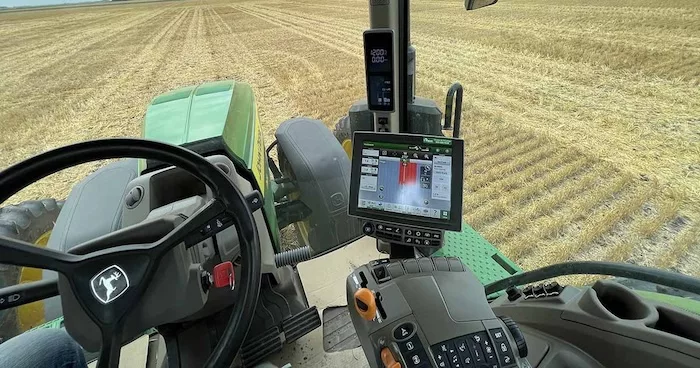
AEM has re-released its breakthrough study on precision agriculture.
Originally published in 2021,The Benefits of Precision Ag in the United States now includes updated field data and first-hand farmer insights on how precision ag technologies are helping to improve crop yields, reduce inputs, and strengthen the resiliency of America’s food supply chain.
“We wanted to make this study something people from outside the agricultural industry could relate to,” said Doug Griffin, Partner at AEM member company Kearney, a global consultancy firm that developed the report. “For agriculture professionals, some of the information may seem obvious at times. But for others, including policymakers, it’s not.”
The report, which can be viewed and downloaded on AEM.org’s Insights page, details how precision agriculture has been helping farmers produce more crops on less land, all while reducing usage of water, fertilizer, herbicides, and fuel. It’s important for policymakers and the general public to understand that because farming practices often come under undue scrutiny that isn’t rooted in science.
AEM developed The Benefits of Precision Ag in the United States in collaboration with the American Farm Bureau Federation, American Soybean Association, CropLife America, and the National Corn Growers Association. Griffin was joined by representatives from those organizations during an AEM Member Education webinar on Oct. 16.
“The evidence presented in this report helps show that these technologies don’t just make sense environmentally; they make economic sense as well,” said Carson Fort, government affairs manager at the American Soybean Association. “This is especially important at a time when growers face significant headwinds. The farm economy remains difficult, input costs are high, markets are volatile, and new challenges like the Make America Healthy Again (MAHA) Commission have adding additional uncertainty.”
Key Findings
The report focuses on five key areas of precision ag technology:
- auto guidance
- machine section control
- variable rate application
- fleet analytics and telematics
- precision irrigation
Analysis of data generated over the past couple of decades helps cement the notion that farmers have been producing more with less, thanks to precision ag technologies:
- Annual crop production up 5%
- Water use down 5%
- Fuel use down 7%
- Fertilizer use down 8%
- Herbicide use down 9%
Keep in mind that these significant gains have occurred with relatively low technology adoption across the industry. To that point, the report also forecasts the additional gains that could be realized as a result of more widespread adoption:
- Annual crop production up another 6%
- Water use down another 20%
- Fuel use down another 7%
- Fertilizer use down another 14%
- Herbicide use down another 12%

![[Technology Corner] Aligning ‘Smart Implements’ with Autonomous Tractors](https://www.precisionfarmingdealer.com/ext/resources/2026/10/01/Aligning-Smart-Implements-with-Autonomous-Tractors.webp?height=290&t=1790966217&width=400)

