
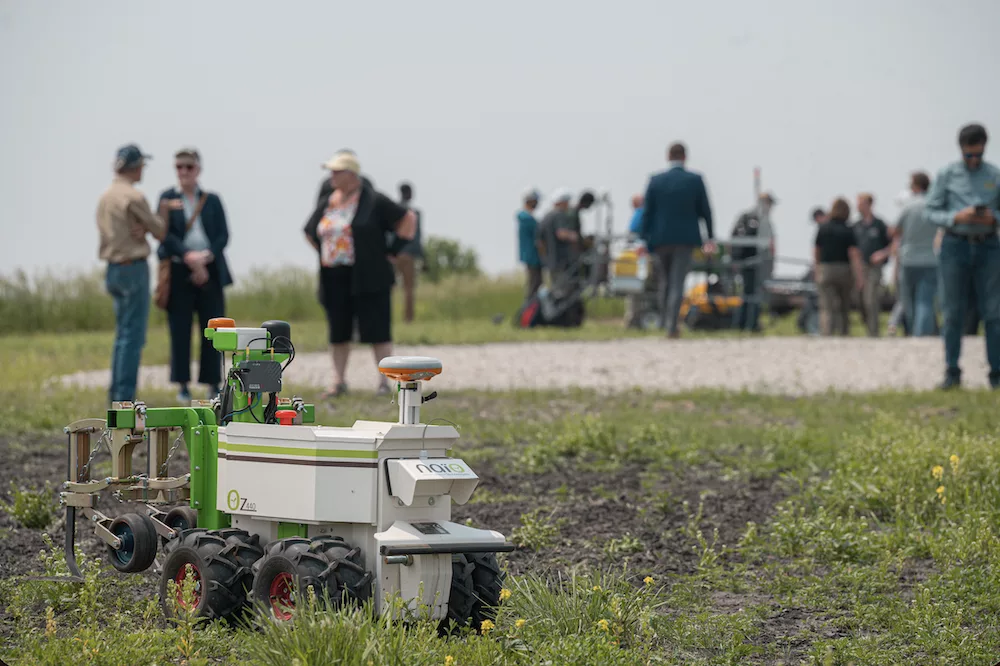
The USDA is launching a national program to evaluate farm technology in “real world” conditions and hired a North Dakota on-farm research center to manage the program.
The USDA National Proving Grounds Network for AgTech will, according to the agency, “thoroughly test and validate both existing and emerging tools under real-world production conditions,” to provide farmers and ranchers with reliable insights to make product decisions.
The goal for the program is to support the private sector as they address a national agricultural priority, align the public sector on partnering with tech companies and innovators, and focus the farm tech ecosystem on transformational technology that will benefit U.S. farmers and ranchers.
The program manager for the proving grounds will be Grand Farm, a hub for field trials, research, demonstrations, events and collaboration located in Casselton, N.D. Its parent organization is Emerging Prairie, an outfit in Fargo, N.D. created to support entrepreneurship.
The initiative will be spearheaded by USDA’s Agricultural Research Service (ARS), working in coordination with other USDA research agencies, as well as land-grant universities that will serve as primary research and testing partners.
The NPGN said it will implement a structured process that includes technology intake, readiness review, standardized field testing and performance evaluation to ensures technologies are assessed consistently and transparently across diverse production environments.
USDA will provide the testing and certify the results but Grand Farm will facilitate much of the logistics of the network.
ARS has created a new director of digital agriculture to position the agency for the “AI and digital agriculture era, and to support the responsible adoption of novel innovations,” said ARS Administrator Joon Park.
“As the lead for USDA’s NPG-AgTech, ARS remains firmly committed to ensuring that emerging technologies are rigorously evaluated through a transparent, science-based process supporting their adoption.”
USDA Undersecretary Scott Hutchins said the national research network will objectively validate new and emerging technologies, especially digital and AI-driven technologies to ensure row crop, specialty crop and livestock producers, “all have access to reliable performance data for their investment decisions with a goal to accelerate adoption of (ag technology) innovations.
“Moreover,” he said, “we fully expect that NPG-Ag will expand and facilitate the development and application of emerging technologies across the public and private sector to uniquely benefit U.S. agriculture.”
Grand Farm got its start in 2017 when entrepreneur Barry Batcheller challenged the region to define its “major” and the answer was agriculture technology.
The vision behind the research farm was to create a place where growers, researchers, startups, corporations, educators and public leaders could come together to solve real agricultural problems with applied technology.
That same year, the Grand Farm Test Site was launched in 2019 with support from former USDA Secretary Sonny Perdue, U.S. Sen. John Hoeven, and corporate partners such as Microsoft.
Grand Farm received a $10 million grant through the state of North Dakota in 2022 to build the Grand Farm Innovation Campus in Casselton.
Last year, UGA Grand Farm in Perry, Ga. launched its inaugural growing season, extending collaborative research and testing into the Southeast.
Grand Farm is now a network of more than 2,900 organizations collaborating to solve problems in agriculture through technology and innovation. Phase II of the Innovation Campus underway to expand capacity and create more opportunities to test and scale innovations.
Agricultural technology companies will be invited and encouraged to enroll commercial and pre-commercial products.
Companies with pre-commercial entries may also engage with testing under non-disclosure terms and work with research partners to refine and improve technologies based on field performance.
The Grand Farm team will serve as the focal point for technology company engagement and “nominal entry fees” may be used to help offset the cost of testing, analysis and reporting.
Field trial participants last year included some big names in agriculture such as including CHS, ADM, Pivot Bio, Anheuser Busch, Sound Agriculture and KWS, as well as several other technology-focused companies working in areas such as crop protection programs, crop varieties and crop rotation, sensors, drones, RNA analysis and nano fertilizers.
AI technology is looming large in the farm tech industry and its use in controlling weeds will be important early on, the USDA says. Traditionally, visual ratings have been used to assess weed control performance in field scale trials, “and will continue to serve as benchmark data in the early stages of the USDA National Proving Ground,” the agency said.
“At the same time, artificial intelligence will play a central role. The initial program will focus on weeds, using computer vision and machine learning to quantify weed density and coverage before and after precision technologies are applied, providing a more objective and scalable evaluation.”
As the Network expands to other areas such as disease, animal production and water management, “appropriate evaluation systems will be developed using AI and other domain specific approaches,” the USDA said.
Agricultural technology companies can enroll commercial and pre-commercial products with Grand Farm when the request for products is opened to the public. More information can be found at the USDA National Proving Grounds Network for AgTech website.


![[Technology Corner] ‘There’s No Going Back’ … Advice for Getting Started with AI](https://www.precisionfarmingdealer.com/ext/resources/2026/03/27/Theres-No-Going-Back--Advice-for-Getting-Started-with-AI.webp?height=290&t=1774641421&width=400)


