
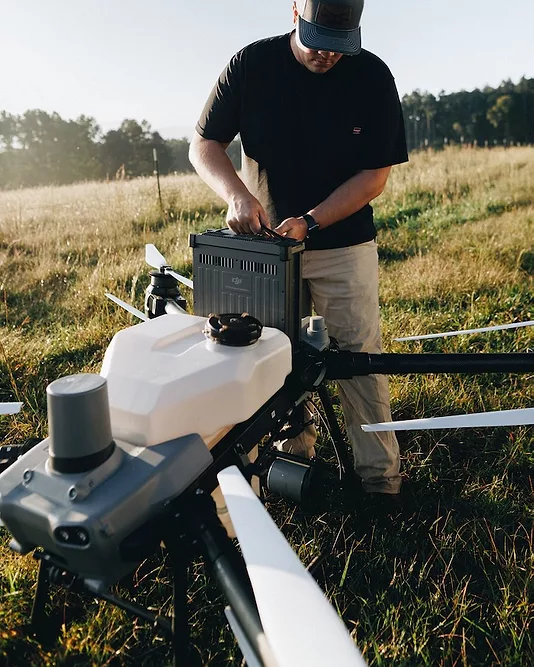
Dakota Crow is sitting in the driver’s seat of his Ram pickup truck beside fields of wheat in Missouri.
It’s seeding day today. He is on his laptop, connected through a Starlink connection, checking field maps and following up with business. His friends and team members, Tyler and Caleb, are both operating two DJI drones from the backseat by remotes held in their hands.
Crow, the owner of Monarch Drone Solutions, an aerial spraying and seeding company, is using a 23kW-240V Makinex generator to power the drones. Crow also sells and services drones for agricultural uses such as his own.
“Drones are reshaping farming practices by helping to reduce costs, increase yields and adopt sustainable practices,” he says.
As drone use rapidly expands in farming for tasks like crop monitoring and spraying, the need for fast, reliable charging in remote locations has never been greater.
“The biggest pain point for us though is downtime,” said Dakota. “I can't tell you how much downtime I've had from other generators, and that's the worst nightmare. If we don't have power, we don't have the ability to get these things in the air.”
Power Where It's Needed
Crow’s grandfather built the family farm and operated it for decades. When Crow saw the opportunity to use drones to begin a spraying and seeding business, he established his niche.
“The ground here is insanely tough on equipment, so being able to get a lot of what you need to get done from the air is pretty cool,” said Crow.
Crow has successfully run his business for three years, but a dependable portable power supply has historically been an issue.
“Everybody that got into this two or three years ago, they had a 9,500 constant running watt Westinghouse, which at the time was like, oh my God, people say it's a big generator, and now it won't even power many of our chargers,” said Crow.
Generators are critical tools across a wide variety of agricultural operation, such as powering irrigation systems, pumps, ventilation and climate control, lighting, refrigeration, and now, powering the flight of agricultural drones for businesses like Crow’s.
“I was tired of my generators crapping out. My dad's usually pretty savvy, and he saw me struggling and said, ‘Oh, I'll find you something.’”
Crow’s father researched and found an industrial-grade generator from Australian manufacturer Makinex. He called their North American headquarters outside of Dallas, Texas to ask for a demo to see if their product could work to power the DJI drones and more.
Borrowing From the Construction Industry
Not yet well known in the ag industry, Makinex has been receiving calls over the past year from agricultural drone operators, such as Crow, looking for more power.
Makinex generators are commonly used on construction sites to power equipment such as floor grinders, brick saws, and welders; in equipment rental fleets; and in remote or rural areas where grid power isn’t readily available. Their portability and power make them a go-to solution for temporary and mobile operations.
“We’ve had a surge in inquiries from agricultural-related businesses highlighting a critical need for dependable power sources in various farming operations including drones, irrigation, spraying and more,” said Brad Boehler, president, Makinex USA. “The Makinex generator line is a smart, turnkey solution for reliable on-site power that’s actually perfect for the ag sector.”
For modern day farming and off-grid operation, the need for high-output, portable power has shifted from being merely useful to utterly essential, driven by the rise of autonomous equipment, drone spraying, precision seeding, Starlink internet, and mobile farm offices.
According to Global Market Insights, the North American portable generators market was estimated at USD 4.6 billion in 2024. That market is expected to grow to USD 7.1 billion in 2034, at a growth rate of 4.5%, underscoring that portable power needs are foundational to modern ag and here to stay.
The Gen Sets
The name "Makinex" stands for "making inefficiencies extinct," a reflection of its core mission: to eliminate inefficiencies in the workforce. Founded in Sydney, Australia in 2004, the company has grown into a global innovator, delivering cutting-edge tools and equipment designed to boost safety, productivity, and efficiency where needed.
“Having a quality generator that is reliable is crucial,” said Crow. “Their generators are next level: they are industrial-grade providers of reliable, consistent power while offering fuel efficiency. These generators can be used for a lot of other things too, especially around the farm, like welders, pumps, lighting, seeders, etc.”
Ranging from 16kW to 32kW, with both 240V and 480V options, these generators feature dual-phase output—providing both single- and three-phase power from one unit for maximum versatility.
“What sets Makinex generators apart is the simplicity of the design of having just three components: engine, alternator and electrical panel,” said Brandy Carmona, product manager, Makinex. “There are no complicated electronics, inverters, or anything to provide interference on producing clean and consistent power.”
All generators are built in a compact, portable frame and mounted on wheels. Fitting in the back of a pickup truck, they are easy to transport, and can be positioned closer to the work area, improving power delivery where it's needed most.
“It’s got handles on the back of it, and it's not that heavy,” said Crow. “You can pick it up, and wheel it around, so it's easy to move. In most cases with other generators, that's not the case. This works really good for us.”
Makinex generators run on gasoline and feature efficient Honda GX series, or Vanguard engines. They are fuel-efficient, consuming approximately 0.92 gallons per hour at 50 percent load. This allows for a run time of up to 10 hours on a single tank, minimizing downtime for refueling, and maximizing productivity on site.
The noise levels are approximately 72 dB at no load and peaking around 78 dB at full load. While not classified as “silent,” they are engineered to minimize operational noise as much as possible. Emission controls are integrated to ensure compliance with industry and environmental regulations.
“Safety is a top priority in the design of all Makinex equipment,” said Carmona. “The residual current breakers with overload protection (RCBOs), ensures safe operation for users and prevents electrical faults. If the generator is overloaded, the inbuilt circuit breaker will trip, protecting the user from electrocution and electrical damage to the attached equipment.”
Maximizing Time
Crow says he sees folks that grew up around the farm wanting to come back, but it didn't pencil out. Operating ag drones is a way to make returning home a reality.
“Drones offer a nice supplementary way to make some cash off the farm, or you see a lot of people that are using drones for their own farms, and then they help out some friends on the side, that sort of thing,” he says.
“There’s a lot of different types of people flying ag drones, but most of them do need some form of ag background, or some sense of what that work looks like to be succesful, because that's really what it is, its cool tech incorporated into ag,” he says.
Crow says that any downtime is lost time. This season, a particularly wet and windy one, meant days of not flying the drones.
“You might only get 20 ‘perfect’ spray days out of the year, and then the other hundred, or 150, you just live with. So you’ve got to get as much done in the field as possible,” he says.
“Before, we were using generators that were 10,500 kilowatt. They weren't incredibly reliable; they weren't industrial grade, and we were just kind of getting by,” he said.
“I think the nice part about a commercial-grade generator, it's a very consistent power supply,” said Crow. “Day in, day out, we're using it and I believe our batteries and chargers are better off from it too.”
As more farmers adopt drones, autonomous equipment, and satellite-based tools, one thing is for sure: without reliable portable power, none of it gets off the ground.

![[Technology Corner] Aligning ‘Smart Implements’ with Autonomous Tractors](https://www.precisionfarmingdealer.com/ext/resources/2026/10/01/Aligning-Smart-Implements-with-Autonomous-Tractors.webp?height=290&t=1790966217&width=400)

