
Artificial intelligence (AI) is poised to make a big impact in the farming world just like it already has in several other industries. But AI won’t replace farmers — only make their lives easier, says Colin Hurd, CEO of Mach, a supplier of autonomous technology to OEMs.
“Throughout history there has always been this narrative that new technology is going to take all these jobs,” Hurd says. “AI is a new technology. It’s going to be highly disruptive, very impactful and it will shift jobs, but it’s not going to eliminate jobs.”
AI as the ‘Middleman’
Hurd views AI as the middle piece within an end-to-end process. Farmers still must point the technology in the right direction, give it an objective and validate the outcome to make sure it’s achieving the objective, he says.
With that in mind, Hurd believes AI will be an instant difference-maker, especially in the data management department.
“Farmers have been collecting massive amounts of data for years on different fields, hybrids and fertility programs,” Hurd observes. “Most farmers wonder what to do with all that information. It can be overwhelming. I don’t know of a product available right now where you can dump all your data into it and get meaningful insights. But there will be one eventually.”
Farmers should make sure they’re collecting consistent data right now and organizing it so when a useful AI product hits the market they’ll be ready to put it to work, Hurd says.
Work Smarter, Not Harder
Chris Hunsaker, co-founder of Acuitus Ag, a company that delivers software tools to farms, supply chain partners and OEMs, agrees that people in the ag industry should be ready to leverage the potential benefits of AI.
“If an agronomist isn’t current on what these tools are and can’t integrate them into their workflow so they’re better at their job and can cover more acres quickly, they won’t exist anymore. The people who do that will still be in demand,” Hunsaker says. “There’s a lot of talk about AI taking away peoples’ jobs. It’s partially true, but for the people who figure out how to harness it, it will make them 10 times more valuable because of all the things they’ll be able to do faster and at a lower cost.”
As an example, Hunsaker points to one of his customers who manages a large acreage farm that was previously employing 15 people to monitor its irrigation system in shifts year-round. They asked Hunsaker if his company could automate the process, which would ultimately help lower their payroll costs.
“So is the way to automate it to just turn AI loose and then never look at it again? No. It’s to use the AI tool and reduce the team of 15 significantly. And is that possible? It totally is. There are hugely disruptive possibilities and they’re not 10 years away, they’re more like 2 years away.”
AI in the Cab
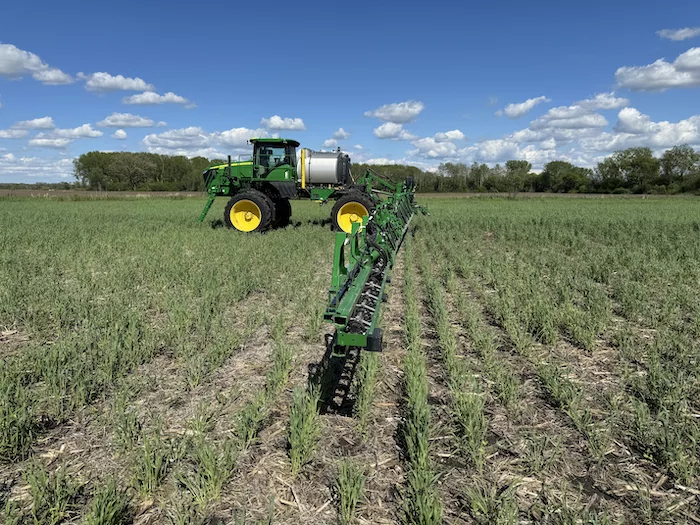
Tyler Troiola is already putting AI to work in his 2,800-acre corn, soybean and wheat operation near Eagle, Wis. He used John Deere’s AI-powered See & Spray for the first time in 2024 after learning about it during a roundtable discussion at the 2023 National No-Tillage Conference.
Equipped with cameras, AI-machine learning and machine control, the smart sprayer system identifies, targets and sprays weeds.
“I was skeptical at first but became interested after hearing other farmers talk about the cost savings,” Troiola says. “Plus, I want to be an early adopter of this technology before chemical usage is regulated because there are already counties in Wisconsin where atrazine use is restricted. I figured, why not try to cut down on herbicide usage on my own before it’s regulated?”
Retrofit First
After talking it over with his agronomist, input supplier and friends, Troiola went the retrofit route for his 2018 John Deere R4038 sprayer, opting for the See & Spray Premium. It’s a roughly $25,000 retrofit kit that can be installed on John Deere sprayers equipped with ExactApply nozzle systems as old as model year 2018.
“Being in no-till, we don’t have to buy a lot of new equipment, so that frees up a lot of our budget to spend on technology,” says Troiola, who also uses RTK, GPS and Deere’s AutoPath guidance. “It makes the most sense for our sprayer to be the most technologically advanced piece of equipment because we use it more frequently than anything else on our farm.”
The See & Spray Ultimate system comes factory installed on new sprayers, but that was out of Troiola’s budget. See & Spray Premium is a 1-tank boom system that allows farmers to either target spray established weeds or broadcast spray entire fields, whereas Ultimate is a dual-tank system that can simultaneously target spray and broadcast spray during the same pass.
“We turned off See & Spray Premium and used the sprayer for a normal broadcast application for our first pass,” Troiola says. “With no-till and cover crops, we’re already a 2-pass system anyways. We burn down our cover crops before we plant into them, and then we come back in June around V5 and spray again. Now, we’re just going to move some of our residuals from the second pass to the first pass to try to keep the weeds down. And then the second pass will be with See & Spray.”
First-Year Challenges
Troiola traded in his Hagie sprayer for a used 2018 John Deere R4038 sprayer with a 120-foot boom and 1,000 gallon-tank so he could upgrade to See & Spray Premium. His dealer, Sloan Implement, installed the 36-camera system, which took almost 2 weeks to complete.
“Deere told them it would take up to 80 hours to install,” Troiola says. “They laughed and said, ‘No way.’ But Deere was right. It ended up taking about 2 solid weeks to install the system because it’s the first one they’ve done. I’m sure the second system they install will be a lot faster. It’s a big learning curve for them, just like it is for me.”
Troiola anticipated some road bumps, just like with any other new technology. He believes timing is most important because the bigger the corn and soybeans, the more they’re going to shade out weeds and potentially block the cameras from seeing them. On the flipside, if he sprays too soon, he worries the weeds might be too small to detect.
“The other thing I questioned in a no-till situation with a lot of cereal rye is how the cameras are going to handle heavy residue,” Troiola says.
He planned time for an extra sprayer pass just to work out the kinks. Troiola also sorted through questions about label rates.
“A lot of these products don’t have a label rate for See & Spray,” Troiola says. “We need to work through that. My thought is if you’re only spraying 10-20% of the field, then you can afford to do a higher tank mix rate on that acreage. We’ll obviously still follow the labels, but we’re hoping to be on the higher end of the rates.”
Despite the unknowns, Troiola is optimistic the technology is a practical long-term weed management solution for systems with no-till and cover crops. He has extra time to scout and add another pass if needed, and his weed bank isn’t very big to begin with, thanks to his cereal rye.
“I’m hoping the chemical savings will ultimately pay for the cost of the technology,” Troiola says. “If I can save dollars on chemicals every year, I should be able to apply that to the technology, instead of investing in a bunch of chemicals. It will require some patience, but I’m excited about it. I think it’s the future.”
Opening Statement
Troiola was relatively happy with how See & Spray performed in its rookie campaign. The herbicide savings were as advertised on corn, but soybeans were a little trickier. A big key, he says, was making sure the system was accurate before unleashing it on the entire farm.
“We went into a field and marked a bunch of weeds with yellow, water-sensitive paper,” Troiola says. “We put some water in the sprayer and tested it out to see if the droplets were hitting the mark, and it turned out they were. It hit everything that was out there.”
The shorter the corn, the greater the savings, Troiola quickly discovered. He sprayed his no-till corn with a tank mix of Roundup and BASF Status herbicides and Jackhammer and Crosshair adjuvants when the corn was around V4-V5 at 10 inches tall, 14 inches tall and 18 inches tall.
“The system sprayed about 13-18% of the field on 10-inch-tall corn, which resulted in over 80% in herbicide savings,” Troiola says. “On 14-inch-tall corn, it sprayed about 25% of the field, dropping the savings to 75%, and at 18 inches, it sprayed about 35%, which still saved us 65% on herbicides.”
Jury’s Out
Troiola’s soybeans, drilled in at 30-inch, 15-inch and 7.5-inch spacings, presented more of a challenge for the cameras.
“See & Spray worked best on 30-inch beans, but it still sprayed about 60-70% of the field on average and up to 85% on some fields,” Troiola says. “That’s only 15% herbicide savings. When you’re paying a $4 per acre subscription fee, are you really saving anything?”
The answer to that question might ultimately be yes, Troiola says, considering his tank mix for soybeans — which includes Roundup, Liberty, Enlist and adjuvants — is more expensive than the corn program. Time savings were priceless, he says, due to not having to stop and reload the tank as often when planting-and-spraying windows are smaller in a wet summer.
Troiola theorizes the cameras had trouble distinguishing between weeds and soybeans planted in heavy residue consisting of corn stalks and terminated cereal rye. When in doubt, the system sprayed.
“You can change the setting to if the camera doesn’t know what to do, it doesn’t spray,” Troiola says, “but we had it set for if the camera fails to distinguish between cash crops and weeds, then it just sprays. The heavier the residue or the bigger the crop, it seemed to spray more. The system errs on the side of caution and over-sprays rather than under-sprays, which we’re OK with.”
Final Verdict
Despite the mixed results, Troiola hasn’t given up on See & Spray with soybeans yet. He’s going to make some adjustments with timing in the future to see if he can increase his savings, and John Deere has been more than willing to help.
“They get reports every day of how much herbicide I used with the system,” Troiola says. “After seeing I had a couple fields with only 15-20% savings, they reached out to see what went wrong and what they can do better. They’re trying to improve just like I am.”
Troiola knew there would be a significant learning curve with the new technology. But he’s already answered his two biggest questions — will it work in heavy residue, and is it practical for a no-till system?
“As long as the cereal rye was dead, the system seemed to work because I think it distinguishes color as well,” Troiola says. “Every farm is different, and technology like this isn’t one-size-fits-all. It’s going to take a lot of management, and it will only improve as time goes on. I’m excited about it.”


![[Technology Corner] Aligning ‘Smart Implements’ with Autonomous Tractors](https://www.precisionfarmingdealer.com/ext/resources/2026/10/01/Aligning-Smart-Implements-with-Autonomous-Tractors.webp?height=290&t=1790966217&width=400)

