
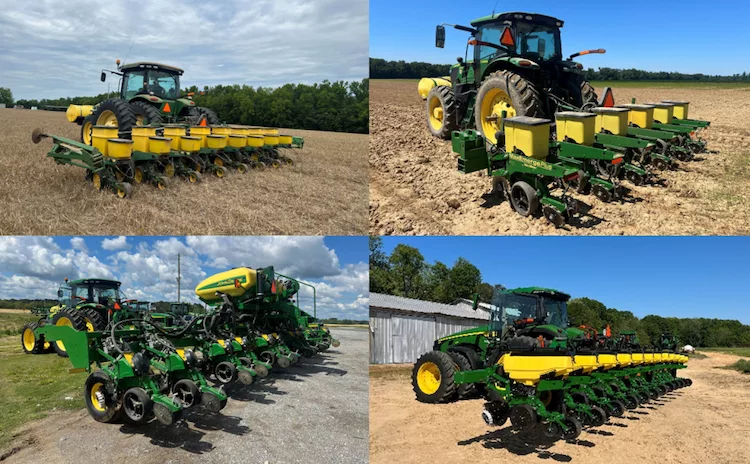
Several cotton planter studies were conducted in 2025 at Auburn University research stations and on-farm with grower collaborators across the state. These studies included evaluations of different planter types (seed meters), seeding configurations, seeding rates, and high-speed planting technology. Presented below are some of the main findings and suggestions based on these studies, along with summarized data for a few selected trials and/or locations.
Singulated Versus Hill-Drop Planted Cotton:
- Singulated cotton (one seed per drop) showed improved crop emergence and stand uniformity compared to hill-drop cotton. In some cases, singulated cotton also yielded more than hill-drop planted cotton.
- Singulated cotton helps in more uniform placement (even seed-to-seed spacing) and becomes more important for good stand establishment at lower seeding rates (≤2 seeds per ft).
- For growers using John Deere planters, two different cotton seed plate options (32- and 64-cell) are available for planting singulated cotton. Precision Planting also offers a singulated cotton seed plate for eSet and vSet seed meters.

Traditional versus Precision Seed Metering:
- Cotton planted using precision seed meters (equipped with singulation components such as John Deere MaxEmerge5 or Precision Planting eSet and vSet) performed better in metering and planting the target seeding rates.
- Higher rates of over-seeding were observed with the traditional seed meters (without singulation components) across all studies, as these meters are more sensitive to vacuum pressure, seed size/weight, planter speed, etc.
- Upgrading existing seed meters or investing in precision seed meters for cotton pays off quickly, given higher seed costs and the potential for seeding-rate errors with traditional seed meters.

Cotton Seeding Rate:
- While small numerical differences were observed in cotton yields across the seeding rates, lint yields were statistically similar across different seeding rates tested at each location.
- For growers planting higher seeding rates (especially more than 2 seeds per ft), there is an opportunity to lower and optimize seeding rates to reduce seed costs without sacrificing yield.
- With the latest planting technology (hydraulic or electric drives), conducting seeding rate strip trials is easy and the best way to determine optimal seeding rates for your fields/farm.

High-Speed Planting Technology:
- A slight reduction in applied seeding rate and emergence was observed at planting speeds above 10 mph, but overall cotton yield was statistically similar across planting speeds.
- Modern planters equipped with high-speed planting technology can effectively plant cotton at speeds above nominal (5-6 mph), but proper planter setup and calibration are essential to ensure accurate and uniform seed placement.
- A high-speed planter is a costly investment and may not be a good fit for every farm or operation. This decision should be considered based on your total cotton acreage, the size and shape of the fields, and the capabilities of current planting equipment to plant intended acres in a timely manner.

![[Technology Corner] Aligning ‘Smart Implements’ with Autonomous Tractors](https://www.precisionfarmingdealer.com/ext/resources/2026/10/01/Aligning-Smart-Implements-with-Autonomous-Tractors.webp?height=290&t=1790966217&width=400)

