
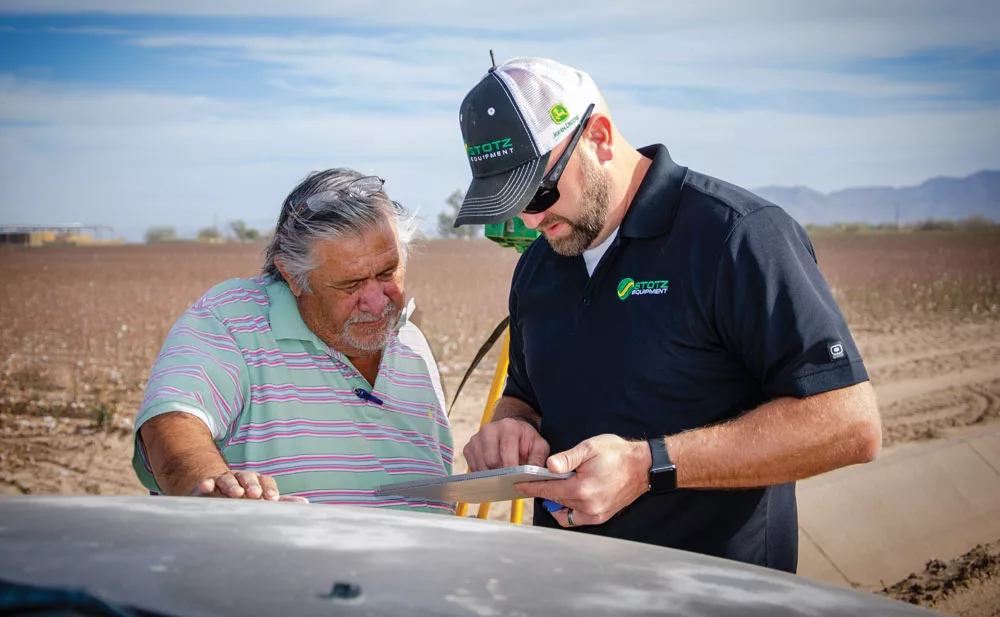
Over the years, Layne Richins has worn many different hats for Stotz Equipment, a 24-store John Deere dealership with locations in Arizona, California, Colorado, New Mexico, Nevada, Idaho, Utah, Wyoming and Canada as part of a cross-border partnership with Premier Equipment.
Richins started as a technician in 2004, then worked his way up to manager of the service department and eventually took over the precision department around 2015.
“At that time, there were basically 3 precision specialists across our whole company,” he recalls.
Times have certainly changed since then. Now, as chief technology officer, Richins guides a team of over 30 precision specialists who cover a wide range of farming practices and crops across 8 states, as well as internal software development, hardware/network and data analytics teams.
Other key players in the Stotz precision department include Justin Murray, director of precision technology, Clayton Eliason, north region manager, Omar Porras, south region manager, and Ezequiel Felix, precision golf manager.
“You have to use AI in a way that’s safe and be conscious of where that data is going…”
“When I took over the precision team, we really wanted to focus on customer needs,” Richins says. “The customers have a lot of equipment. We’re an equipment dealer. So, we wanted to figure out how we can use all that equipment data and provide value in the technology they’ve purchased.”
Precision Analytics
Precision data solutions manager Justin Childears heads up the 3-person data analytics team, helping customers across the 8-state footprint make sense of their data and use it to make improvements in their operations.
“Justin and his team focus on creating analytical reports to help our customers utilize their data to become more efficient,” Richins says. “One of the things we’ve been doing for a long time is benchmarking and showing customers where they rank against their peers.”
Stotz offers a variety of data analytics packages that can be purchased by customers. Some customers prefer extensive packages, “where we do basically everything for them,” Richins says, and others opt for more basic weekly or monthly reports.
“We summarize the data, so they don’t have to spend all that time in front of their computer trying to wrangle everything together,” he adds. “We want to find those wins and opportunities for them to save some money or find a better product. That can range from fleet optimization, fleet sizing and different operational efficiencies.”
Analytics in Action: Making Data Pay
Layne Richins is a big believer in using data analytics to push equipment to its peak optimization. A good example of that is the work his team did with a customer’s fleet of combines in Idaho, pushing the speed of the combine and tracking how it impacted acres harvested per hour.
“The blue line (right) is acres per hour. When we started the season, we were running 9 acres per hour,” Richins says. “But as we started improving that process, he got up to 12-13 acres per hour. That’s a significant decrease in the harvest window, so they can get that crop out. Maybe they got it out before the rain event or before protein dropped, just by utilizing the technology and data available to maximize that piece of equipment.”
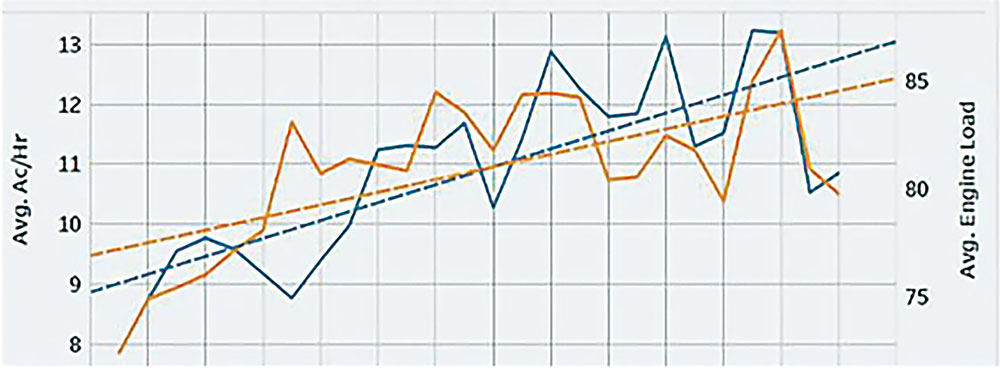
Through optimizing the combine’s performance, Stotz Equipment was able to move one customer’s combine from harvesting 9 acres per hour to around 13 acres per hour. Stotz Equipment
Richins outlines the three areas a precision specialist can focus on when trying to optimize a machine’s performance, using a windrower as an example. By adjusting the machine’s purchase price, idle time and cutting speed, Richins can find the optimum settings to lower the cost per acre for his customers. Purchase price is something customers will always talk about when trying to lower their cost per acre, he says, but it may not provide the savings they think it will. For example, saving $10,000 on the price of a windrower will only lower that customer’s cost per acre by 40 cents.
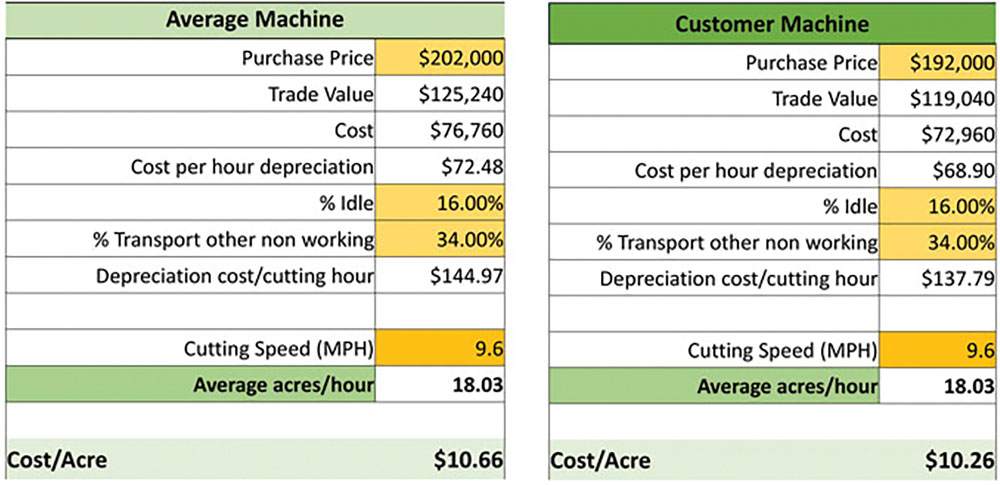
By lowering the cost of a windrower by $10,000, a customer would see a roughly 40 cent drop in their cost per acre.
Richins compares this to reducing the machine’s idle time from 16% to 10%, which decreases the cost per acre by $1 or roughly 10%. Richins stresses the goals they set for farmers, like this reduction in idle time, should be manageable. He says an increase in cutting speed from 9.6 mph to 10.6 mph also gives growers a $1 savings on their cost per acre.
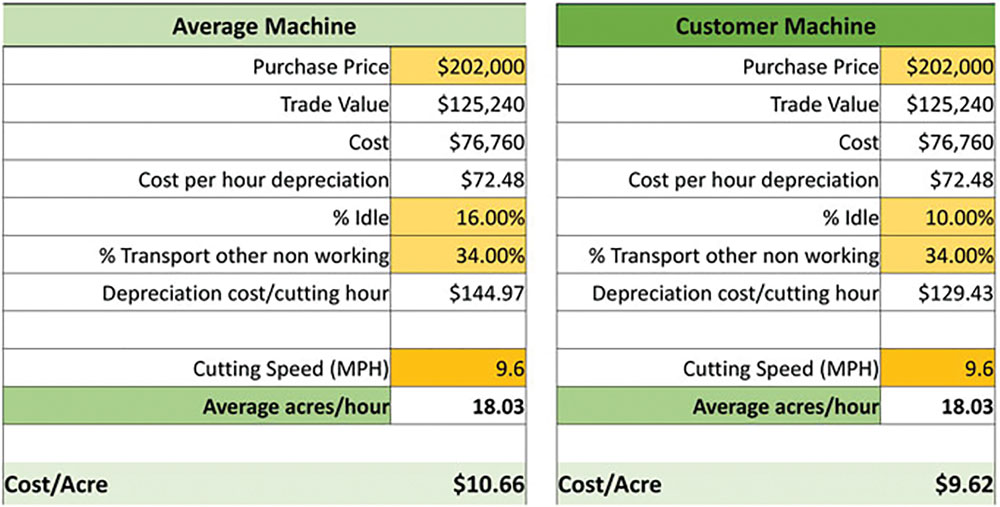
Without adjusting any other parameters, a decline in a windrower’s idle time from 16% to 10% would result in a customer saving $1.00 on their cost per acre.
Putting the 2 metric improvements together, Richins shows how a Stotz customer was able to achieve a cost of $6.91 per acre by achieving 8% idling time and 12.95 mph cutting speed, a 35.2% reduction in cost per acre.
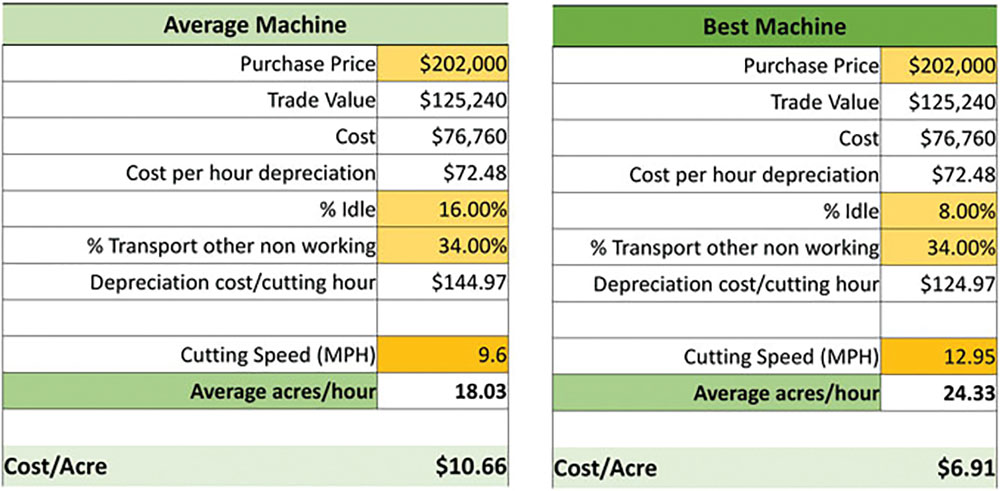
With manageable adjustments to idling time and cutting speed, Richins shows customers can find real savings on their operations through analyzing their data.
“This customer’s cost per acre was significantly lower than the average machine,” Richins says. “The $10,000 price difference didn’t really help much. But we have a lot more opportunities like this out there.”
The data analytics team also helps customers set up agronomic trials and guide them on how to leverage on-farm data through various John Deere software tools they have access to. But the challenge is their customers don’t fit the typical corn-soybean mold that most available programs are geared toward.
“We’re working on standardizing the process. It’s fairly easy when it comes to corn and soybeans because Deere spends so much time on it, but most of our customers don’t grow corn and soybeans,” Richins says. “Especially in Idaho, for example, where it’s all sugar beets, potatoes and small grains. It’s a challenge trying to figure out how we use the data and what matters to our customers vs. a traditional row-crop farmer.
“Obviously AI is in a lot of those spaces,” Richins adds, “and one of the things that we’ve been working on is just trying to figure out how we can safely connect different data sources to AI so that we can have AI do a lot of analytics for us.”
StotzGPT
Stotz started implementing AI at the dealership recently through a partnership with a company called Mainstreet AI.
“We all know that AI is awesome, but you’ve got to use it responsibly,” Richins says. “You have to use it in a way that’s safe and be conscious of where that data is and where it’s going.”
Richins says there was some hesitation with using AI initially, just like there is with any other kind of new technology, but Mainstreet AI helped guide their maiden voyage and ease concerns about data privacy.
“Our organization is very data hungry and we’re always looking for different ways to make our business run better…”
“They were essentially a consultant and helped us understand the tools that would allow us to utilize AI in a quick, easy and safe manner,” Richins says. “AI is constantly evolving and we’re trying to figure out how to use it to make us more efficient.”
With Mainstreet AI’s guidance, the dealership created “StotzGPT,” its own private version of the well-known ChatGPT platform. Internal documents were loaded into the platform, so if an employee has a question about something like insurance benefits, for example, they can ask StotzGPT and get an answer immediately.
Internal Software & Analytics
Richins also guides a team of internal software developers based in Arizona and California. Their goal is to create tools to make life easier for everyone working at the dealership, he says.
“We have a dealer business system, but you’re never going to fill all of the gaps with it,” Richins says. “There’s always going to be something we want to do differently or experiment with or add pieces to. And with AI now, the software team is trying to see how we can use it to automate some of those everyday tasks and processes and build upon all the tools available for us today. So, our software team, just like our data analytics team does for customers, focuses on making it easier for us to achieve our goal of creating a better life for our families, communities and those connected to the land.”

Featured Speakers
Tom Rosztoczy and Joey Rosztoczy of Stotz Equipment will dive deeper into AI, data and analytics during a presentation at the 2026 Dealership Minds Summit, Aug. 4-5, in Springfield, Ill.
To further accomplish that goal, Stotz employs a team of three internal business data analysts. They focus on ways to improve performance inside the dealership.
“And that kind of goes hand in hand with the software development team, but we have our own internal website where everything is housed,” Richins says. “That’s where we have all of our financials and analytics reports. Our organization is very data hungry, so we’re always looking for different ways and opportunities to make our business run better.
“Every store is its own business, and they want to make sure they’re running things optimally,” he adds. “The managers get business analytics reports and go over them with their teams to figure out how to make their store more efficient and profitable. What’s missing? What’s the difference between this store and that store? What does their store need to work on? It’s all tied to having the data needed to make key decisions.”

![[Technology Corner] Aligning ‘Smart Implements’ with Autonomous Tractors](https://www.precisionfarmingdealer.com/ext/resources/2026/10/01/Aligning-Smart-Implements-with-Autonomous-Tractors.webp?height=290&t=1790966217&width=400)

