
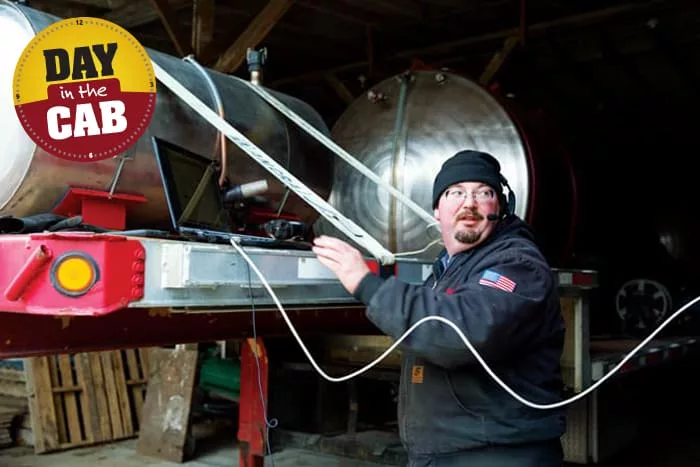
Dealer Takeaways
- Keeping customers in the loop on potential delays or detours on service visits can go a long way toward establishing a trustworthy, longstanding partnership.
- Establishing a pay-per-call service plan helps to justify lengthier inquiries, provide an additional source of revenue and cut down on the total number of calls altogether so more on-site tasks can be accomplished.
- On-site service visits during the slower months allow for extended conversation and relationship building opportunities that are harder to come by with customers during the rest of the year.
Life as a precision technician during the winter months may yield fewer calls from distressed customers over the course of a week, but the unpredictable nature of the job can still call for a demanding day with hundreds of miles on the road.
Anticipating for unplanned service calls and embracing on-the-go solutions proved to be two essential qualities for Lanty “Spud” Armstrong, precision farming manager for Ag Technologies in Rochester, Ind., during our 10-hour ride-a-long adventure with several twists and turns along the way.
Prior to his current role, which he has held for the past 8 years, Spud worked as a service technician at New Holland Rochester for 6 years; a dealership that shares on the same lot as Ag Technologies (a standalone precision-focused spin-off business of the New Holland store). In that time, he mastered the mechanical background of equipment while also building strong customer relationships which he maintains today.
“Networking is so important for this job, and my wife gets mad at me because I’m always running into someone and getting into a conversation,” he says with a laugh.
Our 11th installation of the Day in the Cab series highlights several “offseason,” yet essential jobs to tackle, including a malfunctioning sprayer as farmers rush to finish fall burndown and the installation of an RTK base station as New Holland aims to expand its data prescription offerings.
6:45 a.m. The unmistakable sound of my iPhone alarm stops a dream in its tracks at the Super 8 hotel in Rochester, Ind. A 5-hour trek from Milwaukee into the heart of Indiana the day before spares us the task of an early morning commute, with our destination of Ag Technologies just 5 minutes down the road.
7:30 a.m. Meeting our freelance photographer, Lauren Harrigan in the lobby, we stop at the Dunkin Donuts drive-thru on the way to the dealership. As the cashier hands us our coffees and assortment of mini donuts, she happily informs us that the driver ahead of us has already paid for our order.
7:58 a.m. While no rain is in the forecast for the day, the combination of heavy rainfall the day before with near-freezing temperatures makes the roads deceivingly slick as we arrive to meet Spud in the Ag Technologies building of the dealership. Walking into a store with a bevy of supplies ranging from GPS attachments to connective wire, we find Spud in his corner office shuffling through a cluster of daily emails.
Passing on our offering of donuts, Spud says the primary objective of the day will center on installation of a base station for New Holland’s RTK+ cellular network roughly 90 miles away on the farm of John Kingma in Demotte, Ind. CNH’s goal, he explains, is to install a base station for each of the New Holland dealership’s 7 locations within Indiana to improve the reach and connectivity for customers. They currently have 5 and plan to install the final 2 over the next couple of months. “We’re able to cover 5 times more area than we used to, which gives us more opportunity to sell subscriptions at an improved connectivity to prospective customers,” Spud says.
8:05 a.m. Eli Fred, the other precision technician for Ag Technologies, walks into the office and introduces himself. Eli, who is in his mid 20s and has worked under Spud’s mentorship for 5-plus years, is handed a manual on base station installations as the two walk towards the shop to cut antennae for the job. Spud says the antennae needs to be cut to between 4-5 feet to support the tripod once the base is installed on the roof. He cuts it with a power saw as Eli takes the remaining supplies including copper wire, ethernet cable and satellite to their 2016 Dodge Ram service truck.
You May Also Be Interested In...
What Farmers Want From You: Pain Points and Precision Needs
Learn about all the ways that you, as a dealer, can help your customers make the most of precision data. Farmers are beginning to look even more closely to the dealer in an effort to seek out assistance with making the most of their precision technology. We have made this eGuide completely FREE to you, so that you can learn exactly what it is that your farming customers expect out of you. Download now »
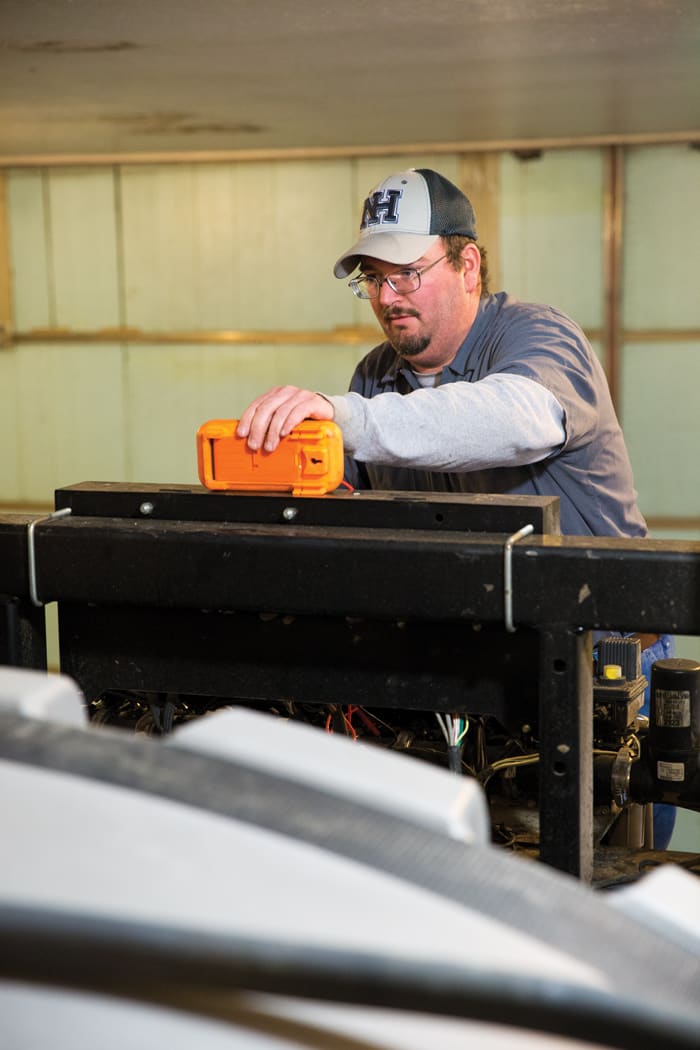
While service calls come less frequently in the winter months, Spud Armstrong, precision farming manager for Ag Technologies in Rochester, Ind., says malfunctioning equipment can remain equally detrimental. Faulty boom valves on sprayers are a common, but stressful issue in the fall and early winter for farmers looking to complete burndown in the fields.
8:43 a.m. After checking in at the main New Holland store across the lot to see if any precision-related tasks are needed for the day, Spud, Eli and I hop into the loaded truck with Lauren following us behind in the rental car. Within 5 minutes of being on the road, Spud gets a call from Trevor Bathke, a corn and soybean farmer out of Medaryville, Ind., who’s been unable to power the boom valves in his 2012 Apache AS 1020 sprayer. After giving John a quick call to see if it’s okay to take a detour prior to installing the RTK base, he reaches back out to Trevor to tell him he’s about 45 minutes away and will give the sprayer an inspection. In the peak of planting season, Spud estimates he gets up to 90 calls per day from customers during peak planting, but in the late fall and early winter, roughly 10 calls throughout the day is typical.
9:05 a.m. As Spud maneuvers through the slick roads, he describes the scope of his customer base, ranging from Indiana to regions of eastern Ohio and southern Michigan. While roughly 30-40 of his customers are year-round interactions, he estimates that figure doubles during peak planting season. With a small presence of New Holland dealers within the 100-mile radius, Spud says he’s had to embrace a “Jack of All Trades” approach to his services, requiring him to stay up to date on equipment that his New Holland dealership may not carry anymore (such as the Apache line).
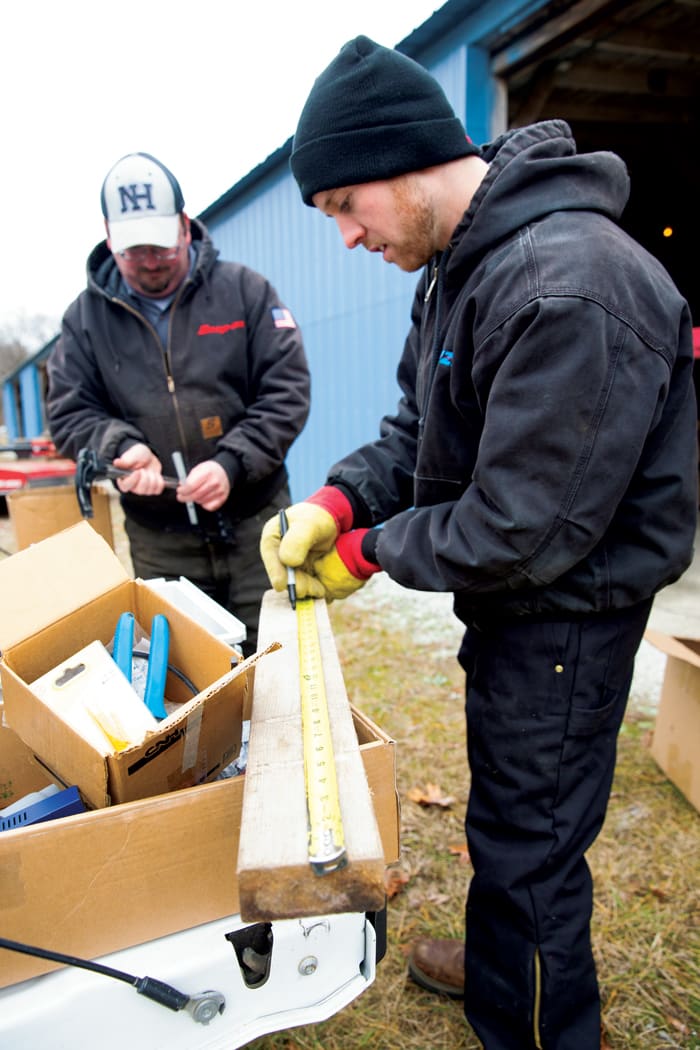
Ag Technologies Precision Technician Eli Fred’s (r) agricultural and mechanical background make him not only a mentee to Precision Farming Manager Spud Armstrong but key a contributor for when service calls require some improvising and engineering.
9:17 a.m. Spud receives another call from a customer inquiring about sprayer speed during fall burndown. The farmer, who was applying 28% nitrogen, wants to see how fast he could travel across the field while still applying accurately. Spud recommends 4-5 mph. “They’re better off doing it carefully when it comes to 28%, but some customers can’t stand to go slow,” he laughs.
Discussing his management of service calls, Spud doesn’t charge customers for simple questions on equipment. But on calls where he’s actively walking a customer through a process, such as organizing a display monitor, he’ll typically charge $30 per phone calls that take 30 minutes or less. For some of his most frequent customers, he’s set up a $400 annual service package, an offering that several regulars have accepted. “When charging for a phone call, most customers won’t argue that you didn’t help them out. I usually write down what was discussed and the payments aren’t an issue. I won’t say we’re getting rich at it, but it’s alleviated a lot of problems and cut down on some of the calls, which helps me get more done in a given day,” Spud says.
9:35 a.m. We arrive at Bathke farms and walk into the workshop, where Trevor Bathke and members of his family are chatting next to the Apache sprayer. Although Ag Technologies no longer represents the Apache brand, Spud had sold the model back in 2012 and still stops over to service the sprayer as a way of maintaining a customer relationship. Prior to getting started on the job, Spud spends a few minutes chatting with the family, catching up on the previous season. Spud and Trevor have developed a rapport over the years, and it’s revealed that Trevor likes to send Spud funny pictures of mistakes made in the field.
“When charging for a phone call, most customers won’t argue that we didn’t help them out. I usually write down what was discussed, and the payments aren’t an issue…” — Spud Armstrong
9:45 a.m. With a power testing kit on hand alongside the sprayer manual, Spud and Eli get started on diagnosing the source of the outage on the boom valves. With Eli working underneath the cab checking power sources, Spud uses a ladder to climb up about 6 feet to inspect the boom valves in the back of the sprayer. When the boom vales are functioning properly, a 12-volt constant output is produced through a through a 3-wire feed when the master switch is initiated from the cab. When the testing kit confirms that volts weren’t being produced, Spud determines the outage is coming from the side of the sprayer where the boom valves are activated.
9:57 a.m. Eli and Spud begin the process of checking each of the sprayer’s 10 valves for any damage that could have resulted in a blown fuse, utilizing both the power testing kit and visually inspecting each connecting wire and fuse.
10:20 a.m. After several valves had been inspected and cleared, Spud finally comes across the damaged wire responsible for blowing a 30-amp fuse in one of the valves. The wire had been rubbed down due to friction from a nearby hydraulic hose connected to the back of the sprayer. “Power issues and boom valves going out are a common issue, especially as corrosive material flows through. Replacing them every couple of years is commonplace,” Spud says. Maintaining his balance on the ladder, Spud tapes over the damaged wire and replaces the corresponding boom valve. Eli then reboots the master switch to test the boom valves, and all ten were now successfully functioning. Getting the entire job done in under an hour, Spud credits Eli for the efficient process. “Eli’s had some experience working on these types of troubleshooting tasks, so having a partner on hand certainly helped when rejogging my memory on how those fuse blocks were laid out,” Spud says.
10:47 a.m. Before heading out to install the RTK base, Spud and Eli hang around to catch up with the Bathke family more, an opportunity that comes less often during busier times of the year. In between sharing stories from the field and discussing the sprayer, Spud shares his future plans to take over his dad’s farm, a process that he adds will require outside help as long as he’s focused on the precision business.
11:00 a.m. We hop back into the loaded service truck and after a few minutes back on the road, Spud receives a call from another farmer inquiring about a pull-type sprayer maintenance issue. Since he’s already bumped back the RTK installation once this morning, he schedules an appointment for later in the week with the customer. “The weather this fall turned south in early November and hasn’t gotten better since, so when it comes to trying to get burndown applications done, it’s tough for farmers to find a window,” Spud notes.
11:32 a.m. With a gap between customer calls, Eli shares part of his story about getting into the precision business. After receiving a bachelor’s degree in agricultural systems management from Purdue, he’s spent the past 5½ years working under Spud.
12:06 p.m. Arriving at John’s farm, he greets us with a smile as Spud jokes about how much warmer the job would have been the week before. Walking through a massive equipment shed with machinery ranging from tractors to planters (as well as multiple boats kept in pristine condition for the next summer), Spud, Eli and John discuss different options for where to install the RTK base station. A key requirement to the location is keeping the RTK antennae at least 150 feet away from any objects higher than it so that data transfer remains accurate. With 2 grain towers neighboring the front of the shed, they settle on a wall along the opposite side close to a power outlet to mount the main power source. John rubs his hands together, smiles and thanks Spud and Eli before heading back to the main shop to tend to his machinery.
“Networking is so important for this job, and my wife gets mad at me because I’m always running into someone and getting into a conversation..."— Spud Armstrong
12:30 p.m. I quickly run to the car to put on a second pair of socks as Spud and Eli begin the lengthy installation process. They soon discover that the power station won’t safely mount into the thin wall without extra support from the top and bottom; an unanticipated setback. It became quickly apparent, however, that this wasn’t the first time they’ve needed to find a solution on-the-fly, finding a piece of plywood on the ground in an opposite corner of the shed to convert into a makeshift stabilizer.
12:43 p.m. Measuring out the selected section of wall at 22 inches between the studs to fit the power station, Eli marks the plywood accordingly and uses a saw to slowly but surely create the top and bottom stabilizer. After finding the right screws to solidify the power station into the wall, Spud holds the station in place as Eli drills 4 screws into each corner to ensure its secure. “The only thing taking this thing down now is the wall itself,” Eli says.
1:12 p.m. With the power station secure, the next step is lining the connective cord from the station to the eventual satellite that will be installed on the roof of the shed. Working methodically up the side of the wall all the way across the bottom part of the roof, Spud holds and feeds the cord to Eli as he uses a ladder to clamp the cord at roughly 3-foot increments for a total of around 40 feet. Realizing that more clamps are needed halfway through the process, we decide it’s a good time for a lunch break and subsequent pit stop to Ace Hardware.
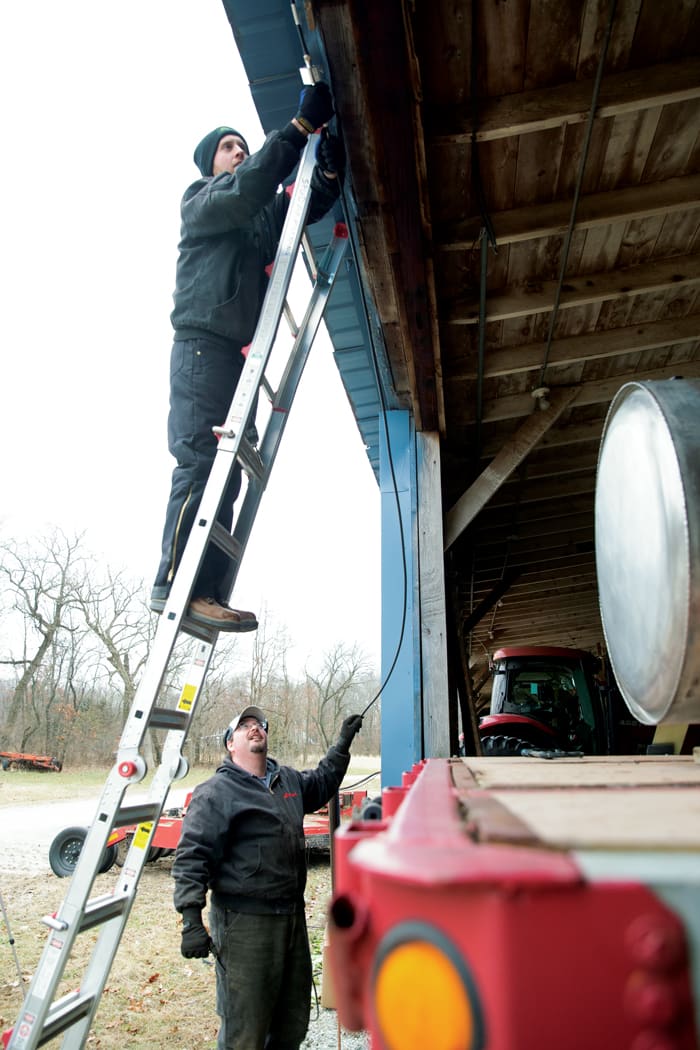
A key requirement of a base station satellite is keeping the RTK antennae at least 150 feet away from any objects higher than it so that data transfer remains accurate. Spud Armstrong isn’t a big fan of heights, so he happily tasks Eli Fred with the job of going up on the roof to install the tripod and satellite.
1:45 p.m. We decide on Pizza Hut as our reprieve from the near-freezing temperatures. Eli, Lauren and Spud elect for wings as I go for the buffalo chicken sandwich (with breadsticks for everyone, of course). The Ace Hardware was a quarter-mile down the road from the restaurant, allowing us to waste little time restocking the wire clamps and head back to the worksite.
3:00 p.m. We arrive back to the farm, but before resuming the wire installation, Spud and Eli’s attention turns establishing the lightning rod for the RTK base. Taking an 8-foot copper rod out of the back of the truck, Spud picks a spot in the dirt approximately three feet away from the shed to begin pounding it into the ground. “Hopefully we don’t run into any rocks, which is why I asked John how far we were from the foundation of the shed earlier,” Spud notes. Using a helmet-like contraption, Spud successfully hammers down the rod all the way down until just about 5 inches of the rod is still visible from the ground level.
3:17 p.m. With the lightning rod secure, Eli and Spud redirect their attention to the main connective cord from the power station, finishing the clamping process and installing a polyphaser at the end of the wire. Attaching copper wire to the lightning rod, Spud and Eli run the wire again through the clamping method all the way up the side of the shed and along the edge of the roof to connect to the other side of the polyphaser, completing the initial stages of the setup prior to installing the tripod and satellite on the top of the roof,” The lightning rod and polyphaser are essential to attract any lightning and redirect it away from the power station itself. Otherwise, we risk losing valuable aspects of the network if a severe storm hits,” Spud explains.
3:55 p.m. The handwriting of my notes appears increasingly chicken-scratch as I put on gloves for the final stretch of the day. Spud reveals he’s not a big fan of heights, so he happily tasks Eli with the job of going up on the roof to install the tripod and satellite. With Eli up top and Spud scaling the ladder to provide assistance, the two work together to carefully bring the tripod and satellite dish to the top of the shed, “This roof isn’t too steep, but with the snow up here I still have to make sure I don’t turn this into a slide,” Eli says.
4:12 p.m. Stretching out the connective wiring as far as it can go, Spud feeds the wire as Eli clamps it down all the way to the tripod, which is positioned at the opposite end of the roof. Lauren scopes out a spot about 30 yards from the shed to get a better shot of the action as Eli begins bolting down each leg of the tripod. Spud at the top of the ladder doubles as a source of guidance and supplier of clamps and silicon to seal the legs.
4:20 p.m. With the tripod stable, Eli takes the satellite and secures it tightly to the top of the tripod. Checking the wires to the satellite dish, he smiles and takes a few photos of his own work before carefully heading back down the latter to meet Spud to test the functionality of the base.
4:32 p.m. Spud connects his laptop to the router port in the power station and calls CNH to report on the status of the base and test the connection of their RTK headquarters. At the moment, the station is powered by a backup SIM internet connection as they didn’t have enough time to install the primary Ethernet connection. After waiting briefly for confirmation, Spud receives a call back that the station is up and running. “At this point, this station will be officially added to the New Holland RTK+ database within the next few hours, which allows CNH to track connection strength as well as subscriptions from tractors as they run in the field,” Spud says.
4:48 p.m. We head back to the main shop to catch up with John, updating him on the status of the base station and their intent to return at a later date to finish up the Ethernet connection. John currently has a subscription plan with another brand, but Spud says part of having the base installed on John’s farm opens the door for potential discounts should he ever change his mind and switch to the New Holland RTK network.
5:00 p.m. With two productive visits, and the avoidance of frostbite or falling off a roof, Lauren and I bid our farewells to Spud and Eli as we begin the 5-hour commute back to Milwaukee and wrap up another successful day in the cab.
Check Out Day In the Cab Videos!
Take a closer look at a day in the life on the job with Lanty “Spud” Armstrong, precision farming manager with Ag Technologies, through exclusive videos filmed during Precision Farming Dealer’s Day in the Cab. Visit www.PrecisionFarmingDealer.com/ditc.
Video topics include:
Learn More
-
8 Tips for Building Better Dealer-Farmer Precision Partnerships
Three farmers and three precision equipment specialists discuss strategies for anticipating service needs, maximizing sales opportunities and avoiding customer conflict.

![[Technology Corner] Aligning ‘Smart Implements’ with Autonomous Tractors](https://www.precisionfarmingdealer.com/ext/resources/2026/10/01/Aligning-Smart-Implements-with-Autonomous-Tractors.webp?height=290&t=1790966217&width=400)

