
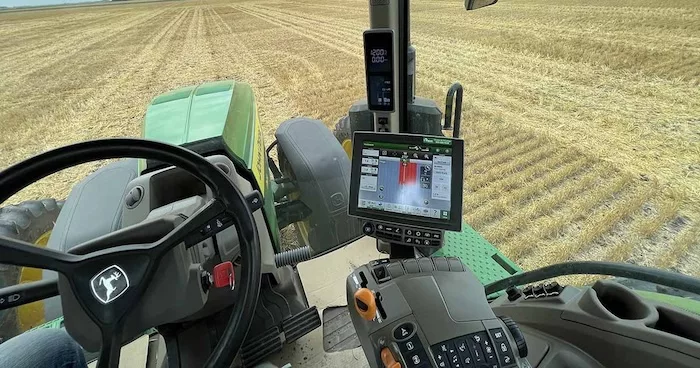
A new study says precision technology is helping growers improve yields, reduce inputs and improve the resilience of the country’s good supply chain.
The study, an update of the original 2020 AEM analysis, says current adoption of precision ag has boosted annual crop production by 5%, and this metric cold improve another 6% with further adoption. This has come through optimized fertilizer and herbicide use and reduced fuel and water use, which saves growers potentially tens of thousands of dollars.
Through improved adoption AEM asserts there could be further reduction in fertilizer use (14%), herbicide use (12%), fuel use (7%) and water use (20%).
Precision ag practices such as auto guidance, variable-rate application and section control have also helped avoid cultivation of 11.4 million acres of cropland, the study says — an area comparable to five times the size of Yellowstone National Park.
The study also says growers using precision ag have reduced input costs and boosted productivity, contributing “billions” in efficiency to the farm economy. AEM officials say this enhances resilience in the U.S. food supply chain and helps stabilize prices for consumers.
Without current precision farming technology, an estimates 8% more fertilizer would be needed to produce the same amount of food. The application of an estimated 54 million pounds of herbicide was avoided due to precision ag, and broader adoption could bring 66 million pounds of addition herbicide that could be avoided, the study says.
In the study of targeted spray application, experts explored technology that makes application plant by plant where weeds are detected.
Although technology and data requirements are high, and they’re also sensitive to lighting, speed, model accuracy and optics maintenance, savings potential is high for growers. But currently, 90% of farmers rely on traditional broadcast methods, while only 5% use variable-rate application and less than 1% of farmers at the current time.
Current research shows 40-60% less herbicide volume applied with targeted spray application technology, AEM says.
Participants such as John Deere, PTx Trimble, Case-New Holland, AGCO and Greeneye Technology have pioneered the newer technology, and other OEMs have innovations in the pipeline.
As farm consolidation, access to labor, and weather challenges continue, the need for precise application methods will increase and will produce the next “s-curve” of innovation in weed management.
The 32-page study was commissioned by the Association of Equipment Manufacturers (AEM) in collaboration with the American Farm Bureau Federation, American Soybean Association, CropLife America and National Corn Growers Association.
The entire report, entitled The Benefits of Precision Ag in the United States, is published on AEM’s Insights page.
The study also introduces, for the first time, a targeted spray application case study. This emerging technology — still in its early adoption stages — promises 50-90% savings in herbicide volume (depending on application window) and rapid adoption growth across varying acreage scenarios.
“Farmers using precision ag technologies today are already reaping meaningful gains — and society as a whole benefits from healthier soils, more responsible water use and fewer emissions,” said Curt Blades, AEM’s senior vice president of agriculture services and forestry. “This report shows that if precision practices continue to scale, the impact could be extraordinary.”
Megan Tanel, AEM’s president and CEO, adds the findings provide a “clear, data-driven case” for advancing policies, investment and infrastructure that support precision ag. Precision ag is a story of progress and it’s one we’re proud to help tell.”


![[Technology Corner] Aligning ‘Smart Implements’ with Autonomous Tractors](https://www.precisionfarmingdealer.com/ext/resources/2026/10/01/Aligning-Smart-Implements-with-Autonomous-Tractors.webp?height=290&t=1790966217&width=400)

