
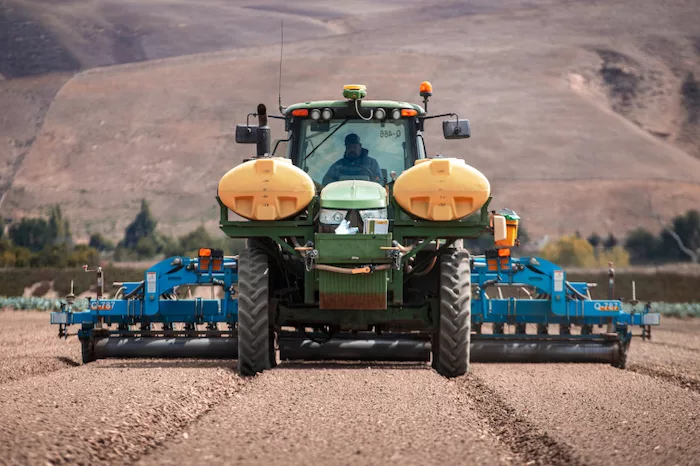
Salinas Valley operation leans on connected tools to keep planter performance, and machine uptime on track across multiple planting cycles.
Queen Victoria Produce, part of Ippolito International, plants and harvests leafy greens almost year-round in California’s Salinas Valley. With three planting-and-harvest cycles and roughly $6 million invested in seedlings annually, precise placement is essential to hit timing windows and market quality expectations.
“Our goal is simple: putting vegetables on as many plates as we can,” said Hiram Quintero, equipment manager at Queen Victoria. “We run nearly 200 machines, each with a specific job to keep things moving.”
Why Planter Performance Matters
Wind speeds vary in Queen Victoria’s fields in the valley. When operators are planting on a tight timeline and the weather can’t be controlled, the ability to monitor seed placement in real-time becomes essential.
“Most farmers in the valley say that if they can see half their seed after planting in the field equally spaced out, then it was a good pass,” said Jack Swartz, precision agriculture product specialist at RDO Equipment Co.
Queen Victoria uses John Deere’s 6155M tractor connected to the John Deere Operations Center to pull a Monosem MS planter equipped with John Deere’s SeedStar. They’ve integrated this custom-built planter equipped with seed shoe sensors to send agronomic data to their Farm Management Information Software (FMIS), the John Deere Operations Center.
Night Planting Raises the Stakes
Operators must move quickly, sometimes in low visibility, while still maintaining high quality planter performance when it comes to applied rates and seed spacing.
Swartz explained that, during critical times, it’s common for Queen Victoria to have tractors in fields as early as 3 a.m. to harvest a crop from a field so they can get to planting other fields by 7 p.m.
Watch the Queen Victoria team in action with RDO team members working in partnership to precisely plant and produce quality crops.
“When you’re hustling in the dark, it’s harder to confirm you’re hitting your population and depth targets without a reliable monitoring system,” Swartz said.
The team’s approach focused on making the technology usable in the cab and actionable in the office. Machines were connected, field boundaries were mapped and operators were trained on SeedStar so key metrics show up clearly on displays and flow to the Operations Center.
SeedStar sensors placed at the planter’s seed shoes capture performance in real-time, allowing operators to monitor:
- Population to stay on target for optimal seed spacing
- Singulation to reduce skips and doubles
“When Queen Victoria wanted more data, we started at the seed,” Swartz said. “Dialing in the planter and the dashboard first helps the rest of the operation fall into place.”
Swartz worked with Garrett Long, an RDO account manager who’s worked with Quintero for more than five years, to set up Queen Victoria’s tractors with customized displays, so operators can quickly decipher the data sent from the sensors.
In-Cab Adjustments, On-the-Fly
With live data in the cab, operators can adjust their planter’s population settings or tractor speed when conditions change, such as soil moisture or wind. The Monosem MS metering system, shoe opener and press wheels, plus John Deere’s Seedstar system, help operators to plant the optimal number of seeds at a consistent depth with 4-inch spaced rows
“Sub-inch accuracy is so important when planting, especially when the crop is young and they have cultivation bars coming through,” Long said. “It helps with efficiencies.”
Quintero points to more symmetrical rows and steadier stands. On the management side, Operations Center data — GPS accuracy, fuel use and machine location — helps identify efficiency opportunities and reduce downtime.
“I use the Operations Center almost every time I need to make a decision during planting,” Quintero said. “I can’t be everywhere, so having confident visibility across machines makes the day easier.”
Looking Ahead: Planning the Next Pass
Quintero said RDO team members are in constant communication with their team. Queen Victoria uses the Operations Center and RDO’s remote support team to make faster, informed decisions during critical planting windows.
“One operator may be too busy to spot a potential issue,” Quintero said. “If I can see where machines are and get alerts, I can coordinate fixes and keep planting on schedule.”
For upcoming growing seasons, they’re working on integrating John Deere’s Work Planner into their operation so they can document tasks to understand what’s working in their fields.
“We have chat groups going so I can reach out to technicians or product specialists or Garrett when I have questions,” Quintero said. “This, plus the operational view from my Operation Center, gets the seed in the ground when it needs to.”
“We want Queen Victoria to see what was done last pass and carry those insights forward,” said Long. “Support doesn’t stop when the tractor leaves the lot — it continues in the field.”
![[Technology Corner] Aligning ‘Smart Implements’ with Autonomous Tractors](https://www.precisionfarmingdealer.com/ext/resources/2026/10/01/Aligning-Smart-Implements-with-Autonomous-Tractors.webp?height=290&t=1790966217&width=400)

